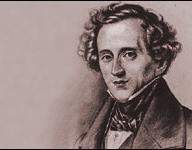
Bach Reborn? Mozart of the 19th Century?
Evening Music | May 6, 2010
Depending on who was speaking, Mendelssohn was either “the Mozart of the 19th century” (Robert Schumann), or he was “Bach reborn” (Franz Liszt). Stay tuned for our second-hour essay of his Violin Concerto.
Beethoven lightened the texture of his Serenade in D, Op. 25, by scoring it for flute, violin, and viola—in effect writing for two soprano instruments, and one tenor. As Edward Blakeman’s notes for this recording point out, the originality of this instrumentation wasn’t appreciated until Max Reger borrowed it for his two serenades. The players for this evening’s performance are flutist Susan Milan, violinist Levon Chilingirian, and violist Louise Williams.
Nathan Milstein is the soloist in Mendelssohn’s singular Violin Concerto, while the Pittsburgh Symphony is conducted by tonight’s birthday honoree, William Steinberg (1899).
Scholar Maurice Brown wrote: “The single leaf containing the Andante sostenuto—one of Schubert’s profoundest and most poetical essays—is frail and the ink is fading; one takes it in one’s hand and wonders with awe how such a page, scrawled so hurriedly and so faintly, can embody an experience that belongs to the highest aspirations of man: truly one of humanity’s priceless documents. Tonight we hear a performance equally inspirational, that by Artur Rubinstein.
Beethoven lightened the texture of his Serenade in D, Op. 25, by scoring it for flute, violin, and viola—in effect writing for two soprano instruments, and one tenor. As Edward Blakeman’s notes for this recording point out, the originality of this instrumentation wasn’t appreciated until Max Reger borrowed it for his two serenades. The players for this evening’s performance are flutist Susan Milan, violinist Levon Chilingirian, and violist Louise Williams.
Nathan Milstein is the soloist in Mendelssohn’s singular Violin Concerto, while the Pittsburgh Symphony is conducted by tonight’s birthday honoree, William Steinberg (1899).
Scholar Maurice Brown wrote: “The single leaf containing the Andante sostenuto—one of Schubert’s profoundest and most poetical essays—is frail and the ink is fading; one takes it in one’s hand and wonders with awe how such a page, scrawled so hurriedly and so faintly, can embody an experience that belongs to the highest aspirations of man: truly one of humanity’s priceless documents. Tonight we hear a performance equally inspirational, that by Artur Rubinstein.