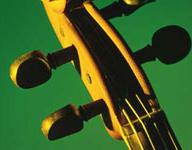
String Theory
Evening Music | May 6, 2010
There’s more than one way to string an instrument. On tonight’s show, we’ll explore music for different "strings." Plus, we’ll hear an interesting work that explores the nature of time.
"You see, it’s all about the strings!" the conductor Leonard Slatkin playfully proclaimed in rehearsal one day, after the latest scientific theory of the universe (dubbed "string theory") was announced. While strings (the musical ones at least) may not literally rule the universe, there’s almost no limit to the different ways you can get sound out of a string. Tonight, maverick Guitarist Manuel Barrueco strums up the dances of Spain with four of Enrique Granados’ "Danzas espanolas," while Violinist Rachel Podger bows her way delightfully through Bach’s Violin Partita No. 3 in E. We’ll also hear one of John Cage’s linear works for Harp, "In a Landscape," plucked out for us by Mariko Anraku. And later in the evening, Alexandre Rabinovitch strikes the piano strings with the Orchestra of Padua in Mozart’s Piano Concerto No. 19 in F.
Einstein may not have come up with a "string theory," but he did show us that time (among other things) is relative. Certainly, music can make time seem to go by faster (or slower). We’ll spend the second hour of tonight’s show with a most unusual concerto that explores not only the nature of time, but of mortality and the function of music itself. David Lang’s "The Passing Measures" is a forty minute long piece for bass clarinet, amplified orchestra and women’s voices that, in the words of the composer, "is about the struggle to create beauty."
"You see, it’s all about the strings!" the conductor Leonard Slatkin playfully proclaimed in rehearsal one day, after the latest scientific theory of the universe (dubbed "string theory") was announced. While strings (the musical ones at least) may not literally rule the universe, there’s almost no limit to the different ways you can get sound out of a string. Tonight, maverick Guitarist Manuel Barrueco strums up the dances of Spain with four of Enrique Granados’ "Danzas espanolas," while Violinist Rachel Podger bows her way delightfully through Bach’s Violin Partita No. 3 in E. We’ll also hear one of John Cage’s linear works for Harp, "In a Landscape," plucked out for us by Mariko Anraku. And later in the evening, Alexandre Rabinovitch strikes the piano strings with the Orchestra of Padua in Mozart’s Piano Concerto No. 19 in F.
Einstein may not have come up with a "string theory," but he did show us that time (among other things) is relative. Certainly, music can make time seem to go by faster (or slower). We’ll spend the second hour of tonight’s show with a most unusual concerto that explores not only the nature of time, but of mortality and the function of music itself. David Lang’s "The Passing Measures" is a forty minute long piece for bass clarinet, amplified orchestra and women’s voices that, in the words of the composer, "is about the struggle to create beauty."