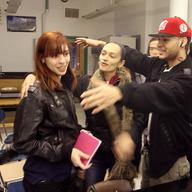
At a Harlem Transfer School, a High-Tech Celebration of Student Achievement
At 6:05 p.m. on Friday, Lisandra Morales’s family charged into Harlem Renaissance High School with flowers and balloons. They were late, and they knew it.
“Where is Lisandra’s room?” said Sandra Morales, Lisandra's mother, who said she had gotten tied up at work. With the information in hand, Ms. Morales corralled her daughters, son, nieces and nephews into the classroom where Lisandra, 19, waited. Enveloped by hugs, kisses, screams and laughter, Lisandra burst into tears.
“She thought we weren’t coming!” Ms. Morales said. “She thought we were going to miss my baby’s show!”

Lisandra and 10 other students were the stars of the Harlem Renaissance expo, a showcase of the work and achievements of the school's graduating seniors. Nadav Zeimer, a bespectacled former computer engineer and robotics coach who took the helm at Harlem Renaissance in 2010, said the event served both as a shout-out to students and a way to engage them with the larger community.
Mr. Zeimer came up with the expo event in concert with PENCIL, a nonprofit organization that looks to boost student achievement by linking educators with business leaders.
From 4 to 6 p.m. on Friday, each classroom was transformed into an individual gallery space displaying various student projects. The students played host to family and community members who came to help them celebrate their achievements. They displayed their best school work, photographs and collection of inspirational quotes. The whole time, videos chronicling their journeys were running on a screen. A jazz musician greeted guests at the school’s entrance. They then went around from room to room, munching on snacks while watching videos and writing testimonials for the participating students.
Many students come to Harlem Renaissance after struggling at other schools, and the school itself has struggled recently. Harlem Renaissance is on the list of 33 schools targeted for "turnaround'' according to a federally prescribed improvement plan for struggling schools. The designation has meant some instability for the school.
The videos were prepared by volunteers who interviewed the students about their best work -- Kassandra Lugos, 19, spoke about her science project on osmosis and diffusion in an egg – and then involved them in the video editing process. And there are added pluses: students often use their video profiles to supplement college applications. Mr. Zeimer, known to the students as Mr. Z., said the videos had helped students land internships with corporations and government agencies.

“We have some powerful stories,” he said of a school whose students have high poverty and truancy rates and who might be facing problems related to gang violence, teen pregnancy and depression. Harlem Renaissance has 225 students. But because many of them come to the school with spotty academic records, they have not followed a traditional academic path and not every senior will graduate at the end of the school year.
Many of the stories the students told in their videos were indeed emotional; some graduating students spoke of a lack of motivation, others of the anxiety of life in a new country. In a room decorated with a traditional African ceramic bowl and clippings of her favorite quotes, Diane Zoundi, a 19-year-old student from Ivory Coast, spoke about moving to the United States and learning English. “They make fun of you -- of your accent, of the way you speak,” she said.
Diane transferred in from New World High School, where she said she failed her Regents exams. Sticking her tongue out when smiling, she bragged that she had passed her remaining four Regents in January. She said she had applied to several colleges, including John Jay College of Criminal Justice and Monroe College.
Among those gathered to celebrate Diane were the parents of her best friend, Bernadette Dravie, who is from Togo. “She’s evolved,” Sassou Dravie, Bernadette's father, said in French. “When you change, you get better.” The mother, Louise Dravie, who embraced Diane after her video, said she was a big believer in education. “Why sit at home?” Mrs. Dravie said. “I would want Bernadette to go to school even if she was gray-haired.”
In her video, Diane also introduced what she referred to as her new “boyfriend,” a dictionary given to her by Miguel Vasquez, the parent coordinator at New World High School.
Mr. Vazquez, who has a boxer’s nose and a philosopher’s manner, said: “I told her, ‘He won’t leave you, won’t let you go, but don’t play him dirty.’”
Another student, Maya Bedell, 17, who had transferred from Frederick Douglass Academy, was gluing together a collage of her childhood photographs for her gallery. She said she wasn’t applying to college this year because of financial constraints and because she was “too nervous.” But Maya, who wants to be a nurse, said that Harlem Renaissance had helped her change her mindset. “Before, I just wasn’t motivated,” she said. “Now I am my own support system.”
Lindsay Heinlein, who is partnership coordinator for PENCIL, said she hoped other schools would adopt the expo idea, particularly the emphasis on using video to tell a student's story.
The school's "turnaround" designation means that the school may lose up to half its teachers, and since some of them are so involved in the expo, it is unclear how the program will change in the future. But the "turnaround" designation won't deter the school from trying out new ideas, said Mr. Zeimer.
“We don’t really care if we’re turnaround or not. We’ll get a new name, have to do a little extra paperwork, but we’re committed to improving the school independent of that.”

WNYC is funded by sponsors and member donations


