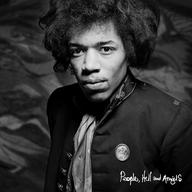
Jimi Hendrix Took It All Too Far. But Boy, Could He Play Guitar
Billboard editor Joe Levy on the just-released album from the late guitarist and icon. Hear more from Joe Levy here.
If you looked at the charts this week and saw that Jimi Hendrix’s newest, People, Hell & Angels debuts at No. 2 on the Billboard album tally and that David Bowie’s latest was on its way to claiming the No. 1 spot on the UK charts, you’d be forgiven for wondering if we’d all tripped, fallen into the Way Back Machine, and landed in 1972.
That’s the year that Bowie immortalized a Hendrix-like figure on The Rise and Fall of Ziggy Stardust and the Spiders From Mars, capturing all the lost potential and mythic power of rock’s greatest improviser on songs like “Rock & Roll Suicide.” Two years earlier, on September 18, 1970, Hendrix had become the first of the rock stars to die for our sins (beating Janis Joplin by a mere 16 days), though like many of the departed starmen and women, he’s never really left us.
In part that’s because Hendrix left behind hundreds of tapes, as he tried to work out new directions and songs in a series of studios in London, Los Angeles and New York. The recordings Hendrix was working on when he died began appearing almost immediately (Cry of Love came out just five months after he passed away), and really haven’t ever stopped. Studio tracks, concert recordings (soundboards and bootlegs), more studio tracks with overdubs, BBC soundchecks — all rotating endlessly on what the Kinks once called the Moneygoround.
Hendrix is the sixth best selling catalog artist of the SoundScan era, moving 16.7 million albums since Neilsen SoundScan started tracking sales in 1991. (The Beatles are No. 1, with 64.3 million, followed by Elvis Presley at 35.2 million.) It would take a better man than I to keep track of all of the posthumous Hendrix releases — I can’t even keep track of the stuff I own. I just played side one of my triple vinyl version of 1999’s Live at the Fillmore East — because that rock palace was once just down the street from my apartment! — and realized that none of those 16 tracks are actually on 1970’s Band of Gypsys, so I pulled that out and realized I’d forgotten about 1986’s Band of Gypsys 2...so basically I can spend the next five hours listening to music recorded just down the street from my apartment, except that half of Band of Gypsys 2 was recorded in Atlanta and Berkley...anyway, you see what I mean. (BTW, Hendrix just quoted “Little Drummer Boy” 5:24 into “Stone Free,” so this is definitely worth it!)
I'm not alone in my fascination. People, Hell & Angels sold 72,000 in its first week to debut at No. 2 on the Billboard 200. It's the highest Hendrix has been on the chart since Electric Ladyland claimed the No. 1 spot for two weeks in 1968.
People, Hell & Angels is being marketed by Sony Legacy as “an essential new album premiering twelve previously unreleased studio recordings.” And marketed it has been — Sony Legacy told Billboard that the company was treating this “like a front-line record,” meaning a new release from a major artist. Along with TV tie-ins (six songs were featured on an episode of “Hawaii Five-O”) there was an exclusive CD single of “Somewhere” available through Walmart, a first listen stream at NPR, an exclusive CD and t-shirt bundle at Best Buy (these packagings are new to me, and smart — they’re a bargain for hardcore fans, and tempting for casual listeners who like the t-shirt), and more Hendrix t-shirts coming through the Gap.
There’s nothing wrong with any of this, except maybe calling this album “essential.” It’s not. I like it plenty, but it’s made up of new versions of Hendrix mainstays — many with guitar solos that will instantly rewire your mind — along with previously issued tracks stripped of tinkering and overdubs, and a few skippable vault scrapings. Not for nothing do the Hendrix curators say this will be the last — the last! — album of studio material.
Still, this music is expansive and fascinating, if ultimately unresolved. Hendrix's sound is the sound of new discovery, with the never-ending surprise being that he maintains control of explorations that seem unbridled. But like a lot of posthumous Hendrix, People, Hell & Angels isn’t for casual fans, and it’s a little sad that once great collections suited for casual fans — like single CDs of Hendrix at Woodstock or on the BBC — have gone out of print and been replaced by expansions ad infinitum: doubled! quadrupled! more than quadrupled!
Of course, I’m a total sucker for this stuff — I love 1987’s Live at Winterland, a distillation of a three-night 1968 run at the San Francisco venue, and maybe the single best live Hendrix disc — but I still bought the 2011 four-CD box set that documented the complete concerts, and I bought it from Amazon because it came with a bonus disc from the Fillmore West soundboard (kinda iffy, if you must know). And I’ve held onto all three attempts to piece together First Rays of the New Rising Sun, the double LP Hendrix was working on when he died (there are only three, aren’t there?), because they have different running orders, overdubs, mixes — they’re all good (but the out-of-print Cry of Love will cost you about $6 on vinyl, and it sure did sound great last night), and they all say something different. (Purists hate the overdubs and edits that Alan Douglas imposed on Hendrix material from the mid-’70s to the mid-’90s. They like to point out that it’s the drummer from the Knack overdubbed on the out-of-print Voodoo Soup, his version of First Rays. But I’m still not parting with my copy, and it sure did sound great this morning.)
I keep coming back to these recordings, and eagerly playing new ones, because Hendrix was an unmatched musical inventor, able to rework many of the same tricks endlessly, and gifted with the ability to combine melodic and rhythmic improvisation in ways that yield instant satisfaction but reward repeated investigation. (He’s like Thelonius Monk that way. What he does sounds simple until you try to explain it.) Is there too much Hendrix? Of course there is. There was too much of everything in his life. He took it all too far. But, boy, could he play guitar.

WNYC is funded by sponsors and member donations