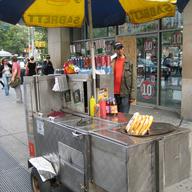
Object # 3: The Food Cart
Eating outside has always been a part of the New York City way of life. “The early colony was downtown,” Fabio Parasecoli of The New School told us. “Food had to be brought to southern Manhattan from the nearby farms.” Often, that food was sold and consumed on the street. (continue reading)
The food cart as we know it today emerged in the mid-1800s as immigrants arrived in the city looking for opportunity. “On the one hand [the food carts] were one of the only ways immigrants could start their own business,” Parasecoli said. “And on the other hand they allowed migrant communities to have access to the food they were familiar with.” Those immigrants also transformed the city's politics and culture and even its culinary palate. “The presence of food carts made food in New York City quite cosmopolitan—not in a refined way—but cosmopolitan in the sense that you could get foods from all over the place,” Parasecoli said.
Over time new waves of immigrants took on other communities’ foods and their food carts. “Today, most people selling hot dogs and pretzels are not of German and European descent,” Parasecoli said. As a result, we now think of things like the hot dog, the pretzel, the bagel and pizza not as ethnic cuisine but as New York food.
While the dirty water hot dog cart is thought of as quintessentially New York, the street food offerings on our curbs have become increasingly diverse and upscale with the arrival of the food truck. Parasecoli pointed out, “These trucks are the brain child of entrepreneurs with more financial and cultural capital.” Those two facts give them an advantage over your corner pretzel seller when dealing with city regulators. “For an immigrant coming into the system and opening a food cart, having to deal with New York City regulations is not that easy.”
Of course, mobile food sold on the street is not a phenomenon exclusive to New York City. As the manager of NYStreetFood explained “Food trucks are really popular in L.A., but people drive to them.”

WNYC is funded by sponsors and member donations