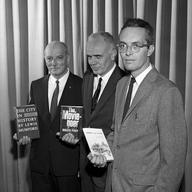
1962 National Book Awards Banquet
Thirteenth annual book award
Poetry: Alan Duggan's Poems
Non-Fiction: Lewis Mumford - The City in History
Fiction: Walter Percy - The Moviegoer.
The event is emceed by National Book Committee Chairman, Emerson Greenaway. Duggan reads three short poems for his speech - on prizes for poetry, aesthetics, and winning money for poems. Mumford talks about the changes that went into writing his book on the historical city. and Percy compares writing his book with his work a pathologist at the Bellevue Hospital Morgue. Leo Rosten closes out the evening with an occasionally humorous speech, providing a path for ridding the world of myth.
A WNYC announcer introduces the event's proceedings at the Hotel Astor in Times Square. He notes the three categories being awarded - fiction, nonfiction, and poetry. He discusses some of the luminaries who have won the award or spoken at the event. He mentions the day's speaker, Leo Rosten, author of the "Hyman Kaplan" books, who is set to publish another volume later this month. He introduces Emerson Greenaway, chairman of the National Book Committee to the radio audience. Greenaway will emcee.
Greenaway talks about the prestige of the awards. He notes the attendance of four former winners - Rachel Carson, Bruce Caton, Brendan Gill, and William L. Shirer. He talks about the parties involved in conferring the awards, including book publishers and manufacturers.
The National Book Committee is involved in other events, including National Library Week. He notes the Library Week's success. He notes the efforts at restriction of what libraries many provide their patrons. The NBC fights against this censorship and provides how-to documents and other assistance to librarians.
He mentions the Awards Advisory committee, chaired by Gilmore Chapman of the New York Public Library. Other members include Joseph Duffy of the American Book Sellers Association, Storer Lunt of the American book Publishers Council, and John Phillips of the Book Manufacturers Institute. He names other members of the committee who are not from the 3 award granting groups.
He announces Alan Duggan's prize for poetry. After introducing the poetry judges Leone Adams, William J. Smith, and Martin Van Doren.
Duggan uses his speech to make three points, in poetic form. The first is about prizes for poetry - a poem about writing Dylan Thomas's epitaph in "advertisement towards an epitaph."
The second is a poem about aesthetics - "on an accident, on a newspaper story"
The third is about winning money for having written poems - "voyage" always getting ready to go out, but never leaving.
Greenaway introduces the Non Fiction judges - Lauren Isley, August Heckscher, and Lewis B. Wright, and reads the citation for Lewis Mumford's City in History.
Mumford gives thanks to the committee. He talks about the oddities of his book through the words of some of his reviewers. He talks about how cities slaughter their sacred cows. He discusses how books can have a way of their own and quotes Ralph Waldo Emerson to do so. Mumford's book was meant to be more about the present city rather than the history it became.
He talks about his debts in writing the book, especially his grandfather who walked him through New York when he was a young boy, as well as his time with his publisher(s) and editors at Harcourt and Brace.
He rounds out his speech with thanks to the donors and judges and those who approve it going to him and this book.
Greenaway mentions the three fiction judges - Lewis Gannett, Herbert Gold, and Jean Stafford, and reads the citation for Walker Percy's The Moviegoer.
Percy jokes about the southern writer's rancor against the Yankees, ruined by his receiving the award. He thanks his editor, agent, and publisher. Also his wife.
He talks about his book and his feelings winning the award. He alludes to his time working at Bellevue Hospital in the morgue as being from another life. He compares the Moviegoer to the pathologist - the pathology of the loss of individuality.
Greenaway reads a telegram from the White House from John F. Kennedy, honoring the winners of the award.
He talks about the machinery behind the granting of the award, which is especially meaningful to the writer because it comes from other writers.
He introduces Leo Rosten. He describes Rosten's equal adeptness in academia and Hollywood. He praises his wit, jokingly introducing him as "Mr. Kaplan."
Rosten begins his speech by claiming that we live among madmen. People confuse "A" way of thinking with "The" way of thinking. People project on the outer world that which comes from within. He talks about the importance in testing what is new, even threatening.
He talks about the necessity for "basic research." The most important things are ideas, and the freedom to confront the conventional. The writer is trying to free his of her self from their perspective.
He talks about Cezanne's experiments with perspective and the expressionists' use of color to help guide perspective.
He talks about the courage it takes to confront the known as if it was new - they create the reality we inherit. He uses the examples of Newton's curiosity about gravity, Harvey on blood, Darwin on evolution, and Lobachevsky on geometry, Rutherford on atom, Einstein on simultaneity, and Freud on accidents and dreams. All these men confronted the prevailing myths.
He talks about the current myths in American life - that facts don't speak for themselves; one should always tell the truth; the right and left political wings are diametrically opposed (they are more like a circle) - the far right and left both suppress ideas and treat them heresies; security is the considered the highest social good; men and women are equal - they are different species says Rosten; You can't explain neurotic behavior by attributing to an unhappy childhood - all childhoods are unhappy, many emerge well-adjusted; you can't spank a child - he goes into the psychology of a child; children should adjust to their group; a 35 hour work week is better than a 40 hour week; every problem must have a solution; eloquence means wisdom; and finally, that the purpose of life is to be happy, which he describes as a "narcotic pursuit," and he talks about the dignity of depression and the reinvention of moods as symptoms.
He ends his speech with a creed to which "free men" - scientists and artists, should act - they should oppose hysteria and error, even if we don't like them. they should learn to seek change and avoid violence. They should try to understand "men" - most never mature. They must meet fanaticism with courage. Be skeptical of what is promised but not proved. Life is lonely and given to misunderstanding. They must avoid conformity (citing Emerson). Above all, meet life in tentative approximations, knowing that the truth may not be reached.
A WNYC announcer recaps the broadcast.
Audio courtesy of the NYC Municipal Archives WNYC Collection
WNYC archives id: 150531
Municipal archives id: LT9365