1953 American Academy and National Institute of Arts and Letters Awards Ceremony
A snapshot of the American cultural establishment is provided by this recording of the 1953 American Academy and National Institute of Arts and Letters Awards Ceremony. Archibald MacLeish starts the festivities with some brief observations on the relationship between artists and the state. Pointing out that "artists are the most fanatical individualists on earth…they have to be," he seems to be acknowledging the tightrope all the participants are walking by taking part in this government-sponsored event. (It's important to remember that 1953 was the height of the McCarthy Era.) Louis Kronenberger introduces the new members, reading citations about their work. The most notable are Rachel Carson and Reinhold Niebuhr. Marc Connelly then bestows grants of $1,000 each on a variety of artists, again lauding their accomplishments. The recipients include Jacob Lawrence, Paul Goodman, and Delmore Schwartz. The Rome Prize, given by the American Academy in Rome, goes to the novelist Sigrid de Lima.
The Gold Medal for Distinguished Achievement in Poetry is presented to Marianne Moore. The presenter, Glenway Wescott, tells of his copying out her poems from magazines as a young man. He describes meeting her for the first time, and of her trying to describe a particular bird. She finally took down a shoebox of feathers and, in the act of rummaging through it, "talked plumage," going on about bird-life until she "transposed their music into words." Wescott extends this metaphor to encompass Moore's hard-won aesthetic, concluding with: "suddenly the feather sings; it is a poem." It's a very moving, highly stylized encomium. Moore, not to be outdone, starts off her response with a phrase which sounds exactly like one of her lines: "Magnanimity is a magnificent anomaly." Fans of her poetry will be interested in hearing her flat, midwestern accent as well as the recognizably eccentric rhythm of her speech.
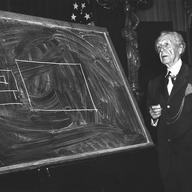
The Gold Medal for Architecture is presented to Frank Lloyd Wright. Wright, who was in his nineties at the time, sits patiently through an introduction comparing him to Prometheus, Moses, and Walt Whitman. Accepting the award, he remarks wryly on the "outrageously inadequate" description and worries that the slew of awards he has been receiving will bring on the "disease of humility." He then launches into a bare-fisted assault on "Greek abstraction," arguing for "an architecture of our own," dreaming of an American culture, the absence of which is "disgraceful." "To say that you're a poet is to confess a certain measure of weakness, isn't it?...It puts you in the back yard and rather out of things." Yet the artist must be a poet "or he is nothing." Wright remains, in this speech, an uncompromising visionary. His message sounds as urgent today as it must have over a half-century ago.
The Award of Merit Medal for Sculpture is presented to Ivan Meštrović. Meštrović, who has chosen not to attend, in a written acceptance speaks of art's "apostolic mission which is akin to religion."
The concluding event of the evening is the Blashfield Address, delivered by the Anglo-Irish novelist Elizabeth Bowen. Her talk, entitled "Subject and the Time," asks "How do we judge contemporary art?" We certainly can't judge by a set standard for "today is fluid." Failure to see that is to "mistake the very nature of the contemporary." Bowen contends that the art of the past, merely in the act of surviving into the present, has seen its "original harshness" evaporate. It is this quality contemporary art must be prized for. Today's art must "put us through the ordeal of pure beholding," and so is allowed to break the rules of the past. Speaking specifically about her own genre, Bowen says that the novel "stands at the edge of art." Because it can't afford to be wholly abstract as, say, music or painting can, the subjects of novels inevitably repeat and reappear. But it is in the choice of portrayal, how a subject is treated, that the writer's sense of his or her time is revealed. "We need not seek far for subject. Subject is found by Time."
MacLeish then gives very specific instructions on how various sections of the auditorium can reach the reception area. Organ music accompanies the conclusion of the ceremony, reinforcing the sense that we have indeed been listening in on a quasi-religious gathering.
Audio courtesy of the NYC Municipal Archives WNYC Collection.
WNYC archives id: 150189
Municipal archives id: LT3423

WNYC is funded by sponsors and member donations