Woody Guthrie's New York Radio Debut on WNYC
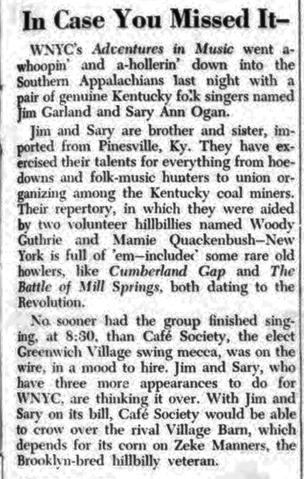
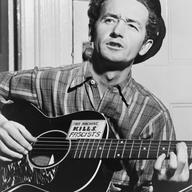
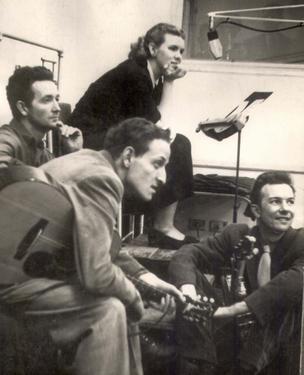
Woody Guthrie left California and arrived in New York early in 1940. That summer, two days after his 28th birthday, he took the elevator to the 25th floor of the Municipal Building for an appearance on Henrietta Yurchenco's Adventures in Music at WNYC.[1] That day, July 16, the theme of the show was the folk music of the mountains and the plains; it featured Jim Garland, Sarah Ann Ogan, and Guthrie, who the announcer introduced as "a modern troubadour who sings as he pleases and makes his own tunes as he goes." Guthrie performed Hobo Blues, Dusty Old Dust, and Tom Joad.[2] Soon after this New York radio debut, the irrepressible folksinger wrote to his friend, folklorist Alan Lomax:
Jim Garland, Sarah Ogan and me put on a radio program on WNYC last week. We got three more coming up. Ivan Black of Café Society was on the phone when we got through. He has lots of idaes [sic] about getting me on different radio programs as a guest...PM give Jim and Sarah and me a nice write-up. Gonna shoot the ink to us again next week after our next entry special, easy riding, honest to goodness, high rolling, double barrell [sic], double special, specially compounded, copyright, and patented, gum dipped, cork tipped, lead loaded, rubber lines, felt padded, fur trimmed, slick finished, radio program.[3]
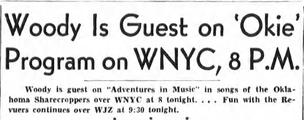
This appearance on WNYC was also the first time producer Henrietta Yurchenco met Guthrie and she described it in the forward to her book, A Might Hard Road: The Woody Guthrie Story, published in 1970.
There was much hubbub in Studio D, guests and performers talking among themselves. Someone touched me on the shoulder. "See that little guy over there in Levis and a plaid shirt, the one with the wiry-looking hair? That's Woody Guthrie." I looked around. I had heard about the Oklahoma singer, but had never met him.
"Ask him to sing Tom Joad -- it's a ballad he just finished. It's based on the Grapes of Wrath. (Everybody in New York was talking about Steinbeck's novel and the movie Hollywood had made of it.)
I walked over to the thin little man and introduced myself. We exchanged a few words, and then I asked, "About that song you've just written: would you mind singing it for us?"
"Don't mind if I do."
Woody pushed a chair into the center of the room. He put his foot on the seat, swung the guitar from his back to playing position, tuned up and strummed for a moment or two. All eyes were instantly on him. The hubbub died down quickly and everyone found a chair. The strumming began again...[4]
Woody Guthrie appeared on WNYC many times between 1940 and the early 1950s. He was a regular guest on Leadbelly's weekly show, Folksongs of America, which was also produced by the late Henrietta Yurchenco. In the recording above, from the show's December 12, 1940 broadcast, Guthrie sings Jesse James, John Hardy, and Tom Joad. Joad, of course, is the lead character in John Steinbeck's The Grapes of Wrath, played by Henry Fonda in the feature film directed by John Ford and released nine months earlier. "I didn't read the book, but then I seen the picture three times," Guthrie says. Lead Belly, (Huddie Ledbetter) sings Good Night Irene, You Can't Lose Me, Cholly, Frankie and Johnny, and The Boll Weevil Song.
Guthrie proposed a daily 30-minute program to station director Morris Novik on March 8, 1945. His letter, two legal-size typed pages, single-spaced, described the importance of WNYC's American Music Festival, on which he had performed the previous month. The modest folksinger wrote, "My appearance on your Music Festival series was a little thing because there are eight or ten million folks out there that can sing as good if not better than me..."
In a poetic stream of consciousness ramble, he went on at length about the difficulties of getting folk music on the larger commercial stations, writing that he was often misunderstood, misinterpreted, discriminated against, and censored. But it was WNYC, Guthrie wrote, "One little station out of a whole big mess of them," that was bringing hope to the "long hairs." In short, he penned:
If there is the littlest faintest spark of hope for the nervous salvation of our other New York stations then I see a whole big blaze of hope for WNYC.
Before closing his pitch, Guthrie added, "I have been told by commercial agents that a regular program over your facilities would let all the sap drip out of my prestige. I told them that it was a pretty considerably increased feeling of prestige that I always got out of standing in front of your microphones." [5]
Novik replied to the folksinger, "To say thanks for your recent letter is a great understatement. I appreciate your spirit, and I am in complete agreement with your analysis of the commercial radio stations. Your suggestion for a series is accepted 'hands down.' " Novik indicated, however, there was no money to pay for the show.[6] Guthrie replied in a second letter that he would do the show for free and would phone; there were notes indicating calls were to be made.[7] Unfortunately, beyond that, it appears no regular show was programmed. However, Guthrie performed on other WNYC American Music Festival concerts and dropped in on Oscar Brand's Folksong Festival, as he did in the recording below, from January 1950.
_____________________________________________________________________________________
[1] It was another month (August 19, 1940) before Guthrie would appear in the pilot program for Alan Lomax and Nick Ray's Back Where I Came From on CBS.
[2] WNYC radio script for Adventures in Music dated July 13, 1940, WNYC Archive Collections.
[3] Guthrie, Woody, letter to Alan Lomax, late July 1940. Woody Guthrie and the Archive of American Folk Song: Correspondence, 1940 to 1950
[4] Yurchenco, Henrietta and Marjorie Guthrie, A Mighty Hard Road: The Woody Guthrie Story, McGraw-Hill, 1970, pgs. 9-10.
[5] Guthrie, Woody, letter to Morris S. Novik, March 8, 1945, La Guardia and Wagner Archives, CUNY.
[6] Novik, Morris S., letter to Woody Guthrie, March 22, 1945, La Guardia and Wagner Archives, CUNY
[7] Guthrie, Woody, letter to Morris S. Novik, March 23, 1945, La Guardia and Wagner Archives, CUNY.
This article was originally published on June 24, 2011. It was revised and updated July 12, 2020.

WNYC is funded by sponsors and member donations