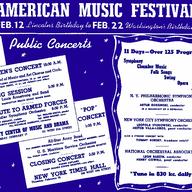
13th Annual Festival
This episode is from the WNYC archives. It may contain language which is no longer politically or socially appropriate.
Town Hall concert. Olga Koussevitzky gives Koussevitzky Foundation Award to WNYC for the American Music Festival. Interview with Elie Seigmeister. 7 sides.
Seymour N. Siegel speaks, then introduces "Madame Serge Koussevitzky".
"Today marks the opening of WNYC's 13th annual festival of American music. The number of contemporary works which have had their first hearing at these festivals is truly impressive. Through these programs year after year, encouragement has been given to a great many of young composers. The listening public has had an opportunity to become aware of it's own musical heritage and the basis of all musical culture has been broadened and deepened. It is indeed a fitting occasion that WNYC should receive this mark of gratitude from the Koussevitzky Music Foundation created by my husband, Serge Koussevitzky, ten years ago to serve in various ways the same cause for which these festivals are dedicated. It is particularly fitting that the first award of the Koussevitzky Music Foundation should be presented to the radio station of the City of New York because of Serge Koussevitzky's long-cherished hope that music and the fine arts be recognized and supported by governments as essentials elements in the life of the people."
Siegel introduces Mayor Vincent R. Impellitteri.
This award is given to you as well as WNYC. American Music Festival cannot exist without your support and interest. We live in an age with greater leisure time, which we must fill and fill profitably in order to lead full and good lives. There is a need for something more personal in entertainment. This we can find in music. You will fine not only the old favorites, but the new music which expressed the feelings of our age. Your sole responsibility is to listen to and enjoy the many public concerts and studio broadcasts for the next ten days.
PROGRAM
Symphonia for Woodwind Quartet (Bernhard Heiden)
New York Woodwind Quartet:
Samuel Barren, flute
Jerome Roth, oboe
David Glazer, clarinet
Bernard Garfield, bassoon
Ralph Pile, French horn
Divertimento for Ten Winds (Robert Nagel)
New York Wind Ensemble:
Norman Greenberg, French horn
Robert Nagel (composer)
Theodore Weiss, trumpets
Julian Menken, trombone
Josef Novotny, tuba
Four songs (Elie Siegmeister)
Chalkmarks on the Pavement
Childhood Memories
Yes, No or Maybe
It Ain't Me
Music set to texts by Lanston Hughes
Brenda Miller, voice
Elie Siegmeister, piano
Fantasy for Flute, Cello and Piano (Joseph Goodman)
Written for the Segal Trio
Segal Trio:
Mary Stretch, piano
Muffy Vonn, cello
Edith Segal, flute
Interview with Elie Siegmeister
Siegmester's inspirations? Stravinsky, Beethoven, Musorgsky, Prokofiev, Ives. Talk about composing film scores.
How Siegmeister came to write the four songs to the words by Langston Hughes. Hughes wrote poems, sometimes a couple of lines of poetry and Siegmeister would compose around it and then Hughes would add some more lines. Have you written in concerto form? No. Chamber music? Yes, mostly in his early years. Recently, mainly symphonies. What do you look for in the future of American music? Symphony and musical play, an evolution of an American style which would partake in both these elements.
Introduces compositions by Marcel Grandjany and Gunther Schuller.
Poem for Harp, Horn and Orchestra (Marcel Grandjany)
La Petite Suite (Gunther Schuller)
New Chamber Music Society (Paul Wolf, director)
Audio courtesy of the NYC Municipal Archives WNYC Collection
WNYC archives id: 8611
Municipal archives id: LT7391

WNYC is funded by sponsors and member donations