On Your Record Release Radar: Gang Gang Dance
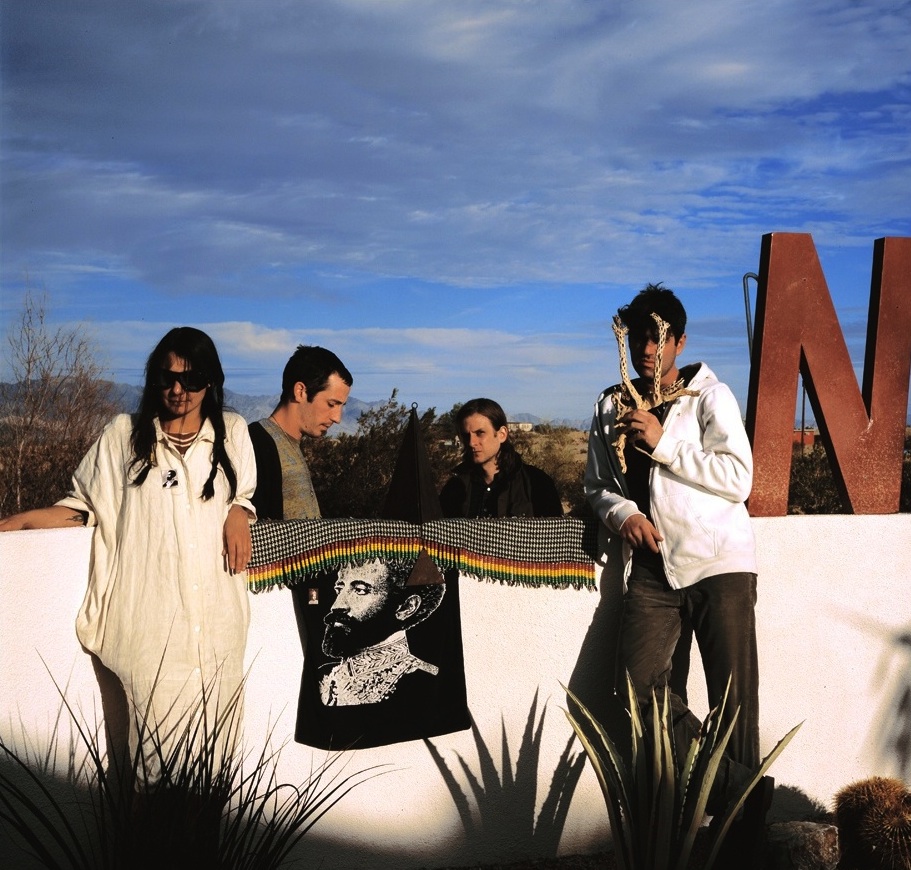
New York City’s percussive experimental band Gang Gang Dance released its fifth full-length album Eye Contact on Tuesday. Showcasing the grand digitally distorted vocals of Long Island native Lizzi Bougatsos, the quartet escaped Manhattan's distractions to write and record the new record, its first on the U.K. label 4AD.
“We just decided to go to the desert... Joshua Tree. It was really desolate,” Bougatsos told WNYC. “We just packed up our music studio and went out there and wrote.”
After some time touring with the new material, the gang finally finished Eye Contact at Dreamland Studios in Woodstock, NY. Bougatsos said she and the band listened to daily doses of rap -- J. Dilla and Nas along with a D’Angelo record found at the studio -- for inspiration during recording sessions. Hip-hop served as inspiration and left room for improvisation in the studio.
WNYC recently interviewed Bougatsos about the band's decision to record under a new label, Joshua Tree and “Mindkilla,” which you can download for free here.
Douglas Q. Smith: You’ve released your previous records on Brooklyn’s The Social Registry record label. Why move to the UK label 4AD for Eye Contact?
Lizzi Bougatsos: I think that the 4AD thing came out of the need to step up the game. I think the band was at a place were we just needed something new. When we left The Social Registry — and, we didn’t really leave them, we still work with them a lot — but they were just handling the States and we were touring Europe and it was really hard to get good guarantees. We had no representation. We just struggled a lot by not having a label that was backing us while we were touring. It was really extreme. It was so punk-rock it almost killed me to death!
DQS: How do you approach live shows?
LB: Well, I try my best to have a little down time before I go on stage. And then when I’m on stage, I just try to take in the force and for me it’s kinda heavy. I pretty much live to do what I do. And I try to really bring it when I see that it’s affecting people, or when I say things that people would relate to and it would make them feel better. I just realized that there was a greater good or a higher power in what you do when you’re on stage. So, I try to really sing as best as I can. And I loose my voice pretty often. [Laughs]
DQS: You guys got out of town to record this album. Where did you go and what was the reason?
LB: Before we got a record label, we just decided to go to the desert, Joshua Tree. Our friend has a house at Twentynine Palms and it’s really desolate. We just packed up our studio and went out there and wrote a lot of the songs that are on the record. Then, we finished the album at a studio called Dreamland in Woodstock, NY. And it has those two elements in it. I think we just needed to get out of town because, really, it just never works in Manhattan or Brooklyn. Somebody’s always hungry, somebody’s always late. There’s always someone bitching and everyone always goes home to somewhere different. We just needed to be in one place.
DQS: The band had a collective performance piece in the 2008 Whitney Biennial. Is the band still involved with art endeavors?
LB: Brian (DeGraw) has an art show up right now at the James Fuentes gallery, down on Delancey Street, and that’s my gallery, too. I have a show in Moscow right now and I have a show in about a month at Art Basil in Switzerland. And most importantly, we’re both in a show in Japan to raise money for the earthquake victims. We show a lot. And the thing is, that Brian and I, we went to art school and we formed out of the art crowd like ten years ago in New York. I worked at a gallery and I also started to show there and curate. The gallerist would always let us play. [Laughs] She would always be breaking glass, tying people up with duck tape and carrying them around in a box. We could just do whatever we wanted to do.
DQS: What art school did you go to?
LB: I went to West Virginia University. I went there because I didn’t know anything about it and the rave scene was really big in New York and everyone was taking ecstasy. I was really freaked out by that. [Laughs]
DQS: You were freaked out by ecstasy so you left town?
LB: Yeah, I didn’t want my spine to split open because I went to some fucking party with all these drugs flying around. [Laughs] I still don’t believe that I went to college. I mean, sometimes I have to check the certificate that shows my degrees — that whole part of my life seems so outlandish.
DQS: Where were your early New York haunts?
LB: This was about 1998. There was this place on St. Marks. They had a happy hour and it was really, really fun. I forgot what the bar was called but everyday I would meet my girlfriends there and every time there would be this dude with a mohawk dancing on the table. [Laughs] It was the punkest bar in the entire world. I remember it was so punk that some film director came in and asked if we could be extras in his movie. We said, 'Yeah,' and brought our whole crew and invented this dance for the film and made it look so good. It was a terrible movie, but we made it look really good.
DQS: How did the gang come together?
LB: We played a show together in Brooklyn at The Charleston. It was this place that I think still exists but, back in the day, I think it was ‘97, there was this guy that had this strobe light and he would just flash it constantly. It turned out that he was the owner and he would have his own light show with this one strobe light and he would just hold it. [Laughs] I met the guys from Gang Gang at that show. My band was playing and their band was playing, and we played together. Then I started dating the drummer of their band and my best friend started dating Brian [DeGraw], now of Gang Gang Dance. They lived in D.C. and we would go visit them and then they would come here.
DQS: Were they already called Gang Gang Dance?
LB: No. They were called Death and Dying. They were really morbid before I came along! I think they kind of needed me. [Laughs] I don’t think they owned anything but black clothes. And black leather. There was a lot of leather.
DQS: You went through a cape phase...were there any capes involved back then?
LB: There were no capes. Capes came later. Capes came along in I think 2007. I became really obsessed with them as far as their movement. And I was really into Martha Graham, just to watch her move. And I was really inspired by Japan. So, the cape thing just sort of happened and now I have a lot of capes. People always tell me that they’re making me a cloak, and, yeah, I have a lot of them. [Laughs]
DQS: What are some of your musical influences?
LB: Back when I was in my band Russia, when I met the guys now in Gang Gang Dance, I was obsessed with the Wu-Tang Clan. I think they laid down the law for hip-hop. I like them a lot. I always go back to them when I’m sort of lost or recording. I have a few people I go to, like The Last Poets and Mary Margaret O'Hara, but Wu-Tang is usually high on the mix. I like they’re back-up singer a lot. She’s really, really soulful. It’s really all about struggle and I identify with that because I’ve struggled the entire time I’ve been in New York. I mean this is probably the first year that I can even buy anything. I just find that their lyrics and their hustle -- and I didn’t really feel like I’m such a hustler -- but I do like their humor and every album that they’ve put out. They’re all really talented and they're all in one group. I mean, it’s incredible. I also respect how they all run their own game. It’s all on their time. I feel that Gang Gang has our own way as well. Some people call it the "Gang Gang Shuffle." We’re on our own time. [Laughs] And definitely Alice Coltrane. I go back to her a lot and I’ve been listening to a lot of smooth listening, like The Isley Brothers and Smokey Robinson and The Miracles, just to chill me out.
DQS: Where did the band’s name come from?
LB: It came from a record that Brian [DeGraw] found in a record store. It was a band from Africa, they were all white and the name of their album was called Gang Gang Dance. Brian always liked that name and I think when I joined the group, they flipped a coin to see if they should change the name to Gang Gang Dance from Death and Dying ... and Gang Gang won!
DQS: Our listeners can download “Mindkilla” got free here. What can you tell us about that track?
LB: The song is insanely long. There’s actually another half of that song. It’s this African sounding, like, Calypso kind of song. It’s really, really fun. I tend to go back to my roots of what I used to listen to and I think in the beginning of that song I was trying to channel some real deep, soul-searching stuff. Like, it’s OK to lay your head down and it’s OK to rest, but you can still roll. [Laughs] I love the melody of the nursery rhyme in that song. It’s my favorite part. With the 'Hustle, baby, don’t say a word' lyrics, there’s a warping effect on it that I made. It warps this children’s nursery rhyme and makes it kind of dirty with the lyrics 'Now I’m going to move you from behind.' I brought it back to adulthood because there’s really a child in all of us and why ignore that? Keep it dirty and keep it fresh. If you fear things you basically kill your mind. I believe in taking risks and 'Mindkilla' is about that. You can kill your mind by not embracing life in any way that you can.

WNYC is funded by sponsors and member donations