WNYC (Radio station : New York, N.Y.) appears in the following:
Light Music
Sunday, January 12, 1958
If you are interested in hearing some of the world's greatest musical masterpieces and a complimentary emotional experience, please tune away. That, according to maestro David Randolph, is not what you will get here. This program does not aim high. Light music, yet not trivial or salon music but perhaps, ...
Composers Racing with Death
Tuesday, January 07, 1958
David Randolph considers composers and the grim reaper beginning (or ending as is the case) with Bach's The Art of Fugue at his death. The conclusion is played here on the organ by E. Power Biggs. Giovanni Battista Pergolesi's rather difficult life is recounted, but apparently he had a much ...
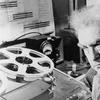
Edgard Varèse and Kid Baltan
Saturday, November 30, 1957
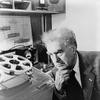
Edgard Varèse - Poeme Electronique
Saturday, November 23, 1957
The Sinfonia Concertante
Saturday, October 12, 1957
In this program David considers a concerto written for two or more solo instruments rather than a single soloist. To musically illustrate his points he plays the following recordings:
Sinfonia Concertante in B-flat opus 84 by Franz Joseph Haydn, from the Vox LP recording of the Pro ...
Childrens Concert
Wednesday, December 12, 1956
The Electronic Music Synthesizer
Sunday, July 17, 1955
Scarlatti-Casella, Handel-Schoenberg
Thursday, June 09, 1955
David talks about how he alienates friends by playing new LPs so that they can identify what's being played. He tries this with his listening audience and then reveals he had played Arnold Schoenberg's Concerto for String Quartet and Orchestra based on a Concerto Grosso by Handel. The recording was ...
How Dry I Am
Sunday, December 12, 1954
David Randolph uses theme from the song, "How Dry I Am" to see the ways in which composers have used this melodic idea. He does not want to suggest, however, they had that specific song in mind when they composed the following works:
Slow movement of the ...
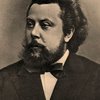
Songs and Dances of Death - Mussorgsky
Wednesday, December 01, 1954
The Siena Piano
Wednesday, October 13, 1954
In this program David Randolph considers the Siena Piano and its ability to sound like a guitar, harp, harpsichord, organ and the piano. To illustrate this, David plays the following recordings of pieces on a Siena Piano:
Malagueña by Isaac Albéniz.
Sonata for Harpsichord by Scarlatti ...
A Program Dedicated to the Clarinet
Friday, May 07, 1954
David Randolph begins with the finale of Mozart's Clarinet Concerto performed by Reginald Kell. The clarinet as a solo instrument and in various combinations is the subject of the program. He features the following work:
Mozart's Quintet in E-flat for Winds and Piano. K 452. - (Clarinet, ...
What Holds Music Together
Thursday, January 01, 1953
The exact date of this episode is unknown. We've filled in the date above with a placeholder. What we actually have on record is: 1953-uu-uu.
David Randolph reveals the types of logic that holds music together. And, just what that logic is. He opens with the familiar Turkish March from ...
Gentle Satire
Tuesday, December 23, 1952
David Randolph says this will be a relaxing program and he might otherwise call this show, 'Fun With Music'. He draws from the following works:
Two final movements of Ballet Suite #1 composed by Shostakovitch. They appear here on a Vanguard LP by the State Orchestra of ...
Eisenhower Victory Speech
Tuesday, November 04, 1952
Variety Concert
Wednesday, December 19, 1951
David devotes this program to 'just pleasant music' without trying to illustrate any particular musical point. Plays the following:
Concerto for Orchestra, Opus 3 No. 3 in G-major by Handel. It is recorded for the Bach Guild (Recording) by the Vienna State Opera Orchestra under the direction ...
Society for the Preservation of Unusual Instruments
Tuesday, October 02, 1951
David Randolph calls to order a meeting of the SPUI, the Society for the Preservation of Unusual Instruments. The purpose of the organization is to listen, every so often, to instruments other than the violin and piano. That is, instruments heard in concertos in a solo capacity. The following works ...
Rhythm In Music
Friday, August 17, 1951
David Randolph talks about rhythm in music. He begins by asking his listeners to conduct as he plays a recording of Beethoven's Eroica Symphony so that they become more sensitive the the rhythms and rhythmic changes in a work of music. He continues with the importance of the beat and ...
Trio
Tuesday, August 07, 1951
David opens with Scherzo movement from the Trio in A Major - a trio for violin, piano and cello by Brahms. The manuscript was discovered in 1924 without a title page but experts have figured it is an early Brahms work. It is performed here for Westminster Records by William ...

