Do you have a photo of your revolution? Is there an image that captures your movement, or an image of a revolutionary you?!



Claire
St. Louis
Other/Almost
My grandpa was in the Hungarian Revolution of 1956. He was at the Parliament building protest when the Soviets started shooting, he was issued a rifle by the other revolutionaries, and his ambulance full of patients from his clinic was almost blown up by a Soviet tank in a Mexican standoff.
The Hungarian Freedom only lasted 2 weeks before it was crushed, but it proved to the world that the Soviets could be stopped.
However, what he has taught me from it is that I should appreciate my life here in the US, never take anything for granted, how to make some delicious Hungarian food, and our problems here really aren't that bad. He also taught me from his experience as a refugee that if I ever move to another country, that I should just let go of my American culture or else I'll hate the new country.
Franciele
New Jersey
Other/Almost
Brazil/ 1984-1990
I was born in Brazil in 1983.
My memories are more about what happened after revolution, and I remember there was mess, political and economical instability. However, when in high school my parents and teachers saying " you're learning things that we're not allowed to learn, we're learning with you" and it's very important to remember. During dictatorship there is brainwashing and its difficult to the people pick it up the pieces after. There will be difficult times, the Egyptians will have to learn how to run the Country. But there is nothing better than freedom. It takes time but it's worth it.
Parsa S. Sajid
New York, NY
Other/Almost
I am from Bangladesh and I wanted to call attention to two revolutions/uprisings in the country's short history. First was in 1971 when we broke free from Pakistan. Second in 1990 when the people overthrew a military dictator.
1971 was before I was born and I was a too young in 1990 to actively participate, but I still have vivid memories from 1990. 1990 was before I moved to the US and first hand experience from leaving under martial law/curfew to overthrew of military dictatorship and knew people who incredible risks to organize and participate.
Given US role in the 1971 war, I would have hope you'd highlight that in your show.
There are so many pictures from these events that I don't know what to upload and what to leave out.
Lessons:
Role of social media: Both of these revolutions/uprising were before the advent of social media. Not to undermine the role of social media in Egyptian/Tunisian revolutions (I know Twitter has helped me to keep up to date and has been immensely helpful), but unjust regimes can be overthrown by a critical mass of people once fear can be overcome.
Post-revolution: If we can draw any lessons from Bangladesh, governing a just society can be just as difficult. Post-1990, we have had democracy but not democratic institutions. We are getting there and I wouldn't trade democracy for anything but it can be a long, hard road to establish democratic institutions.
Joseph T Barna
Jersey City, NJ
Other/Almost
In 1989 in Soviet Georgia a protest on the city hall steps of Tbilisi resulted in many deaths at the hands of the Soviet Army and KGB. In April 1990, on the anniversary, I happened to be in Tbilisi with the Yale Russian Chorus. The Georgian leaders were having a hunger strike on the steps, and we got to sit with them for an hour while they told their stories and we sang to them. (The American songs brought tears and clenched fists from the crowd.) I recorded the interview, translated by our guide. The most amazing comment was "Do not be mistaken. We all agree that the Russians must go. But once they are gone we do not agree and will be at each other's throats." (That is how things turned out.)
The next night, I went out to take pictures of neon signs, and found hundreds of people streaming down the main street. I joined them and found the crowd occupying Lenin Square for the first time in history. (This is where GW Bush had a hand grenade thrown at him, as "Independence Square.") When the leaders saw me, they had someone drive me back to the hotel to get the rest of my equipment to record and be a witness. I was the only westerner in the square. When I took my first picture (with flash, it was night) the Georgians crowded around me thinking I was KGB, but the leaders told them I was American and on their side. Of course, the KGB saw the flash and I didn't know if they would come after me. They sang revolutionary songs for me, showed me Georgian passports from their brief independence in the 1920s, and sat talking with me below Lenin's statue. I snuck out shortly before the troops moved in. On my balcony at the hotel I recorded my thoughts, that it was like being at Concord or Lexington.
No one was killed, but the leaders were arrested. The next day I spent four hours with the crowd outside KGB headquarters as the crowd waited for them to be released, one by one. They all came up to me and thanked me.
The lesson? The people, once started, cannot be stopped. But it is their country. They may not settle things peaceably, but it is their right to settle things and there is little we can do unless we wish to be dictators also.
I'm sorry that after two years of being homeless my stuff is mostly in storage so I cannot share the recordings with you. If someone from WNYC would love an oral history project, they should talk to me. Joe 732 754 9294
josephtbarna@yahoo.com
I included the lessons above. (I hadn't scrolled down to realize there was a separate box. Sorry.
I have images and sound, as I say, but they are in storage somewhere at present, so I have not uploaded anything.
Jennifer Wilson
New Jersey
Other/Almost
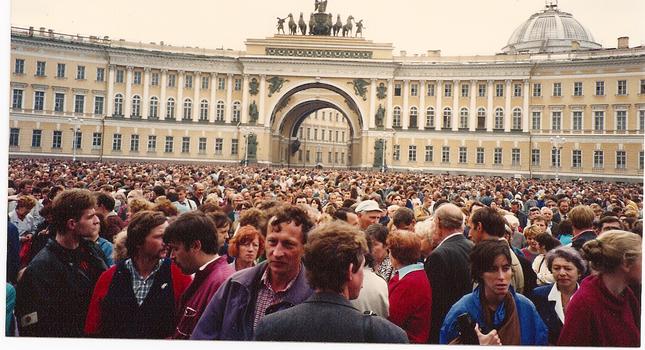
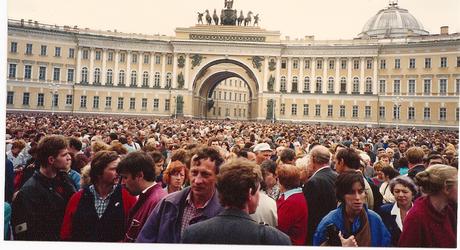
I was studying in St. Petersburg, Russia (then Leningrad) in August of 1991, having just celebrated my 19th Birthday singing Beatles songs with my new Russian and other expat friends when the Soviet Coup D'etat attempt broke out. I was living with a Russian family in a former communal apartment building in downtown Leningrad only a few blocks from the Winter Palace and Nevsky Prospect. I had just returned from spending the weekend in Moscow, where there were no visible signs of unrest. We took the overnight train back to St. Petersburg to learn that the Coup had broken out overnight. My Russian host family invited me into their room, which they had never done before, to watch the news. We were told the old Soviet line that Gorbachev was sick and was taken to the south for recovery, that there were tanks and soldiers in Red Square and that demonstrations were being organized for the Palace Square. The news also reported that the airports were closed and that the phone lines were down. There was no way to get out of the country. My host family told me that I should go to the U.S. Consulate. The subways were still working, even though there was a workers strike, so I went to my language school and found some other students there. I was frightened and exhilarated at the same time. We took a cab to the Consulate to register. I had never felt so patriotic in my life at the sight of that oversized American flag billowing in the wind outside of the Consulate. Inside, the soldiers acted as if nothing was happening outside and simply gave us registration forms to fill out and we were told not to leave the city. We were very matter-of-factly told that the government would get us out if they needed to. This was reassuring, but disappointing. I had somehow expected to be greeted with open arms, enveloped like a child into the strong arms of America, offered a cold diet coke and an open line to call home to my mother, who was certainly worried to death. That didn't happen. I think I grew up a lot in those few minutes.
I was young and naive. I had never been outside of the U.S. before and my understanding of revolution came from my AP American History class. But within the course of 24-48 hours I understood why people rise up. The Russian soul had been beaten down for centuries and you could see it in their faces, in their demeanor, and in their resignation to trudge through daily life without complaint and, moreover, without any great expectation of happiness. Russians were tough, they had proven that they could endure anything and survive, but they had had enough. And there I was marching along side of them, chanting with them, taking a stand against the Soviets and finding my own inner strength along the way.
Benedict Arnold
St. Mary's Church, Battersea
Other/Almost
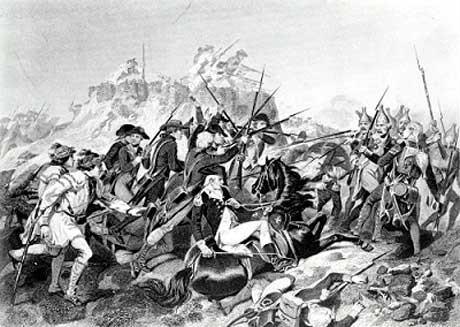
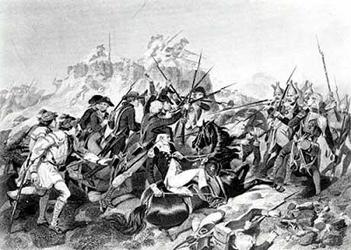
I was a leading figure in the early success of the American colonies' effort to throw off the yoke of England. Unfortunately, my efforts and sacrifice were not appreciated by my peers and so I took my unique skills 'over the hill', as it were.
I suggest you choose your side wisely. Not that I'm bitter or anything.
Sheila Michaels
New York
Other/Almost
I was in the Civil Rights Movement from 1961-64, in the Deep South & in the North, with both SNCC & CORE.
I was in Laos in 1975, working with the Terre des Hommes teenage Vietnamese paraplegic orphans who were airlifted into
Laos by their caregivers, but who the organization ordered returned to Vietnam. I was recruited in an ice cream shop & stayed with the kids a couple of months while the arrangements were made. Only one of the children is still alive. By the time the children were evacuated,the Pathet Lao had completely replaced the Royal Lao government. . After the children left, I traveled to Luang Prabang, when travel was permitted.
I am so pleased to see the world being shown that nonviolent direct action can overthrow a violent force. I can only hope it will continue.
Phil Henshaw
way uptown
Other/Almost
Observations of a systems thinker... A practical vision when there is a danger of none...
One of the key insights mentioned onair today was the importance of the practical steps of people hammering out the details of the new institutions that are the actual strength of a society. What the public, and the press, ever really see of that process foundation building process is the concrete vision of the architects giving it a face.
I think the reason for the feeling that Egypt could be in trouble now, is the absence of that kind of concrete vision for the practical constructive efforts behind the scene, on all sides, to coalesce around. Today, one side says "change" and the other "go slow". Neither is meaningful enough to show both how they can stay out of trouble and begin to to work together. So, what's the practical vision, of the "new day" for Egypt.
I was thinking about how Egypt's civil authority does need time to develop and its need for "safety wheels", of some kind, as it does. One main danger seems to be ending with a democracy in name that is just another puppet of authoritarian rule.
Maybe the vision all the world would understand and could work is the military needing to accept the obligation of taking the immature civil authority on as a protectorate, a relationship that would have it's frictions, of course, but ending in a free civil society as it's unequivocal goal, just some loose strings attached for a while.
posted with my other guides on the subject at http://synapse9.com/blog/2011/02/10/egypt-a-practical-vision-when-there-is-a-danger-of-none/
MARY ALICE McCULLOUGH CESARD
PARAMUS, N.J.
Other/Almost
MY GRANDMOTHER, LILY KEMPSON, JOINED THE OTHER YOUNG PEOPLE IN DUBLIN, EASTER MONDAY,1916, WHO ROSE UP AGAINST THE BRITISH OCCUPATION,WHILE THEY WERE BUSY WITH WW I IN EUROPE.
THEY HELD THE POST OFFICE AND DECLARED THE IRISH REPUBLIC. AFTER A WEEK THE CENTER OF DUBLIN WAS DESTROYED AND TAKEN BACK BY THE BRITS.
THE MEN INVOLVED WERE HUNG AND THE WOMAN WERE EXILED.
MY G-MA CAME TO AMERICA AND LIVED FOR 80 MORE YEARS.
THE REPUBLIC SAW LIFE 5 YEARS LATER, IN 1922---BUT THE BRITISH STILL HOLD THE NORTH ( 6 PROVINCES)
ACCORING TO THE GOOD FRIDAY ACCORDS THE WHOLE OF IRELAND WILL VOTE ONE DAY---LIKE THE SUDAN--- AND CHOOSE TO HAVE THE BRITSLEAVE AND TO RE-UNITE THE NORTH TO THE REPUBLIC.
REVOLUTION LEADS TO VIOLENCE AND BLOOD SHED BUT IT IS WORTH IT . THE NEXT GENERATIONS WILL PROFITS FROM THE SACRIFICES OF THEIR ANCESTORS!
Yin Mei
New York
Other/Almost
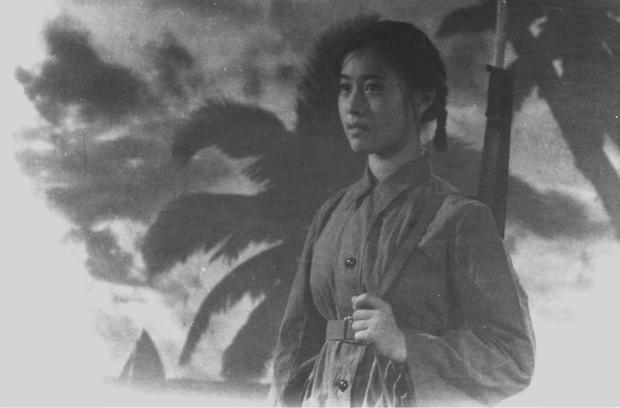
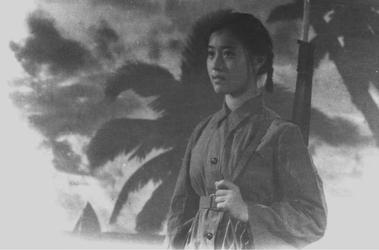
I was born in China, and grew up during the Chinese Great Proletarian Cultural Revolution (1966-1976)
The experiences therein did more than shape my childhood; the Revolution still influences my life to this day. I have used my professions, choreographer and professor (I was hand-picked as a child to study the Revolutionary Model Play in China) to tell my stories. These experiences are mostly alien to those around me, but important to know, in order to understand the spectrum of humanity. Below I include some of my memories in the form of a script that was used as part of my multimedia dance performance in 1998. The witnessing of the Revolution through my experiences is not a passive act, and as such, I continue to create performances such as “Empty Tradition/City of Peonies” because it is through the arts that memory remains/becomes interactive.
EMPTY TRADITION/CITY OF PEONIES
Copyright 1998 Peter L. Critchell and Yin Mei
PROLOGUE
ACCORDING TO LEGEND,
THE EMPRESS TOOK A WALK ONE WINTER DAY
IN HER SNOW-COVERED GARDEN
AND HAPPENED UPON
A LONE PLUM BLOSSOM BLOOMING IN THE SNOW.
DECIDING THAT THIS WAS THE MOST
BEAUTIFUL SIGHT SHE HAD EVER SEEN,
THE EMPRESS DECREED
THAT ALL OF THE FLOWERS IN HER GARDEN
WERE TO BLOOM BY DAWN THE NEXT DAY.
THE NEXT MORNING,
EVERY FLOWER IN HER GARDEN HAD
OBEYED HER EDICT – SAVE ONE.
ALONE AMONG ALL THE FLOWERS,
THE PEONY REFUSED TO BLOOM.
TO PUNISH THIS REBELLIOUSNESS,
THE EMPRESS DECREED
THAT EVERY PEONY IN THE LAND
WOULD HENCEFORTH BE BANISHED
TO A CITY DEEP IN THE COUNTRY’S INTERIOR,
THE “CITY OF PEONIES.”
[PAUSE]
A THOUSAND YEARS LATER,
THERE WAS A TIME WHEN
PEONIES WERE FORBIDDEN TO BE GROWN
EVEN IN THE “CITY OF PEONIES.”
AND IN THAT TIME,
I DREAMED THAT I COULD FLY AWAY
CARRYING ALL THE PEONIES WITH ME,
CARRYING ALL THE PEONIES IN MY ARMS.
I
Bedtime Stories
WHEN I WAS A CHILD,
THERE WERE NO BEDTIME STORIES.
I WANDERED THE DARK IN SEARCH OF DREAMS;
IN THE DAY
I DID NOT KNOW WHAT NOT TO BELIEVE.
II
The Red Book
WHEN I WAS A CHILD,
I LOVED THE SMELL OF BOOKS.
WHEN I GOT MY HANDS ON A BOOK,
I WOULD CRACK THE SPINE,
PUT MY NOSE INTO THE BINDING
AND INHALE FOREVER.
WHEN I WAS NINE,
EVERY BOOK SUDDENLY TURNED RED.
A HUNDRED MILLION RED BOOKS
WITH EXACTLY THE SAME WORDS
ON EACH WHITE PAGE.
A HUNDRED MILLION HANDS HELD
THOSE RED BOOKS HIGH,
LIKE A HUNDRED MILLION PEONIES
ON FIRE.
THAT IS WHEN I FIRST WANTED TO DANCE:
I WANTED TO DANCE
ON THOSE BOOKS.
III
A Broken Voice
WHEN I WAS A CHILD,
I WAS TERRIFIED TO SPEAK
BECAUSE OF THIS BROKEN VOICE OF MINE.
“IT’S A BAD OMEN,’ THEY SAID.
DO YOU HEAR WHAT I MEAN?
I BELIEVED THEM.
I BELIEVED SO MUCH I WANTED TO DIE
BECAUSE OF THIS VOICE.
IV
My Brother
WHEN I WAS A CHILD,
MY BROTHER WAS MY SHADOW,
AND I HIS.
[PAUSE]
I WANTED MY BROTHER TO DIE.
I WANTED MY BROTHER TO DIE
A GLORIOUS, HEROIC DEATH –
A DEATH SO SPLENDID
IT COULD EXONERATE HIM
OF THE CRIME OF
BEING BORN WHITE AS THE WHITEST FLOWER,
AND REPLACE THE SHAME WE SHARED
WITH THE PLEASURE OF REVENGE.
WHEREVER WE WENT,
THEY STARED, AND POINTED, AND LAUGHED,
“THERE GOES THE WHITE BOY,” THEY SAID.
“HE’S LOST HIS WAY IN THE SNOW,” THEY SAID.
“HEAVEN HAS EYES,” THEY SAID.
“IT’S A PUNISHMENT ON HIS FAMILY,” THEY SAID.
IN THE “CITY OF PEONIES,”
IT WAS ONLY IN THE DARK
THAT WE COULD PASS UNNOTICED.
I WAS NOT AFRAID OF THE DARK;
THE DARK WAS MY LOVER.
I WAS AFRAID OF THE DAY.
V
The Wall
WHEN I WAS A CHILD,
WE LIVED OUR LIVES ENTIRELY INSIDE
THE FOUR WALLS OF OUR INSTITUTE’S COMPOUND.
THERE WERE GUARDS AT THE GATE
TO STOP PEOPLE COMING IN
AND TO MAKE A LIST OF WHO WENT OUT.
EVERYONE I KNEW LIVED INSIDE WALLS.
IF YOU LIVED OUTSIDE WALLS,
YOUR EXISTENCE COULD NOT BE IMAGINED.
YET BECAUSE OF MY BROTHER,
A PART OF ME LIVED OUTSIDE THE WALLS,
KIN WITH EVERYTHING
THAT THE PEOPLE INSIDE THE WALLS
WANTED TO KEEP OUT.
[PAUSE]
I CARRY A WALL INSIDE ME, NOW,
AND I STOP PEOPLE COMING IN,
AND I KEEP A LIST OF WHO GOES OUT.
[PAUSE]
IT IS GETTING HARDER
TO TELL THE DIFFERENCE BETWEEN
THE EMPTINESS THAT IS WITHIN
AND THE EMPTINESS WITHOUT.
VI
Soldier
WHEN I WAS A CHILD,
I DREAMED I WOULD LOVE A SOLDIER.
I WOULD LOVE A SOLDIER
BECAUSE SOLDIERS ARE NEVER WRONG,
BECAUSE SOLDIERS NEVER LEAVE,
BECAUSE SOLDIERS HAVE NO GRIEF.
I WOULD LOVE A SOLDIER
BECAUSE SOLDIERS ARE OUR ONLY HEROES.
VII
Hero Of The Revolution
WHEN I WAS A CHILD,
THEY CLOSED OUR SCHOOL AND
SENT OUR TEACHERS AWAY.
OUR NEW SCHOOL WAS A FACTORY,
OUR NEW TEACHERS WERE FACTORY WORKERS.
WE DID NOT HAVE TO READ BOOKS
AS OUR FINAL EXAM,
WE HAD TO START A GENERATOR.
ANYONE WHO STARTED THE GENERATOR
GOT AN “A.”
I GOT AN “A,”
NOT BECAUSE I STARTED THE GENERATOR,
BUT BECAUSE I YANKED THE
STARTER ROPE SO HARD
I LOST MY BALANCE
AND SLAMMED, LIP-FIRST,
ONTO THE ENGINE HOUSING.
I GOT AN “A” FOR EFFORT.
MY LIPS WERE SWOLLEN FOR DAYS,
AND I DROOLED WHEN I SPOKE.
BUT NOT ONE CHILD LAUGHED.
I WAS A HERO OF THE REVOLUTION.
VIII
The Surgeon
WHEN I WAS A CHILD,
I BECAME AN EXPERT AT KILLING
THE CHICKENS AND FROGS AND OTHER ANIMALS WE ATE.
SO TALENTED WAS I THAT MY PARENTS SAID
I WOULD GROW UP TO BE A SURGEON.
ONE DAY, A NEIGHBOR BOY,
A RED GUARD,
WAS ACCOSTED BY A RIVAL GROUP,
WHO TOOK HIM DOWN INTO A BASEMENT,
TIED HIM UP ON AN IRON BED,
AND BEAT HIM TO DEATH WITH STICKS.
BY THE TIME THEY FINISHED,
HIS KNEECAPS HAD DISAPPEARED.
IN THE DREAMS THAT COME BEFORE I SLEEP,
I SEE HIM,
COVERED WITH BLOOD –
MUTILATED IN HIS PRIVATES.
I NEVER DID BECOME A SURGEON.
IX
The Kite
WHEN I WAS A CHILD,
I DREAMED THAT I COULD FLY.
ONE DAY,
I TOOK MY KITE TO THE ROOF OF OUR BUILDING
AND RAN ALONG THE EDGES,
CIRCLING AND CIRCLING
TO CATCH THE WIND THAT RISES ABOVE THE WALLS.
BEFORE I KNEW IT,
I HAD TAKEN A STEP TOO FAR
AND FLOWN MYSELF RIGHT OFF
INTO THE EMPTY AIR,
FIVE STORIES TO THE GROUND.
I BROKE A LEG, BUT I SURVIVED.
I WAS FAMOUS AFTER THAT.
THEY CALLED ME “THE PILOT.”
Uncertainty and insecurity go hand in hand with revolution. Never knowing what tomorrow may bring, and whether your choice will be the right one- these are often life and death decisions with reasons or answers often too big or too complex to comprehend, at least at the time. Revolution is not one man’s intention- it is a creature with its own momentum, its own forces well beyond one’s control. Take care of yourself and your family each day, follow the dictates of basic fundamental human kindness, beyond religion, and beyond politics and cultural divides. Especially, take care of your children. A child needs to grow up in a world with answers, not a world where no one knows what tomorrow will bring.
Paula
NYC
Other/Almost
In Nov. 1973 I was on a one week vacation to Athens, that included air fare, hotel and some meals. When we arrived at the airport we were told we could change money and then get on the bus to the hotel. Immediately after we were told to get right on the bus. Those who didn't, spent the night at the airport, as there was a curfew. We didn't get our luggage, but some people didn't get a room as the group that was supposed to leave when we arrived were barred from leaving due to the curfew.
The following morning we were taken out sightseeing and had to be in by 1 due to the curfew. In the center of town there was a sudden commotion and a male journalist came running out of a hotel asking us what happened.
As the days progressed, we were given later curfews. When we left and I arrived home 3 in the morning and went to slept. When I awoke and turned on the radio I heard there was a take over in Greece and a total curfew.
Other/Almost
Paris 1968. I was a student, living with a French family that participated. Educational experience, to say the least.
Too much to say in this small space. . . .
Suggested reading and pictures, linked from Wikipedia page for May 1968 in France:
http://www.martinfrost.ws/htmlfiles/paris_1968.html
Some lessons I learned:
--Results are often the opposite of what was most desired.
--Better results come from years of good planning, organization, and solidarity.
--Personalities and those with savvy will hijack the mission; troublemakers will come out for the simple pleasure of wreaking havoc. And watch out for 'agents provacateurs'. Everyone will trot our their own grievance points. Muddle.
--Always stock up on supplies because there will be shortages.
--Innocent people get killed, wounded, arrested. Out-of-control mess.
--Have several contingency plans: where to go if you can't get home, how to stay in touch, where to hide incriminating evidence, how not to provoke violence against yourself, etc.
j p mcgeary
chatham nj
Other/Almost
My grand father was a commando (group)
leader during the Rand Revolt in South Africa during 1922. The revolt started as a strike by miners against the rich mine owners but when the government came in on the side of the owners they needed to use tanks , airplanes and soldiers to regain control of the goldmining towns around Johannesburg. Though my grandfather's part was small in comparison to others, he was arrested, charged with high treason and served time in jail.
Money is power. Governments often act badly towards their own citizens.
I accidently discovered the information about my grandfather's role in a book about the Rand revolt by Jeremy Krikler entitled White Rising...
Goto Google books for photos
Linda Hoaglund
Brooklyn
Other/Almost
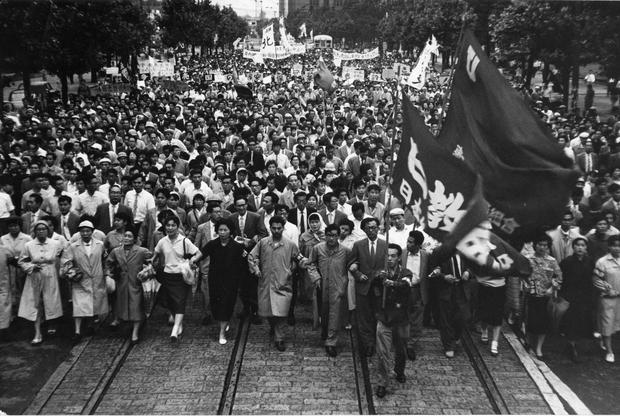
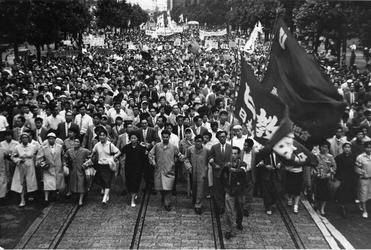
I recently completed a documentary film about the national uprising in Japan in 1960. The uprising was against the prime minister, Kishi, who was trying to extend the treaty keeping U.S. military bases in Japan. He was also, as we know now, from Tim Weiner's Legacy of Ashes, a WWII war criminal on the C.I.A. payroll. From May 19th to June 19th of 1960, millions of Japanese demonstrated everyday, joining in the streets to form the same kind of instant alliances that people in Egypt are finding. The history of this revolution is not taught in Japanese schools, which I attended as an American missionary's daughter. However, it was a watershed moment in postwar history. Because it failed, the U.S. still maintains over 90 military bases throughout Japan and their presence remains controversial.
In the case of Japan, the government saw the amazing energy of the people and decided to redirect that national energy into the economy. This is how the Japanese "economic miracle" was born. The corruption of the prime minister and his C.I.A. backed party was so thorough that it disillusioned many Japanese to the idea that Japan was a "real democracy." The fallout from their disillusionment can still be felt today as a deep cynicism towards the electoral process and politicians.
Phil Henshaw
way uptown
Other/Almost
I'm a scientist who studies the revolutions in natural systems that nature uses to create everything, how a "calm before a storm" becomes a "viral event" that then "graduates" from one level of organization to another... “disrupting and remaking” its environmental relations. The Egyptian revolution is at the stage immediately following the "viral event" of breaking with the past, and now as a “new culture” needing to grope around for what to put together.
The study of similar cultural experiences, like the dramatic collapse of the Soviet Union, or the similar but "silent" collapse of the Crack Culture in NYC from 1990-95, I did a study of the latter that might be of interest: http://www.synapse9.com/cw/crimewave_nys2.htm. You don’t need to use a mathematical analysis, but just observe how a whole environment is changing around any kind of viral cultural or ecological process. Any viral event you see is likely some new form of culture breaking from its constraints. Studying the ones involving your own life gives you a real appreciation for how new cultures can emerge with explosive formation and collapse processes of different things at the same time. There are as many kinds of emergence as there are of ways for new forms of culture to mature.
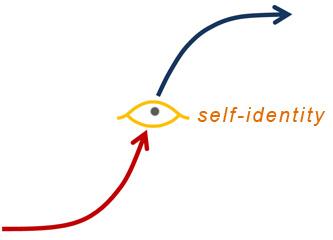
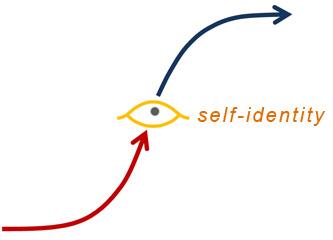
Once new forms of culture emerge from their initial constraints the important things are to 1) try to grasp what the common elements essential to it are, to establish its sense of identity and 2) then be active in learning how to integrate with its environment by being openly exploratory, inquisitive and patient.
Never losing sight of the principles not yet stated, but that permeate the new culture is valuable. Because the reality is different from the perception, it’s important for perception to remain as open to and observant of the reality to not result in being confused as to what the new form is. For a "new born" culture that has just burst onto the scene, the first experience is being “helpless”. It really doesn't know anything at all, like a fragile seedling, or nubie in any field, or your first day on a new job or school. Changes of form all come with that kind of "first day experience" of graduating to a new world and feeling completely lost in it at first, because new systems that have just emerged haven’t discovered their connections yet.
If you've ever watched how ants behave when they first emerge from the nest, for example, they look more lost than any kind of living thing you've ever seen...! You normally think of ants as seeming to really know what they’re doing, but as newbies the difference is remarkably clear. Every new start then, benefits from not rushing that, because it is a learning process and not a program, and from nourishing the learning process in exploratory ways, to keep your identity and find the complementary roles that will knit things together.
The diagram shows the basic sequence, a viral process of emerging culture reaching a stage of coalescing on a "self-identity",(not a "self-awareness" except for thought processes, of course) and begun the process of maturing and integrating with its environment.
John P.
Brooklyn
Other/Almost
The Civil Rights campaign in the Six Counties of Ireland, which began in 1968 and to which I have been a witness these past many years, is still an example of how mishandling by government and press had sparked a terrible low grade war that continued for more than thirty years.
Be careful that your ideals are not hijacked by the power brokers and manipulated to give voice to something other than what you seek. The first casualty of war is the truth. Amerisrael is the giant Goliath in your region are you slingshot is the truth. Use your weapon well.
Other/Almost
I was living in Paris when the events known as May,1968 went down.
people in the streets – talking and arguing among themselves, congregating in groups ever enlarging, confronting the police, etc. – frighten the powers-that-be because that is where individuals of different social classes, occupations, and outlooks exchange political ideas and evolve. Protesters need to stay in the street;
students and young people must link up with the working class and find where their mutual interests lie: the French Communist Party blocked such unity, and that was the beginning of the end of the revolt. Such a link-up may be even more difficult in Egypt because so many youth are unemployed, but it is key to keeping the movement going and growing;
the French government stayed in power because Pres. De Gaulle had the support of the army and his hand on the gas pumps, and that assured him the allegiance of the French “silent majority” which came out in great numbers – some say 500,000 – .to support the government.
Mark Read
Brooklyn
Other/Almost
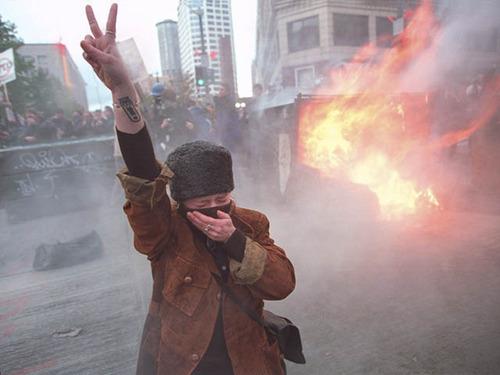
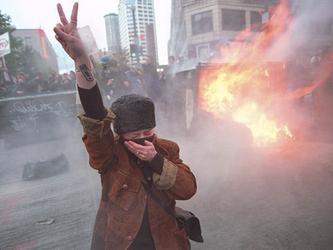
On November 30th, 1999 in Seattle Washington I stood shoulder to shoulder with thousands of fellow citizens to resist corporate globalization and the perversion of democracy by the World Trade Organization. We prevented the WTO from beginning its millenial round that day, and our creative non-violent resistance on the outside helped lead to the collapse of the talks on the inside, and, ultimately, to the diminishing of the WTO's power. Corporate Globalization, as led by the WTO, is a process by which the rich get richer at the expense of the poor and the environment. The movement against it, which began with the global south's resistance against the IMF in the 1980's and reached its peak in Seattle and afterward, peeled away the mystique of "free trade" and revealed the brutal truth of neoliberalism. This truth-telling has played a vitally important role in the uprisings now occurring in North Africa, as resistance to neoliberal austerity measures is at the heart of the the revolutions we are seeing there today. When I see the images of smoke in the air, of those people spontaneously organizing themselves in Tahir Square to tend to their defense and their well-being, I cannot help but think back to the medic teams, and the communications teams, and the affinity groups that were organized in the streets of Seattle, and other cities all around the world; that have been organized each and every time common people rise up against those that exploit and mistreat them. These revolutions and my revolution were the same struggle, the same revolution. A wealthy elite games the system to accrue great wealth and privilege to themselves, and they use the firepower of the state to protect and maintain that privilege. Eventually, people- the slumbering giant- wake up, and shake off their shackles.
Maintain solidarity and resist compromise. You will grow weary and divisions will arise. Take the long view and try to have patience.
Caller to the Brian Lehrer Show
Stanford
Other/Almost
Lived through Hungarian revolution of 1956
We spontaneously formed a national guard to ensure that no unlawful activities would occur. Members were self appointed and put an arm band on to signify their participation and protected against violence and looting. The other thing we did was announce on the radio that farmers should send food into the city. We placed collection boxes on the street corners so those with money could donate for those who were in need.
Caller to the Brian Lehrer Show
Hoboken
Other/Almost
Lived in Greece during the revolution of the late 60s.
The lesson is to take part in your society and make it work,don't just be in it for yourself. Take responsibility for yourself and then there will be some stability.
