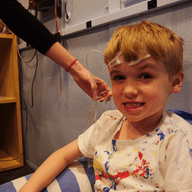
Your Brain On Sound
When Rose* was growing up, she knew something wasn’t quite right about how she heard the world. She says it felt like she was isolated by an invisible wall. But when she got typical hearing tests at an audiologist’s office? She aced them, every time.
Rose’s problem was particularly bad in noisy places. “It doesn’t take much,” she says. “It could be five computers in a room and a bunch of shuffling around — you lose me at that point.”
It took Rose years, and plenty of doctors’ visits, to figure out what was happening. And when she did find out, it was thanks to the persistence of Professor Nina Kraus.
Kraus runs an auditory neuroscience laboratory at Northwestern University. For decades, Kraus has been conducting research on Rose and other patients like her to learn just how vital our brains are to understanding sound. And she discovered how hearing difficulties can be a marker for all types of neurological issues — autism, dyslexia, learning delays — that have nothing to do with our ears.
*not her real name
How our brain translates sound can have a profound impact on how we understand the world around us. Find out more here.