When It Comes to Red Light Cameras, NJ's Numbers Don't Add Up
Red light cameras across New Jersey went dark as of midnight Tuesday, bringing an end to the state's five-year-long pilot program. Local officials are protesting the move, saying the cameras have improved safety, and a group of state legislators wants to bring them back, and make the cameras permanent.
At an event in Newark City Hall earlier this month, surrounded by North Jersey power-brokers and fellow mayors, Newark Mayor Ras Baraka was emphatic: the cameras have been an undeniable success when it comes to changing driver behavior and improving safety in his city. At the heart of his argument is the study conducted by the New Jersey Department of Transportation to determine whether the cameras are effective.
And there's no denying that those numbers look good: An 86% reduction in broadside collisions, a 58% reduction in rear-end crashes, and 83% reduction in red light running. But those numbers only account for two out of the 76 intersections equipped with the cameras statewide.
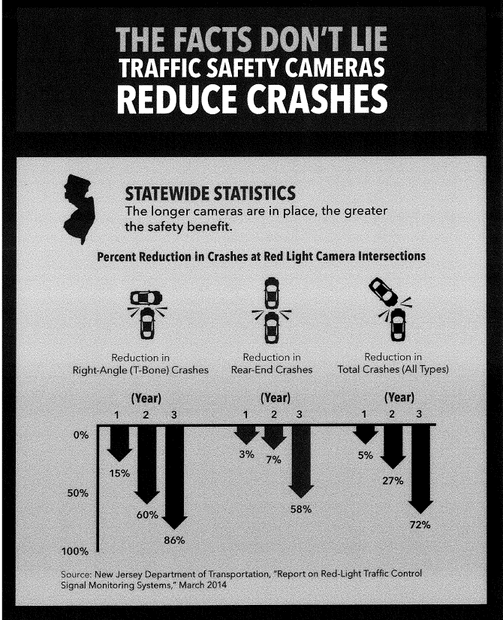
That's because the DOT says they need three full years' worth of data before they can make any formal recommendation on the program's continuation. Only two intersections, both in Newark, currently meet that criteria.
"This [report] is not a credible piece of safety research. I wouldn't put any stock in the findings here," said Joseph Hummer, chair of the civil and environmental engineering department at Wayne State University in Michigan, and an expert on red light camera programs across the country. "It is one of the worst I've seen. If it was handed to me in the highway safety class that I teach, it would not be a passing grade. It basically does nothing well."
Hummer pointed to the lack of any comparison intersections without cameras. If the red light camera is supposed to be changing driver behavior, those intersections equipped with the cameras should be compared to crash data from comparable intersections without them.
Even the Insurance Institute for Highway Safety, a trade group for the auto insurance industry, is critical of the New Jersey report. The IIHS has been outspoken in its support for red light cameras. But when presented with the DOT report by WNYC, a spokesman for IIHS said the numbers from New Jersey look good — the number of crashes are going down — but the state "needs a more complete analysis."
There are other problems with the report. The DOT leaves it up to each town to determine which crashes are relevant to report to the state. Gov. Chris Christie, who's said he's leaning against continuing or expanding the use of the cameras, has pointed to the lack of universal enforcement as his biggest complaint about the program.
Rick Short, co-founder of the anti-camera group, Stop RoboCops, said there is no statewide rules on how to define which crashes are part of an intersection. Some crash data extends as much as a quarter of a mile away from the red light.
"The state just takes the numbers and puts them all in an Excel file, that's all they do," Short said. "They're relying on all the data that's coming from each individual towns. The individual towns are set on different criteria because there is no criteria."
Short thinks the cameras are a cash cow for municipalities across the state, and many New Jerseyans agree. A Monmouth University/Asbury Park Press poll conducted in September found 60% of state residents think that towns are more interested in the devices as a revenue generator than as a traffic safety measure.
Supporters of the program counter that they're more interested in saving lives than making money, but that hasn't stopped some from playing up the camera's financial perks.
"Cities and municipalities across the state are in a dire situation," said New Jersey League of Municipalities president Bill Dressel. "Moneys are not forthcoming from the federal government or the state government. We can't rely on the taxpayers, we need additional tolls to augment [and] supplement our police department," he said, referring to the cameras.
Whatever the motivation for the program, it has been plagued with problems. Many drivers have complained about receiving tickets after making perfectly legal right turns on red. Also, at one point last year, 75% of the cameras were shut down after drivers complained traffic lights turned from yellow to red faster than state law allows. Then, last summer,17,000 citations from the cameras were thrown out after it was revealed drivers never received their tickets.
This has soured the public's perception of the program, leaving safety as something of a secondary issue.
A 2005 report from the Federal Highway Administration shows a small, but significant decrease in broadside collisions, but an increase in less severe rear-end crashes. The New Jersey Department of Transportation may eventually come up with that kind of convincing proof, but it says it won't have an analysis of all the red light cameras until 2016.

WNYC is funded by sponsors and member donations