
Weekly Music Roundup: Soul of Cash and Albanian Saze
This week, the soul of Johnny Cash, and dispatches from Mar-A-Lago and Albania.
Soul Of Cash Brings Johnny Cash And Soul Music Together
Soul singer Brian Owens has just released an album called Soul Of Cash, wherein he joins the long list of musicians who’ve covered the songs of the late Johnny Cash. But Owens’ project is different: he makes a case that these songs are a form of soul music. “What we have in common,” Owens says,”far outweighs the difference that I'm black and he's white.” Owens points out that country music has its roots in the blues and in the church, just like soul music. And he told Rolling Stone, perhaps only half in jest, that the main difference between his covers and the Cash originals was “I sing everything an octave up from Johnny.” It’s true that the songs are all recognizable, but some of the arrangements are strikingly different. I like Owen’s version of “Walk The Line,” with its catchy bass line, twangy guitar, and bowed strings – all reminiscent of the classic early 70s soul of Curtis Mayfield, but married to one of Cash’s signature hits.
UK’s Rationale Sets Out To Conquer US
The singer/songwriter/producer Rationale, born in Zimbabwe and based in London, has just released his debut album, also called Rationale. While he will be a newcomer here, he has been gaining steady acclaim in England since his 2015 single “Fast Lane.” Rationale has a wide-ranging voice that seems like it would be equally comfortable doing straightahead R&B, or jazzy torch songs, or gospel. So he does none of the above – or maybe bits of all of the above. “Loving Life” is the new single from his full-length album, and it’s a fine introduction to a voice we may be hearing more from.
Rationale plays in New York at the Mercury Lounge on November 8.
L7 Return With A Dispatch From Mar A Lago
L7 added a welcome note of gender diversity to what was a very dude-heavy grunge movement in the late 80s/early 90s. They helped inspire the feminist/activist riot-grrrl movement in the 90s, but the band itself had pretty much broken up by the turn of the century. Now, they’ve released their first new single in 18 years, called “Dispatch From Mar-A-Lago.” Rowdy, dirty, and fun, the song acknowledges the problems and challenges of modern times by essentially flipping them off. On Friday, their documentary L7: Pretend We’re Dead, comes out on Blu-Ray/VOD. Can a full-length recording be far behind?
Albania’s Hidden Saze Music, Revealed
Communist but deeply suspicious of Soviet hegemony, predominantly Muslim in a continent that was heavily Christian, and isolated linguistically by a language not related to anything else, Albania was a closed book under Enver Hoxha’s dictatorship. But that book opened up in the early 90s with the establishment of a democratic government, and now we get to read a new chapter, courtesy of the legendary producer Joe Boyd. Boyd, who made his name by producing Nick Drake, Fairport Convention and Pink Floyd in the 70s, moved on to world music projects long ago. His latest is a project dealing with Southern Albanian saze music. This style of folk music is characterized by serpentine melodies, usually two of them twirling around each other, over a series of drones. Many of the melodies have a distinctive falling gesture, almost like a sigh, usually heard in the clarinet and violin. It’s similar to the bluesy music of Epiros, Greece, which is nearby, and might contain echoes of Ottoman music as well. The band is a group that Boyd assembled called Saz’iso, and their album, At Least Wave Your Handkerchief At Me: The Joys and Sorrows of Southern Albanian Song, is due on October 20, but you can hear the leadoff track, the (relatively) jaunty “Tana,” now.
EDM Meets Avant-Garde Classical in Grandbrothers’ New Album
Grandbrothers is the cleverly-named duo of Lukas Vogel, an engineer and software designer, and Erol Sarp, who plays the piano. It’s hard to describe the Düsseldorf-based group’s sound, but if you’re a fan of the prepared piano music of John Cage, or techno pioneers like Derrick May, it’s like some weird, wonderful combination of those. The music reminds me of their Düsseldorf colleague Hauschka, in the way that Grandbrothers take the clanging, percussive sound of the prepared piano and use it in a way strongly influenced by electronic music. The result is propulsive, danceable instrumental music, full of unusual sounds and unexpected little sonic flourishes – all played on Sarp’s piano. Vogel’s live sampling and processing of the sound creates the sonic architecture, which often includes EDM-style bass drops. Their setup looks like this:
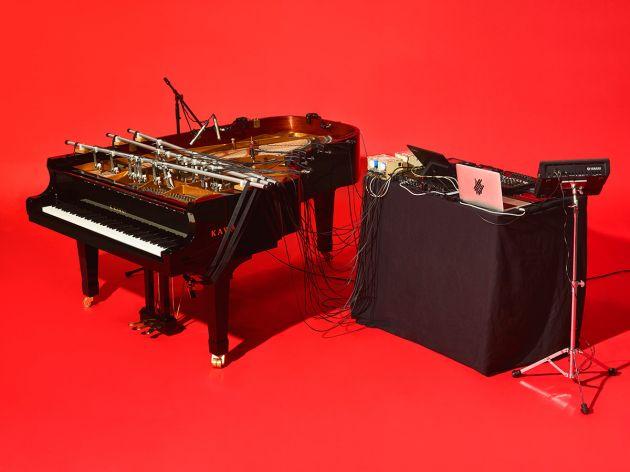
Check out the evocative single “Bloodflow” and its enigmatic dreamscape of a video; and watch for Grandbrothers’ second album, called Open, on October 20.