Theodore H. White
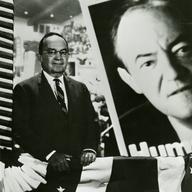
Doug Cooper and George O'Brien meet with White, author of the Pulitzer Prize-wining The Making of the President 1960, and its three progeny.
The Interview
White says the act of politics is an act of leadership. Cooper recalls that author White likened the act of politics to a caravan; you've got to know the present and see the future. He says yes, we're all tramping along to music we don't understand. Was Watergate just a bungled burglary on June 17? I think Watergate can only be understood in the context of the past twenty years. The old Republican and Democratic Parties no longer function. They've been taken over by professionals, young men, drunk with the power of the White House. What is politically allowed and what is unethical?
Cooper states that White has written four Making of The President histories. Aren't Kissinger and other politicos courting you? Of course. Yep. And as they give me nonsense and a hard sell, I try to pick my way through that. It's a game. They outwit me or don't.
A politician seeking office will use phrases from his best speeches, the first time. Then the second and third conversations, you start to get what's really on in his mind. White says he's met very few outright liars. Usually, by 6 or 7PM, the last rally of the day, they're tired, their mind is in neutral, and you can get the measure of the man. This is an exhausting trade. What's in the books is what happens at 11 or midnight. That's the insight I want to seize.
Cooper brings up White's 1960 preface, in which he writes that he found politicians to be amiable people. "I enjoy politicians, he says. I happen to enjoy the drama and spectacle. In my thirty years as a journalist, there've only been three politicians I dread, fear and loathe. And I'm not going to name them."
"Are politicians a breed apart," Cooper presses. "No. Some men want to be leaders, and write their names in granite. Ego is what keeps them going. Longfellow said it:...'and, departing, leave behind us, footprints on the sands of time.'"
_______________________________________________________________________________________________________________
The Douglas P. Cooper Distinguished Contemporaries Collection (1967-1974) contains rare interviews with influential writers, statesmen, artists, songwriters, journalists and others who have left their mark on our culture.
The Origins of The Cooper Collection

WNYC is funded by sponsors and member donations