Baker Jim Lahey Shares His Secrets
The Sullivan Street Bakery was founded in 1994, and has since become known for its bread and Italian-inspired dishes like pizzas and pastries. In his new book The Sullivan Street Bakery Cookbook, James Beard Award-winning baker Jim Lahey shares the secrets behind their bread and shows readers how they can make their own tasty dishes at home.
Note: This segment of the Leonard Lopate Show is guest-hosted by Jonathan Capehart.
Check out a recipe from Jim Lahey below!
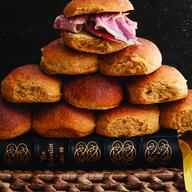
Hamilton Buns
sweet whole wheat (This recipe requires the stiff starter, or biga, see below, and can be “kneaded” in a stand mixer.)
I saw Hamilton, the musical, in the fall of 2015. I became deeply obsessed with both the musical and the historical figure. I read Ron Chernow’s biography of Alexander Hamilton, I read The Federalist Papers, and I developed the irritating habit of finding a way to fit Lin-Manuel Miranda’s dazzling lyrics into every conversation. For Hamilton’s birthday that winter, I decided I had to bake in his honor. “Hamwiches” seemed appropriate—nice little sandwiches made of ham, mustard, and pickle. I don’t know what Hamilton actually ate, but this seemed like Revolutionary War–era fare to me. And of course, for a perfect hamwich, I needed a perfect bun. I imagined a diamond in the rough—a serious-sounding workhorse with surprising delicacy and flair. Here is what I came up with: a whole wheat bun of substance, character, and ample sweetness. May it amaze and astonish.
Yield: 12 rolls Equipment: A stand mixer with the paddle attachment, and an 18-by-13-inch rimmed sheet pan
225 grams (1½ cups) whole wheat flour
175 grams (1 cup plus 3 tablespoons) unbleached all-purpose flour, plus flour for dusting
6 grams (1 teaspoon) fine sea salt
5 grams (1½ teaspoons) fast-acting/instant yeast
Olive oil for the bowl
180 grams (¾ cup) whole milk, plus 30 grams (2 tablespoons) for brushing the buns
180 grams (¾ cup) water
40 grams (2 tablespoons) molasses
40 grams biga (see below)
Put the whole wheat and white flours, the salt, and the yeast in the bowl of a stand mixer. Oil a large bowl and set aside.
Bring the milk to a boil in a small saucepan over medium-high heat. Remove from the heat, add the water, and set aside to cool to 70°F.
Add the molasses, the biga, and the cooled milk and water mixture to the bowl of flour. With the paddle attachment, mix on low for 30 seconds to combine, and then raise the speed to medium-high. After 2½ minutes, scrape down the bowl. Mix again until the dough forms a ball—it should happen quite quickly.
medium-high. After 2½ minutes, scrape down the bowl. Mix again until the dough forms a ball—it should happen quite quickly.
Transfer the dough to the oiled bowl. Cover and let rise for 45 minutes to 1 hour. Pay careful attention; the dough needs to be cut and shaped as soon as it has just about doubled, lest it rise too high to survive. It is helpful to put this dough in a walled container and make a mark on the side to judge when the dough has almost doubled in size.
Turn the dough out onto a lightly floured surface. Divide the dough in half, then cut each half into six pieces using a dough scraper or chef’s knife. Each piece should weigh 65 to 75 grams. Shape each piece into a ball and arrange on a parchment-lined sheet pan 1½ inches apart. Cover with a damp tea towel and allow to proof at room temperature for 1 to 2 hours (but no more), or until the buns are just kissing one another. Heat the oven to 450°F. Uncover the rolls and brush lightly with milk. Bake for 15 minutes or until light brown. Allow the buns to cool on the pan.
* eating
Serve with country ham, mustard, and thinly sliced pickles.
“Jim’s Biga”
a stiff starter
In Italy, the word biga is used to describe an assortment of “pre-ferments”—the already-fermented pieces of dough that are added to bread doughs to speed up fermentation and add flavor to the finished bread. At Sullivan Street Bakery we use the name biga to refer to our own doughy starter. It is made of flour, water, salt, and yesterday’s biga.
There is no precise schedule for making biga—both at home and in the bakery, I make a new batch only when running out of the old one. To get a biga started at home, you will need a dab of healthy sourdough starter.
I infinitely prefer using biga to a liquid starter for three reasons: (1) it’s what I learned as I traveled around Italy as an impressionable young man; (2) it’s more stable than the liquid starter many people use, not to mention cleaner to work with; and (3) it’s easier to keep around than a starter: you don’t need to feed it, remember it, or stir it. At the bakery we wait at least 24 hours from the time it is mixed before using a new batch of biga, but you can often wait longer—a healthy biga that is tightly covered and stored in the refrigerator will stay ready to use for a week.
70 grams (scant ¹⁄³ cup) room-temperature (65° to 70°F) water
10 grams (scant 1 tablespoon) refreshed fermented starter
100 grams (½ cup plus 3 tablespoons) unbleached all-purpose flour
0.1 gram (a tiny pinch) fine sea salt
Mix together the water and the refreshed starter in a small bowl. Add the flour and a few grains of salt. (Use just a tiny pinch, please—a bit of salt will speed up fermentation, but a heavy dose of salt will slow it down.) The dough will look lumpy, uneven, and small. Cover the bowl and prepare to wait about 24 hours for it to triple in size. Don’t be dismayed if nothing happens for the first 12 hours—it takes a while to get going, but once the fermentation starts, it will take off, and it is likely to grow more in the final 4 hours than it did in the first 16.
Poke at it and taste it—a fully fermented biga is pleasantly tangy with a fantastically airy, spongy, viscous structure. It will feel tacky, and it will taste and smell deliciously yeasty with a gentle smack of tartness—a bit like beer, but without any bitterness. At this point it’s ready to use. You may note color changes in the biga as the top layer dries out and oxidizes a bit; this is perfectly fine and to be expected.
Storing Biga in the Short Term
If your biga is ready to use and you are not ready to use it, that’s fine. This is the wonderful thing about a biga—once it’s ready there is a long window of time where it stays ready. It keeps unrefrigerated for several days.
My one caveat is that if your kitchen temperature is above 72°F, it is probably a good idea to keep your biga in the refrigerator or someplace else that’s cool. Extended time in a warm temperature will eventually promote the proliferation of the heat-loving bacteria that are part of the starter. They aren’t harmful, but they will multiply faster than the wild yeast, so that your bread will take longer to leaven and the deeply sour, acidic flavors of bacterial fermentation will overpower the milder flavors of a well-balanced rise.
Keep the biga cool enough that it tastes and smells tart, yeasty, and sweet. A very healthy biga that has been used and refreshed consistently will often keep for several weeks—or even longer in the refrigerator. You can judge the state of the biga by smelling and tasting it. When it tastes painfully acidic, for instance, it is time to make a new batch.
Storing Biga in the Long Term
If you’d like to store a biga for a matter of weeks or months, cover it tightly and store in the back of the refrigerator. A biga may discolor slightly or become a bit like glue in texture. These things are fine—as are smells that range from yeasty to alcoholic. Twenty-four hours before you plan to bake, take a teaspoon of biga and follow the steps for making more biga (page 53). Once this biga has tripled in size it is ready to use.
Recipe and photograph from The Sullivan Street Bakery Cookbook by Jim Lahey with Maya Joseph. Copyright © 2017 by Jim Lahey. Reprinted with permission of W.W. Norton & Company, Inc. All rights reserved.