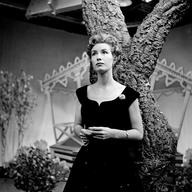
Roberta Peters
Douglas Cooper and George O’Brien interview Roberta Peters, an American Opera singer, at her home in Scarsdale.
Cooper refers to her recent concert in Central Park—one of a series of free, city-sponsored events. She expresses her enthusiasm for the project. It allows people who cannot afford the seventeen-dollar Metropolitan Opera tickets to sit on the grass with a bottle of wine and hear music. Singing in the open in more difficult, however. She says she is always afraid that she will swallow an insect, and has to wear a shawl to keep from getting cold, but also mentions that the system of speakers does not lend itself to good acoustics. The night before, it began to rain, and the audience put newspapers on their heads and stayed to hear the performance, but it was not good for her voice. They talk about outdoor theaters in Verona and Rome, and the live animals they have there.
O’Brien steers the conversation to the impact that she had early in her career, at 20 years old, when she first performed on the 17th of November, 1950. She stepped in to replace another singer, who was ill, and began her successful career. She says that she was very lucky, but explains that she trained for that moment for 7 years, leaving school at 13 to enter an intensive program of musical study, with French, Italian, German, and dramatics.
They discuss the dramatics especially, since opera has shifted and become more about acting. “Today, with TV,” she says, “People don’t accept heavy people just standing stomach to stomach anymore.”
Cooper asks if she becomes nervous before each performance, and she responds that any good performer has to. She had to be pushed out on stage for her first performance, but says that such nervous excitement is always needed. “You cannot be blasé about it.”
Similarly, she argues that vocalists have to train and practice continually. She exercises each day, but also continues to take lessons to work on her technique and her repertoire.
Cooper turns the conversation to the audience, asking how much Italian her audience knows, and how necessary it is to enjoy the performance. She says that most of her audience does not speak Italian, but that it is their duty to purchase a libretto and learn the story beforehand. She discusses various attempts to translate operas, and says that it can be successful with the comic operas, but that there are not many good translations, and when people are singing, it is difficult to understand them anyway.
Audience responses, however, are what make it all worthwhile for her, especially applause. They discuss conductors, and she mentions James Levine, who was 29 at the time of recording, and how promising his career seems to be.
They end the interview with a few questions about her family, which she considers to be her other job. Her husband, she says, is very supportive and understands her business. Her children, who are 13 and 16, enjoy rock music, and sometimes come to her performances, though she does not force them to, or blame them if they do not.
_______________________________________________________________________________________________________________
The Douglas P. Cooper Distinguished Contemporaries Collection (1967-1974) contains rare interviews with influential writers, statesmen, artists, songwriters, journalists and others who have left their mark on our culture.
The Origins of The Cooper Collection
WNYC archives id: 92288