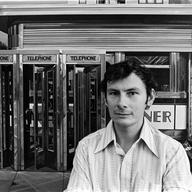
Richard Estes
Douglas Cooper meets with photorealist Richard Estes, at his New York apartment, to examine his insights into an art form also known as hyper-realism and super-realism.
The Interview
I asked Estes to define photorealism as it sets him apart from other styles, but he simply considers himself a realist, with the photos making life simpler.
He insisted that he could be expressionistic, just as Degas and Eakins were. He added that one draws based upon knowledge plus the photograph. He points out the practical problems that are solved—the sun moves, shadows shift, the color of light changes.
It's an old problem. Monet had to work on three or four canvases at the same time; Cezanne's chimney smoke shifted from the left to the right side of the painting.
It's even tougher in the city, where artificial lights and their colors change. But outdoors, people wanna watch. "It's a nice way to make friends, but you can't get anything done."
"Does your approach limit creativity?" I ask. No, he tells me, because it's a matter of selection, adjustments in composition. He goes on to describe art as a purely visual experience. "The explanations add interest, like Gaugin's motives for traveling, but beyond that, it's an intellectual game. "Even Jackson Pollack: it's a visual experience, not a symbolic one."
_______________________________________________________________________________________________________________
The Douglas P. Cooper Distinguished Contemporaries Collection (1967-1974) contains rare interviews with influential writers, statesmen, artists, songwriters, journalists and others who have left their mark on our culture.