
As Pre-K Expands, Early Child Care Gets Squeezed
Families of about 140 children who applied for child care and pre-kindergarten classes at Nuestros Ninos in South Williamsburg, Brooklyn, got a surprise recently when the city told them their 42-year-old neighborhood institution would not be an option for the fall. The news came well after the application deadline.
"I was hoping she would stay here since I was one of the first ones to apply," said Jahayra Jimenez of her daughter Leah.
Executive Director Myriam Cruz said the impact spreads even farther, with families of another 200 infants through toddlers also in limbo because they're served by homecare providers affiliated with her agency. The future of Nuestro Ninos is in question largely because its landlord wants to raise the rent. Officials announced late Monday that the city, who holds the lease, secured the space through January, 2016, while it tries to reach a deal.
This is not an isolated case: at least two day care centers in Brooklyn closed this year because of rising rents, and advocates believe dozens more around the city may be at risk as long-term leases come up for renewal in booming neighborhoods like Williamsburg. Martin Needleman, a board member of Nuestros Ninos, said he's disappointed that Mayor Bill de Blasio isn't doing more to intervene.
"He talks a big game about income inequality and preserving affordable housing," he said.
Lilliam Barrios-Paoli, the deputy mayor for health and human services, said the administration was committed to affordable early child care and was working to keep Nuestros Ninos and other centers open, even if they have to move.
"We're even considering buying buildings," she said.
Moses Marx, the landlord for the Nuestros Ninos site on South 4th Street in Williamsburg, told WNYC he negotiated a lease with the city but it has yet to be signed. The city said it's negotiated a lease through January 2016 and is still working on something more long term.
But it's not just rising rents that threaten early childhood centers, advocates said. Chronic under-funding is another problem. Directors often scramble to make ends meet with a mix of funding streams, including Head Start, the city's Department of Education and the Administration for Children's Services.
The city announced last week that it would change the ACS funding formula to help providers meet costs but it may not be enough to keep some centers from closing.
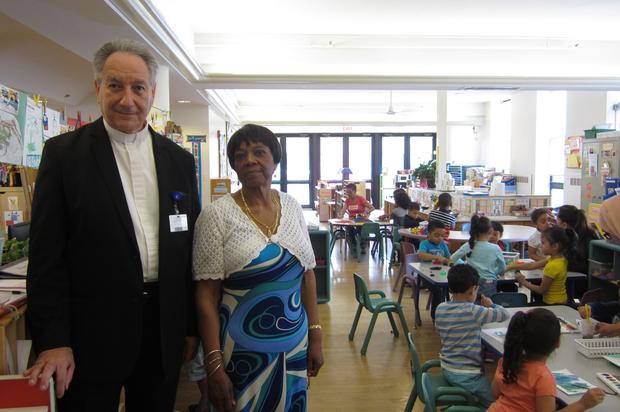
Monsignor Alfred Lo Pinto, chief executive officer of Catholic Charities of Brooklyn and Queens, said his agency has a $1.8 billion deficit at its six childcare centers. With the city's expansion of prekindergarten, he said his agency will use more of that money for four-year-olds instead of ACS dollars.
That switch won't affect programming at some of his centers, like Saint Malachy in East New York, but he will close the John Oravecz early childhood center in Greenpoint, Brooklyn, and John F. Kennedy center in Canarsie, Queens, because they're not financially viable. Lo Pinto also said affordable child care is no longer needed as much in those places.
"These are areas that are switching over economically," he said. "They are becoming high rent areas...They wouldn't qualify for the programs that we operate."
City Councilman Stephen Levin disagrees. "There’s no doubt in my mind that there could be a fully enrolled program at that location," he said, referring to the center in his district of Greenpoint. He said City Hall lacked a long-term strategy for early childhood education.
ACS said it's assessing the need for subsidized care in neighborhoods across the city to figure out where the needs are highest, and Barrios-Paoli said she's confident she can help the centers that are losing their leases before the fall.

WNYC is funded by sponsors and member donations