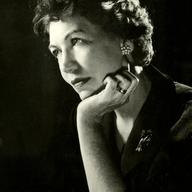
Phyllis McGinley
Douglas Cooper drove from college in Hartford to suburban Mamaroneck, N.Y. to keep a Friday afternoon appointment to record a talk with the Pulitzer Prize-winning poet Phyllis McGinley.
The Interview
Cooper began with the Poet's motive to start writing poetry. Mc Ginley said she wished she could name a particular event that got her started, but that she got inspiration early, at age six, and never wrote prose at all for three decades...the 60's.
McGinley said that she came to New York expressly to write for The New Yorker. The managing editor placed her work at the back of the magazine. She wrote light verse, against the focus of The New Yorker, which was topical and humorous.
When she caught on to the magazine’s strategy, she took a more serious tone. If ever she was criticized, it was for writing for her era, about stay-at-home housewives. Then, in the late 50's, she incorporated prose in her repertoire.
I asked what made her work distinctive, and she immediately answered, "originality;” she felt, as an example, that she'd captured the essence of the adolescent girl, say age 13, exemplified in her poem, Portrait of Girl with Comic Book. Her messages became more implicitly serious; the reach (audience) for work grew, she was given a contract and her work was featured.
Cooper asked about the hallmarks of her Pulitzer Prize in 1961, and cover story in Time. She took great pride in the fact that her collection, Times Three (30's, 40's, 50's) was the first light verse to get the prize. Newspapers took her seriously as an outcome, and the Pulitzer judges felt that her work was increasingly intertwined with "the serious”.

WNYC is funded by sponsors and member donations