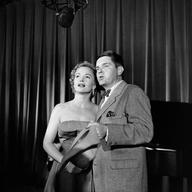
Peter Lind Hayes & Mary Healy
Douglas Cooper and George O’Brien visit with 1950’s media celebrities Peter and Mary at their "Boat House," a lovely, small home Peter has built at the waterside on the Long Island Sound, in New Rochelle, New York.
The couple appeared separately in films during the forties, then both had leading roles in Stanley Kubrick's 1953 cult fantasy musical film, The Five Thousand Fingers of Dr. T. As a couple, they were regulars at major Las Vegas venues during the early fifties, and co-starred in several short-lived television series from 1950-1961. They then broadcast The Peter and Mary Show, a daily breakfast talk show from their home, carried by WOR.
Our conversation found Peter in a jocular mood, while Mary was, as always, sincere, and the “accidental straight lady".
George asked if they would go back to Atlantic City to again be hosts on the Miss America pagent. Peter said they would; it's generally a three-year gig. He reminds listeners that Mary was Miss New Orleans "of an undisclosed era".
Mary recalls that I was a regular guest on their WOR show, reporting the weather. Peter scoffs, humorously. Mary tells the story of one New Year's Eve when Walter Cronkite was a party guest. He came downstairs where their son Michael and I operated a tiny neighborhood station, adjacent to the Hayes' WOR "set," and became a guest on our live broadcast, with a range of only a mile or two.
I ask Peter about the day they were live on air and their mynah bird escaped his cage and was pursued by the dog. Peter says, by the time we got back in order, Mary and I were hysterical. Peter had given me a tape of the broadcast, and that segment is edited into this show.
I made a wisecrack about the bird getting into the Seagrams, and Peter countered that he'd just been hired as a PR consultant for them. Mary says, it's mainly attending golf tournaments. Peter lists recent celebrity participants. Mary says he's left out that he'd won Seagrams' latest tourney, the Comedians' Classic.
We took an unexpected "tour" of the couple's split existence, New Rochelle, where they have roots and catch up with their kids and old friends in the summer, and Las Vegas, when the northeast gets cold.
Part of the purpose for being here, at this time, was their daughter Cathy's wedding. We also asked about son Mike, who had been hired by systems engineering at CBS. Mary starts, and Peter finishes, the story of how they met, told drolly.
I report that I'd seen them a week previous on The Alan King Show. Mary tells about it and how she was especially pleased that Peter's mother Grace—who was an old-timer in Las Vegas, and with whom Peter first appeared at age 16—shared the
limelight and got to do network TV with them.
Peter defends Las Vegas as a bifurcated city, where you could have the quiet of the desert, and said they rarely went to The Strip. He said they were at 2200 feet, and only a short distance away, you could ski on Mt. Charleston at 8200 feet. Also nearby was Lake Mead, where they'd boated among the mountaintops. And then Hoover Dam, where it took over five years to "impound" the reservoir, which was, in places, nearly 600 feet deep.
I said we had to hear about Howard Hughes, as both of them knew him decades in the past. Peter took the opportunity to say what a great scientific mind he had. Mary agreed, saying he contributed a lot to aerodynamics. She says when she knew him he was already somewhat eccentric, that his deafness contributed to that impression.
Mary said he wears one of those "gizmos" (a special hearing aid), and that he does a lot of his business on the phone. So I brought up the recent "presser" he did on the phone, when there were rampant rumors of his death. I noted that when asked if, with all his money, he was a happy man. He said no. Mary commented that, "he just wants to be left alone. But no one will. Guess if you're rich you have to suffer."
_______________________________________________________________________________________________________________
The Douglas P. Cooper Distinguished Contemporaries Collection (1967-1974) contains rare interviews with influential writers, statesmen, artists, songwriters, journalists and others who have left their mark on our culture.

WNYC is funded by sponsors and member donations