'Not everything is about cops and robbers:' Insights from the streets of Brownsville
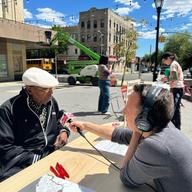
WNYC's Community Partnerships Desk and the nonprofit, Street Lab, are working together to highlight stories from neighborhoods across New York City. We recently stationed ourselves at Zion Triangle Plaza in Brownsville, Brooklyn. Here's some of what we heard.
The transcript of the voices we collected have been lightly edited for clarity.
Kevin Goddard: "I was born and raised here. Right now, I do a lot of anti-violence work with the community. I get kids their IDs, job referrals, if they're having problems in school, [I'm] just like a mentor, an outreach person. [I] just try to clean up the community, stop the violence, get the kids to put the guns down. My sister passed away a few years ago over something that could have been settled in the streets. And it is sorry that she had to lose her life over that. So that would kind of give me the drive to just keep doing the work. She was a real tough cookie and she never backed down from nobody. She'd be proud of me, real proud of me."
Phyllis Tripp: "I'm from the Bronx, New York, but I used to live in Brownsville. It was rough, but I made it through. I lost a lot of childhood friends, you know, through gang violence crime. A year-and-a-half ago, my brother was brutally murdered here. He was thrown off a building. His death went unjustified -- nobody was willing to come forward and talk. It's still a struggle for me to come around the neighborhood because, we grew up here and he lost his life in the same neighborhood that we grew up in. But coming back to visit, it changed a lot. I see it grew for the better. I don't know much about the crime around here anymore, but my dad lives still lives here, so that's why I'm over here."
Robert Scott: "I'm in Brownsville Van Dyke housing. I really believe if you was to put more lighting in area, you would have less gun violence. You won't stop it, but you will slow it down. Cause once the lights come on, everybody hides. The impact of the violence on this neighborhood -- it has to do with no resources. A lot of people that was promising a lot of resources, but it never came true. The main thing, we want change because the new generation is here now."
James Moultrie: "I started a business called James Moultrie, Inc. where I create programs in our community ... to get more resources ... to make things happen in our community -- recruiting young people who want to start their own business and get their business incorporated, Moultrie said. "The curriculum they teach in the school system is not what the students want to learn," he said. "Students want to learn something that's actually going to make them money and change their life around."
Jacqueline Singletary: "I moved to Brownsville in 1964. I'm originally from Virginia. I have seen Brownsville at its highest peak, in the 60s. I've seen Brownsville at its lowest peak. Brownsville was at its best when you would just dress up on Sunday and window shop -- window shop up and down Pitkin Avenue, up and down Rockaway, and you could find anything you wanted. At its worst -- when the stores was burned out and the drugs came in, you know, a lot of people ran, moved away, stores closed. Now I am seeing Brownsville make a U-turn. Not so much of the stores coming back. I see a lot of homes coming back in the area. The biggest change I see -- diversity coming back. When I moved here, Brownsville was very diverse, so I see a lot of diversity and that I like."
Mary Alice Miller: "I was born and raised in Brownsville, moved away, came back. The greatest resource in Brownsville is its people. Yes, there are stories of crime and poverty and under-education and degradation, but there are uplifting stories. There are so many positive people doing positive things in Brownsville -- not everything is about cops and robbers."