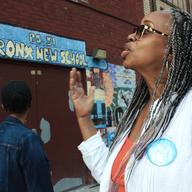
More Rules, Little Transparency, in City's Patrolling of Toxic Schools
In 1991, when a group of parents at the progressive Bronx New School wanted to find a larger, permanent site for their young elementary school, the city leased a vacant building: a former lamp factory in the Norwood section of the borough.
At first, the building seemed to work well for the progressive style of education the school had become known for. But soon enough, students started getting sick. They would go to the nurse with headaches, nausea, dizziness. But few suspected it was the building that was at fault.
“She kept saying to me, 'You know, the school’s giving me a headache,'" Kelly King-Lewis, a former Bronx New School parent, said of one of her daughters. "I thought she meant, 'You know, like, it’s getting on my nerves.'"
Then, in 2011, the city Department of Education tested the air in the school because it was ready to renew the lease. (It was not required to test when it first leased the building.) What it found came as a shock: In the cafeteria, a cancer-causing toxin called TCE or trichloroethylene was measured at 10,000 times above the state authorized level.
Later that year — too late, according to many parents — the city announced the results, shut down the building and moved the school a few miles away. School Chancellor Dennis Walcott apologized and the School Construction Authority promised this scenario would never happen again.
Five years later, advocates and environmental engineers say the city appears to be monitoring problems more closely, but that it’s hard to say that for certain.
“The central fight was always about how far the Department of Education was going to go to improve their controls and manage the monitoring,” said Dave Palmer, who campaigned for more transparency around the issue while he worked at the New York Lawyers for the Public Interest. He is not convinced the transparency now around the issue has improved.
Exposure to TCE, a metal degreaser commonly used in industry, can affect the central nervous system, causing dizziness, headaches and other symptoms in the short-term. In the long term, kidney, liver and cervix cancers have also been linked to TCE.
Few Details Released
As a result of the Bronx New School episode, the School Construction Authority amended its policy and now requires environmental testing and a review process when it first leases buildings, as well as during lease renewals and when it builds a school from scratch.
In addition, the City Council passed Local law 12 in early 2015, requiring the education department to publish links to all environmental inspection reports on its website within 10 days of receiving them.
But it is debatable whether the Department of Education has lived up to that standard of transparency. A spokeswoman told WNYC that it posted 45 notifications of environmental issues found through such tests. But those notifications were only posted on the websites of the individual schools affected, rather than the central department website. The spokeswoman was not able to provide links to WNYC for examination, and because there are more than 1,000 public schools in the city, it is virtually impossible to find those notices online.
The spokeswoman, however, said,"We strictly adhere to the reporting and notification requirements of Local Law 12."
Last November, the city did print a list of affected schools on the department’s central website, but it list only gives one line about each school listed, and no information about the levels of toxins.
Some environmental engineers also find fault with the extent of testing that the school system is undertaking. Guidelines from the New York State Department of Health recommend that, except under unusual circumstances, at least one air test should be done during winter, when toxic fumes are more likely to accumulate indoors because doors and windows are closed.
But Lenny Siegel, an environmental engineer known as the leading national expert in soil vapor intrusion who tested the Bronx New School site said New York City does not seem to be following that guidance.
“Most of the sampling that I’ve seen for the leased school sites were done in August,” he said.
A spokeswoman for the education department said it followed state guidelines, but did not address the question of when testing was done.
"Working with our professional independent environmental consulting firms, we determine the best course of action based on site conditions, surrounding areas and use of professional judgment, while following the guidance given by [state department of health] and other regulatory entities," the spokeswoman, who did not want her name used, said in a statement. "When there is cause, additional rounds of sampling are conducted."
The long-term effects of the contamination at the Bronx New School are still not known. A year after the Bronx New School closed, an 11 year-old former student died of kidney failure. One teacher’s aide was diagnosed with cancer. A pregnant teacher had an abortion after she found out the fetus was severely deformed. Both filed lawsuits and settled out of court.
But there’s no proof that the exposure to the chemicals caused these health effects. Barents tried to create a registry or longitudinal study that might have established any pattern of illness, but they failed.

WNYC is funded by sponsors and member donations