
The Hudson Is Full of Tiny Plastics. And You May Be Too.
Every hour, hundreds of thousands of tiny plastic pieces — each one roughly the size of fine glitter — pour out of the Hudson River and into the ocean. Scientists fear that the particles, and the toxic chemicals that bind to their surfaces, are entering the human food chain via the fish we eat.
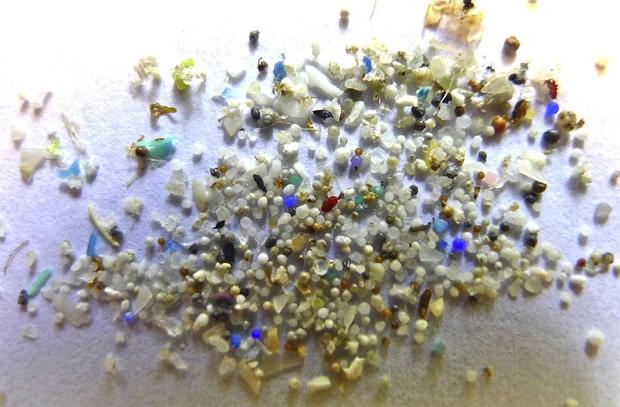
Sherri Mason, a chemistry professor at the State University of New York at Fredonia, recently found that the Hudson River has 62,000 particles of plastic per square kilometer, according to samples taken off of New York City last fall by the environmental group Clearwater. (By comparison, Lake Erie has less, at 46,000 per square kilometer, while Lake Ontario has many more at 280,000.) The vast majority of the microplastics in the Hudson are from products we shed over the course of our day to day lives: plastic bags, food wrappers, cigarette butts, Styrofoam coffee cups, even the fibers from washing synthetic clothing. Weather, waves and sunlight break down this trash into smaller and smaller pieces.
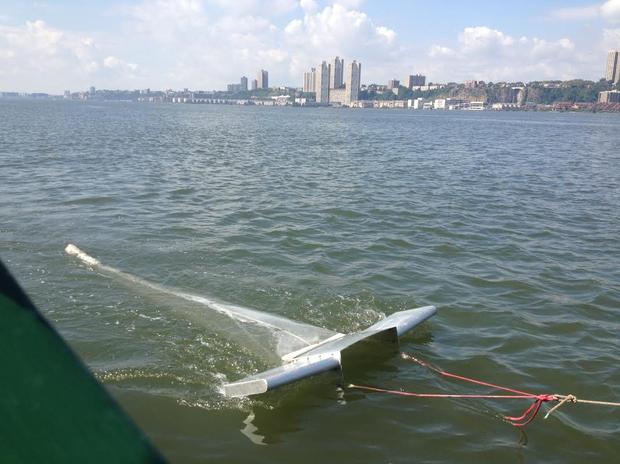
Some good news is that, according to Mason's research, only about 3 percent of the Hudson's plastics are microbead pellets — plastics added to exfoliating consumer products like toothpastes and facial scrubs. (High counts of microbeads are turning up in some of the Great Lakes, sparking a movement to ban them.) Still, she says, all of this plastic is getting eaten and working its way into the food chain.
“We’ve looked at 18 different species of fish at this point and every species has had some amount of plastic within it,” Mason said. "The main concern with regards to plastics is their ability to act as a vehicle to move synthetic chemicals from the environment into the food chain and up the food chain."
Asked if she would find microplastics in people also if she cut them open, Mason replied: "I get asked this question a lot more than you'd think," and then, "Probably."
Some studies have shown chemicals found on microplastics — including PCBs, which have been linked to cancer, hormone disruption and immune system problems — can move into the bodies of fish, but the overall threat to humans is less clear.
“At present it is uncertain how much of an impact the plastics have as shuttles of contaminants into the human body,” said Rolf Halden, an engineering professor at Arizona State University and director of the Center for Environmental Security there.
Halden sees microplastics as a reason for concern but says that industrial pollutants are so endemic, it is hard to determine the source of humans' exposure to them.
“The contaminants that have been identified on plastics, they are quite ubiquitous," he said. "You find them in house dust, ambient air and sometimes drinking water.”

WNYC is funded by sponsors and member donations