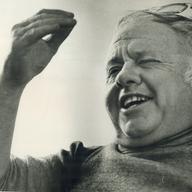
Mickey Rooney
Douglas Cooper and George O’Brien met with Mickey Rooney in Manhattan, as he prepared to open in a new comedy in nearby Westchester.
The Interview
Mickey says he's established the Creative Endeavor Schools, so young people can develop their creativity. These aren't acting schools. The intention is to bring out whatever latent abilities each individual possesses.
He shifts to a diatribe on MGM's That's Entertainment! "It's overbearing of them, say in my case, to take the Hardy Family, Stable Mates, Boys Town. Isn't that groovy? I say, reimburse us for That's Entertainment!
The truth is, the championing today of family films, it's all hypocrisy. Everybody says they want a romance, or an epic or buddy films, but they really want action. Tough talk. What is The Exorcist but a spook film with dirty talk?
You go to the bookstore. The promotion doesn't say, The book everybody should read, but The book NOBODY should read. Then, oh, my, why shouldn't I read it? That's where it's at!
I tour in three plays right now: there's Three Goats (short for Three Goats and a Blanket--about to open), Show Boat, No Sex, Please. Then I just returned from Israel doing a picture, Rachel's Love." He tells us about the film and about the Israelis living crop-to-crop with Arabs.
Mickey pivots, to talk about Watergate. "In Europe they think we're crazy. If he did something wrong, vote him out of office! The Senate Committee keeps coming up with 23 or 44 or 56 opinions on an OMELET. I agree with what Mr. Sandman (Charles W. Sandman, Jr.--NJ) asked. Again, What'd he [Nixon] do? What'd he do?
Look at inflation. It's caused by rising taxes, over-taxation. Every year we have a new set of tax laws. This used to be a calling, now a lot of these guys are on the take. A politician is asked how he's got a $300,000 house on a $27,000 salary. He says, 'I skip lunch.’ "
_______________________________________________________________________________________________________________
The Douglas P. Cooper Distinguished Contemporaries Collection (1967-1974) contains rare interviews with influential writers, statesmen, artists, songwriters, journalists and others who have left their mark on our culture.
The Origins of The Cooper Collection

WNYC is funded by sponsors and member donations