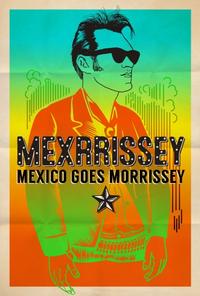
Mexico Loves Morrissey! But Why?
Morrissey’s connection to Mexico, and especially Mexican Americans in California (where he lived for many years), is no accident. Or rather, it might have been an accident at first; but by now it has become something more intentional. The show “Mexrrissey: Mexico Loves Morrissey,” which premiered recently at the Barbican in London and is coming to WNYC’s RadioLoveFest at BAM this Sunday, is just the latest chapter in an unexpected story. So why does Mexico love Morrissey?
Both with The Smiths, and in his solo career, Morrissey has delivered songs that wear their emotions on their sleeves, in the bright Technicolor of a Mexican telenovela. For a guy whose love life and sexual orientation have long been shrouded in mystery and rumor, he certainly projects the kind of larger-than-life emotion that you can pick up on even if you don’t fully understand the language. (Even native English speakers often get the feeling of a Morrissey song before they get the full content—I know that’s been the case with me, for sure.)
So originally, I think Mexican and Mexican-American listeners first responded to Morrissey because they heard, or felt, something familiar in his songs. Mexican rancheras, for example, are often hugely melodramatic—tales of forbidden love, or lost love. For listeners who grew up with this enormously popular sound, it might not have seemed such a leap to listen to this English singer who sounded like he was about to start sobbing at any moment.
It’s also tempting to think there might be socio-political reasons for Morrissey’s appeal to this particular audience. The economic background of a working class Manchester kid in Thatcher’s England was not so different from that of a middle class Mexican kid in the 1990s. The alienation and anxiety of disaffected and often unemployed youth, the feeling that your options are severely circumscribed and that the state has failed you—I wonder if that could be sensed by Morrissey’s earliest Latino fans? I hesitate to make any declarations because I’m not sure those ideas were sensed by his earliest English-speaking fans, and because most listeners usually don’t respond to music they love by immediately researching its origins and context. But maybe we feel those things as part of the songs that we respond to most deeply.
Anyway, that’s speculation. Now let’s get to the facts. First, Morrissey is a smart guy. He might even be as smart as he thinks he is. So when his career hit a relative lull in the late 90s (he had no recording contract for several years around the turn of the century), he made sure to reach out to this unexpected but loyal audience. He released a collection of his videos called Oye Esteban (Esteban being the Spanish form of Steven, Morrissey’s first name) and set out on the “Oye Esteban Tour,” which took him through Mexico and South America. And when he began recording again, he wrote songs that spoke to the Mexican and Mexican-American communities.
“Mexico” is a politically direct song about white privilege and has lines like “I can feel the hate/from the Lone Star State.” A less obvious and to my ears better song is “The First In The Gang To Die,” which talks about gang life in East L.A. It sounds like a modern, English-language take on the corridos, the story-songs of Mexico, which are often full of doomed but noble outlaws and flawed heroes. And then there’s “Irish Blood, English Heart,” an acidic take on immigration which brilliantly uses Morrissey’s own experience as the child of Irish immigrants growing up in England as a way of connecting to Latino kids growing up in the States.

There might be one other factor to consider, which I readily admit seems less important but which I will mention because I cannot pass up a chance to talk about soccer: Morrissey is a big soccer fan. I would imagine this plays well with soccer-obsessed Mexican and Mexican-American teens, and Morrissey has actually appeared in concert wearing the uniform of Chivas, the historic Mexican team based in Guadalajara. (Morrissey has not been above the occasional soccer pun, as in the song “Roy’s Keen,” a reference to his cousin, the gifted Irish striker Roy Keane.)
However it happened, Mexico did fall in love with Morrissey. And Morrissey has made sure to give Mexico some love in return. So when Camilo Lara (Mexican Institute Of Sound) and his collaborators, drawn from the top rank of Mexican and Mexican-American musicians, decided to do the show called “Mexrrissey: Mexico Loves Morrissey,” they weren’t concocting some crazy or gimmicky scheme. It is a reflection of a relationship that has lasted almost 20 years. Which just might mean it’s the longest-lasting love affair Morrissey has ever had.

WNYC is funded by sponsors and member donations