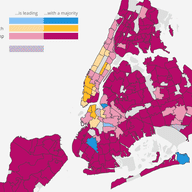
MAP: The New York Primary by NYC Neighborhood
As the votes come in for the New York state presidential primary, we're watching how the candidates fared in New York City neighborhoods.
Motivation and Methodology
Our aim was to provide a picture of which parts of the city voted for which candidates — particularly in the Democratic primary, since Democratic primary voters vastly outnumber Republican primary voters citywide.
From a conversational standpoint, it makes sense to count votes by neighborhood. From a computational standpoint, that's tricky to do, because the precise boundaries of New York City neighborhoods are notoriously difficult to define.
We settled on New York City's map of Neighborhood Tabulation Areas, which is imperfect but divides the city into roughly equal population chunks. Votes are counted and sent to us via the Associated Press by New York City election districts, which tend to span just a few blocks. We calculated which election districts fit into which Neighborhood Tabulation Areas. Where districts straddled two or more neighborhoods, we placed them in the neighborhood in which they had the most square area. We renamed "North Side / South Side" to "Williamsburg" and "Williamsburg" to "South Williamsburg" for clarity.
The city combines the votes of some districts into one "parent" district, so we assign all of those votes to the parent's neighborhood.
The boundaries in the map above follow the contours of election districts we've put in the same neighborhood given these rules, which means that a few of the neighborhood outlines get a little funky.
We've also clipped out water, parks, airports and cemeteries, and dropped election districts where the city Board of Elections reports no registered voters.
Vote counts via the Associated Press.

WNYC is funded by sponsors and member donations
Top Stories From Gothamist
‘Still incomplete': Key questions unanswered on New York state budget
Gov. Kathy Hochul says she’s reached a “general agreement” on a New York state budget — but major policy proposals still aren’t settled, including Democrats’ plan to tax pieds-à-terre in New York City.
The Democratic governor said Thursday that she has had productive talks with leaders in New York City, but it’s proven tricky to determine a method for assessing the high-value second residences that she and Mayor Zohran Mamdani seek to tax.
As a result, basic details like the rate of taxation or exactly how many housing units will be affected still aren’t settled, the governor and her aides said.
What was supposed to be a victory lap instead laid bare the difficulty of taxing wealthy individuals who employ accountants and lawyers to minimize their bills.
“They have certainly managed the tax system at all levels to their benefit,” said James Parrott, a left-leaning economist and senior adviser at the New School’s Center for New York City Affairs.
Assembly Speaker Carl Heastie, a Bronx Democrat, said he had “no details” about the tax. He criticized Hochul for prematurely announcing a budget agreement.
“Even on the policies that she put out there today, some of these things are still incomplete,” he said.
Heastie and Senate Majority Leader Andrea Stewart-Cousins had both supported a tax on pieds-à-terre before Hochul said she wanted to tax residences worth more than $5 million whose owners live outside the city. The plan would capture Russian oligarchs who own property in the five boroughs, as well as President Donald Trump, who has a gold-plated triplex on Fifth Avenue, Hochul said.
Parrott, who sat on a commission convened by former Mayor Bill de Blasio to examine the city’s property tax system, said these kinds of properties are generally assessed at a lower value than they sell for.
Hochul described the city’s current property tax system as “bizarre” and said she was trying to find a new way of determining the values at which to apply the new tax. The goal remains to raise $500 million for New York City, she said.
“Properties that are worth $200 million, for example, could be assessed at $7 million,” she said. “We’re looking at the difference between what is currently assessed but also market value.”
James Whelan, president of the Real Estate Board of New York, said the difficulty should give state lawmakers pause. “Poorly designed or hastily implemented taxes risks reducing, rather than increasing, overall revenue for the city, state and the MTA by discouraging investment and transactions,” he said.
Mamdani said he will propose an executive budget on Tuesday. He’s relying on the state to help fill a $5.4 billion deficit, and said that he was satisfied things are moving in the right direction.
[object Object]“A lot of those conversations are ongoing, and we've said time and again that we're confident in that [pied-à-terre] tax's ability to raise half a billion dollars a year, which will be critical in putting the city back on that firm financial footing,” the Democratic mayor said.
Progressive groups cheered Heastie and said the still-unfinalized budget provided an opportunity to push for income tax hikes and more spending.
Hochul acknowledged that there is no agreement on whether New York taxpayers will pick up the tab for nearly 500,000 people set to lose state-backed health insurance because of a federal law passed last summer.
“We have yet to see details on how New York will close the budget gaps of cities across the state, raise progressive revenue, or stop New Yorkers from losing their healthcare coverage,” Working Families Party co-Director Jasmine Gripper said in a statement.
Fiscal watchdogs said Hochul’s announced $268 billion price tag was too high.
“The governor provided a smattering of details on state finances — but to be clear, we have yet to see a budget,” Citizens Budget Commission President Andrew Rein said. “What we do know is that the budget is bigger, but not likely better for fiscal stability.”
In addition to the question of extending healthcare coverage, another major unsettled variable has to do with sweetening pension benefits for public employees hired after the Tier VI retirement law passed in 2012.
Unions are seeking changes that would let people retire with a full pension at 55 instead of 63 and reduce their required contribution rates. Their plan has a $1.5 billion price tag, much of which would be borne by local governments to which the state is sending bailouts.
Hochul proposed moving the retirement age to 60 and reducing contribution rates by half a percentage point, according to three people familiar with her negotiations with legislators. That idea was rejected, two other people familiar with the talks said, and lawmakers are now trying to reach an agreement on pension sweeteners that will cost around $500 million.
The governor said she is trying to balance the ability to recruit public employees against additional costs.
“We are willing to look at this and make changes, but a much more scaled-back, monetarily, proposal,” she said. “We'll release those numbers as soon as it's absolutely done.”
The New Yorkers thriving during the city's off-peak times
The column first appeared in Looped In NYC, a newsletter to help New Yorkers make sense of the city. Sign up to get the email which also features event listings, NYC news to know and a reader photos.
All respect to the sheeple out there grinding away from 9 to 5 before tucking in for their doctor-recommended eight hours, but this is New York City: a place where you can also thrive while working or playing at weird hours!
As a 12-year veteran of the early morning news shift, I’ve long been an appreciator of off-peak city life. The pre-dawn R train full of napping ironworkers. The midday Central Park suntanning session. The near-empty 2 p.m. Trader Joe’s.
[object Object]I could count on two hands the number of times I passed the same couple doing it al fresco outside a certain restaurant during my 4:30 a.m. walks to the train.
Whether your favorite off-peak activities are done alone or with a partner, fully clothed or less so, we asked “Looped In” readers: How do you take advantage of the city at odd hours?
It wasn’t exactly a surprise to learn that off-peak chores are a hit.
Reader Sam Shapiro takes advantage of a “Free Dry Thursdays” promotion to get his laundry done midweek.
And Sandy Naidich likes to get her grocery shopping done at 2 a.m., when the crowds are gone and you can count on the shelves being fully stocked.
“The other [day] I was in Whole Foods and they were out of mint,” she lamented. “Late at night, you never run into that problem.”
Then there are the off-peak exercisers.
Mihalis Alisandratos said he gets his cycling in between 10 a.m. and 4 p.m., when the roads have fewer cars and the park loops have fewer pedestrians. Will Kang plays midday pickleball.
And Nate Maretzki, a Columbia University undergrad, said he schedules all his classes around midday trapeze sessions at the New York Circus Academy in Bed-Stuy.
“Looped In” tagged along last week for a class, where we also met a Long Island retiree, a stagehand for “The Rocky Horror Show” on Broadway and some people “with jobs” getting their swings in.
[object Object] [object Object]“The midday crowd, we get people skipping work, faking doctor’s appointments,” said instructor Sam Hart. “I’d say the midday crowd is more dedicated.”
Keeping weird hours doesn’t have to dampen your social life. Glenn Krasner, a doorman who works from 4 p.m. to midnight, Friday through Tuesday, said he and his fiancée (single off-peakers, there’s hope!) take advantage of their odd schedules for easier date nights.
“Valentine’s Day, for instance, fell on a Saturday this year,” he said. “So we celebrated the Wednesday before — we went to dinner and a Brooklyn Nets game.”
But for others, having some prime alone time in a city of 8.5 million people is its own treat. Graham Schranz, a self-described introvert, said he hits the road late at night — and even when the streets are empty, he keeps it slow just to take in the sights.
“If driving in New York by day is a constant overlapping cluster of frustrations, then driving by night feels like you own the city,” he said.
P.S. Comment on our video with how you like to take advantage of NYC off-peak.
Nigerian immigrant sues ICE after his arrest sparks chaotic protests in Brooklyn
Lawyers for the Nigerian immigrant whose weekend arrest by U.S. Immigration and Customs Enforcement agents sparked protests in Bushwick have filed a petition in federal court challenging his arrest and detention.
The lawsuit filed on Chidozie Wilson Okeke's behalf alleges masked ICE agents “unlawfully, brutally and violently detained” him as he was entering his parked vehicle Saturday night. The suit, filed on Wednesday, accuses the federal officers of beating and "tasing" him.
After the arrest, federal agents transported Okeke, who is accused of overstaying a tourist visa, to nearby Wyckoff Heights Medical Center, where hundreds of protesters massed outside and some later attempted to block an unmarked government vehicle with Okeke inside from leaving.
The petition asks a judge to order Okeke's immediate release, citing due process violations. Okeke is being held at Metropolitan Detention Center in Brooklyn. The petition further asks that the federal government be barred from relocating Okeke. It alleges the ICE agents lacked probable cause and a proper warrant for the arrest.
A Department of Homeland Security spokesperson said in a statement that the officers acted properly and denied that they beat or used a Taser on Okeke. The spokesperson said Okeke refused to comply with the officers’ demands to leave his car and “weaponized his vehicle” to try to hit the officers.
The spokesperson also alleged that Okeke tried to punch and elbow the officers. The statement said the officers responded with the minimum force necessary to make the arrest. The officers transported Okeke to the hospital after he requested medical treatment, the spokesperson said.
Okeke’s initial arrest and then the chaotic scene outside the hospital were captured on videos taken by bystanders and freelance photographers, and posted on social media.
Video of the street arrest, shared by the nonprofit New York Immigration Coalition, shows federal officers pulling a man later identified as Okeke out of the driver’s seat of a stopped vehicle. Later, video taken by freelance photographer Dakota Santiago shows federal officers dragging a prone Okeke out of the hospital and putting him in another vehicle.
An NYPD spokesperson said eight people were arrested during the Saturday night protest and charged with resisting arrest, obstructing governmental administration, reckless endangerment, and criminal mischief. Another person was given a summons and released.
Other videos from the weekend events spurred criticism of the NYPD.
A widely seen video shared on social media by editor Patrick Hilsman of Turning Point Magazine showed an NYPD officer throwing a demonstrator to the street. At an unrelated press conference on Monday, Mayor Zohran Mamdani said the video was “incredibly disturbing” and that the officer’s actions are being investigated.
The NYPD also transferred police Capt. James Wilson after he was caught on video disparaging Mamdani, calling him “an embarrassment,” “total nonsense,” and “not my boss” while speaking with people in the crowd. During the exchange, he added: “All Democrats: a waste of human race.”
Department policy prohibits officers from publicly expressing personal views about a political party while they are on duty, an NYPD spokesperson said, adding that disciplinary proceedings for the officer are ongoing.
Video showing the NYPD clearing the roadway of debris and protesters and allowing ICE to transport Okeke away from the hospital also prompted concern from local lawmakers and immigration advocates, who questioned whether the officers’ violated the city's sanctuary laws prohibiting city resources from being used for immigration enforcement.
Mamdani said the NYPD did not coordinate with ICE in the agency's civil enforcement, and that police officers were instead responding to protests.


How to Avoid Sneaky Phishing Scams


Justice for Epstein Victims Through NYS


New Doc Celebrates NYC's Weird and Wild Public Access TV Experiment

WNYC is funded by sponsors and member donations