Christian Rap Pioneer Jurny Big On Being Revered And Forgotten
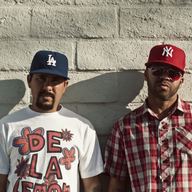
There's three reasons you may not know Jurny Big: he’s a gritty battle rapper, he’s old, and he’s Christian. Praised by his fans as the best Christian rapper ever, Jurny Big is known for his one-on-one competitions -- where one MC proves they're more skilled than another with intricate rhyme patterns, metaphors, and punchlines. On The Change Up, the just-released third record with producer Peace 586 as The Battery, Jurny Big showcases that Eminem-like acerbic wit -- but also a liberal Christian perspective that sets him apart from the hip-hop mainstream.
The Southern California native got his start as a founding member of The Tunnel Rats, a supergroup collective of Christian battle rappers that formed after the Los Angeles riots in December 1992. Along with Jurny Big’s cousin Dax Reynosa -- the group’s architect and half of their duo LPG -- The Tunnel Rats released three albums including its seminal work, 2001’s Tunnel Vision.
Now, on The Change Up's closing posse track, “Copy Us,” The Tunnel Rats reunite after a ten-plus year hiatus -- and remarkably demonstrate the same brash confidence.
But the group was also harshly criticized by many peers for boasting in their rhymes and collaborating with mainstream artists like hip-hop scholar KRS-One -- something, hypocritically, many Christian rap artists also do.
Yet, despite Jurny Big’s revered status and current projects, he still stands in the shadows of Lecrae -- the genre’s biggest-selling artist -- whose 2014 record, Anomaly, opened at No. 1 on the Billboard 200 chart. So while Lecrae gets high-profile performance slots, like on The Tonight Show With Jimmy Fallon, Jurny Big receives fan love on Twitter and Christian rap’s long-running water cooler publication, Sphere Of Hip Hop. More, Lecrae represents one of a handful of young Christian artists (such as Andy Mineo) -- who have used the template established by The Tunnel Rats, and another early innovator, Soup The Chemist, to create pop-leaning hits that leave those original pioneers overshadowed or ignored.
In a conversation with Soundcheck, Jurny Big explains the origins of his music and perspective, his work with The Tunnel Rats and his current project The Change Up, and feeling both revered and forgotten at the same time.
Imade Nibokun: The Tunnel Rats were formed shortly after the 1992 riots in Los Angeles. What was conscious hip-hop and social movements like then compared to now?
Jurny Big: Back then, it was like, "Everybody, let’s go! Let’s take a car out to Broadway and Manchester and break some windows." Now, there’s people doing die-ins and laying down. That’s heavy, heavy, stuff. There was some [protests] with the Rodney King thing, but people were so angry that it didn’t get to that point of [mass organized protests]. Not that they’re not still angry now but it seems smarter.
With hip-hop, it seems like, there was more socially conscious rappers back then. They were touching on that stuff even though they were gangsta rappers. Now, it’s few and far between. It’s super important for us to touch on it because you can almost count on one hand the notable [conscious] hip-hoppers: Kweli, Immortal Technique, Common; but there’s still not a ton of them. For us, that’s what we do. We throw Jesus in there, but it’s all positive stuff. It would be best if we could touch on this stuff more. We should be out in the forefront.
IN: The Battery's new album, The Change Up, begins with “Embrace what’s before you.” Why open with that line?
JB: That’s really been on my heart. It irks me. Like I said in the song, you can’t even get a retweet [from younger artists]. [The Tunnel Rats] always had to speak up for ourselves and even other people too. Especially to see how far we gone as a little genre. Dudes are actually making a living? Not actually making a living just staying afloat -- but dudes are actually making some paper. It would behoove them not to forget about people.
IN: Then in the second song, "The Bitter Pill," you say Christian rap is “entertainment for Christian kids, but hip-hop from a Christian is proving that you can live.” Would you say that reflects your mission statement across your career?
JB: When we were coming up, it was one or the other: It was kids that were not allowed to listen to secular hip-hop -- and so they could only listen to Christian rap. We gotta figure out a way to be dope and get into these kids ears so we can get into these other kids ears who aren’t listening to Christian rap because it’s so trash.
So, basically, Christian rap is for Christian kids. There’s a place for it and it’s necessary. But that’s just not where I’m at [now]. Hip-hop from a Christian -- or when you call yourself a rapper who’s Christian -- it kinda sets you up to speak to kids who are not hearing Jesus in their music all the time. If I’m at an open mic and I’m killin’ fools, they’re like "Dang, he’s a hardcore Christian and he’s still killin’ fools!" I seen it first hand, that raises eyebrows from dudes who didn’t grow up in the church, or [are] not privy to who we are.
IN: The track also talks about how you’re “hip to Rapzilla’s agenda.” You’re taking shots at Rapzilla, Christian hip-hop’s most popular website.
JB: I did, but it’s not just them, it's the whole genre. No, it’s primarily them. They kinda jump on the train of one person, and that’s it! They don’t see anything else. I said since the beginning, that’s like taking sand to the beach. Christian kids need entertainment, but at some point you gotta touch on the cats that are taking it to the 'hood. Some of the stuff that Rapzilla puts on there... is terrible stuff. Super pop. It’s not even hip hop.
The kid, RationaL, that I talk about in the song. He actually had this super dope song. It kinda talks about the history of [the] Toronto Blue Jays. The Blue Jays were interested in it and wanted him to perform it there. He was super geeked about it and he approached [Rapzilla to pitch his song] and they were like, "Nah, I know the people that you run with." When I heard that, I was like, "Are you kidding me?" This kid calls me up for prayer, for advice, for just some encouragement. And he’s going to get it from me. But why isn’t he getting it from y’all? The fact that they wasn’t there for this kid really hurts me.
IN: In Christian hip-hop, if often seems like people have a beef with you, but in a passive way. Can you speak to this subtweeting culture in Christian hip-hop?
JB: That’s the weirdest thing ever. It speaks to a broader issue that Christian hip-hop has. Inherently, hip-hop is vain. You gotta get on there and brag; that’s really what makes you dope. But in Christian hip-hop, you can’t do that. You’re automatically set up to fail.
There was no L.A. Symphony on “Same Team” [popular Christian hip-hop song with remixes featuring different rappers]. There’s no Tunnel Rats on there. I think there’s shade, and the problem is that people don’t want to come out and stay it. Which makes the [conflict] keep going. Just put it out there and let people deal with it.
I don’t have a problem telling somebody. Like in “Bitter Pill,” I’ll mention a name. I don’t have a problem with that. I get that "Same Team"-type stuff -- but is that even real? I’m not even throwing shade toward the "Same Team" dudes, but it’s really not real.
IN: You mention Christian hip-hop’s most popular rappers, Lecrae and Andy Mineo, but you had some positive things to say.
JB: When I was younger, it was opposite to be a 100 percent honest. I would have been like, "Nah, they’re wack, there’s no place for it." But there is. There should be Christian rap in everyone’s ear. Even the little 13-year-old kids in youth group. They need to be entertained. That’s why I don’t understand why these guys get so much hate. Who cares what [Lecrae] calls himself. Listen to the music. I think what he does is so dope. Working with big-name secular producers? That’s super dope.
IN: You guys paved the way in doing the same thing 20 years ago.
JB: And getting flack for it. I love what Lecrae and Andy Mineo are doing though. They’re doing the same thing, but bigger. I love watching Andy Mineo on Sway In The Morning. That makes me so happy because I know even if he don’t acknowledge it, or nobody acknowledges it, I know I had something to do with that.
IN: You were very personal with “His Shoes” and put your childhood on the table.
JB: With that one, I said, maybe it would do me some good to put it out and obviously some other people. The relationship between the dad and the son is rough. Men are so wacko that there’s this macho type thing that we have to uphold. You can’t show emotion and stuff like that. With my situation, there’s some stuff that my dad did or didn’t do that still affect me. I know that there’s a ton who had it worse than me. It’s a crazy thing.
IN: There was a part in the song where you said you didn’t give your mom “the deets” of what you were doing in the neighborhood. I really don’t know a lot about your B.C. days. Did you run the streets before you started Christian rap?
JB: Seriously, in sixth or seventh grade was when I started getting stupid. Drinking and smoking. I was doing a lot of it. I was a break dancer and trying to learn how to rap. But I was going through it. Whereas some kids start when they’re a junior or senior in high school, I was a little bit early.
[My parents] just didn’t know where I was. My dad was doing his own thing. I remember coming home super, super drunk. I’m in seventh grade! I remember walking into the garage, walking through the garage to say hi to my mom, going back to the garage, and throwing up in the washer because I was so drunk. I remember thinking, later on, "How did you not know?"
They put me into Christian Chapel, a full-on Christian school; a private school. And I had to change, because I didn’t have a choice. I had to get up early to get there and came home late. My friends were different. I wasn’t running around in the hood. And I literally had a bible class. So I was trying to get my life in order at an early age. That’s when I got serious about the rapping stuff. And then later on, I was like, maybe we should start doing this in church.
IN: Does it sometimes feel like you helped pioneer a genre that you now don’t feel a part of?
JB: Some days I question "Am I really a part of this?" We’ve always been at the peripheral of all this, but also at the center of it. Some days I don’t want no part in it -- and sometimes I could be a spokesman for it. The thing about The Tunnel Rats is that you either love us or you don’t even mention us. We don’t even touch your tongue because you’re so appalled by what we do. Or you’re so down for us. And there’s a few people like that. To me, that’s everything. There’s cats out there that straight up love us. They message me: "I was going through some stuff and that’s what got me through."
And even The Battery stuff now, they appreciate. That’s kind of cool. On the good days, I remember those.

WNYC is funded by sponsors and member donations