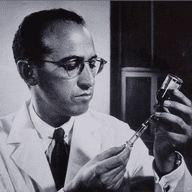
Dr. Jonas Salk
Jonas Salk, developer of the Salk polio vaccine, met with Douglas Cooper in his midtown Manhattan hotel room. Salk has, since 1966, been considered "The Father of Biophilosophy," merging concepts on the frontiers of bio-science with the ideas of humanists and artists to achieve an understanding of man in all of his physical, mental and spiritual complexity.
You find that a knowledge of biology opens the door to greater self-knowledge? Salk says he's able to look at humans from a biological viewpoint. This knowledge provides useful analogies for understanding human nature.
People think of biology, the biology I'm engaged in, only in practical terms. In the future a knowledge of biology will contribute to an understanding of ourselves that will be equally important.
I want men to draw on the scriptures--authoritative writing--of nature to enhance conscious awareness and the capacity to imagine and anticipate the future and choose from among alternatives.
Cooper introduces the fact that Salk's Institute also takes an interest in philosophical topics as well as biological research.
Salk eagerly adds that the Institute was conceived to examine not onlythe frontiers of biological science but
philosophical, cultural, social and psychological problems.
You assert that mankind is at a turning point? Cooper begins. Salk does see an inflection point, a fork in the road where we can become more constructive and creative, or lose out to greed which stifles others' achievements. He feels so strongly about this dichotomy that he refers to the current Epoch as A and the emergent Epoch as B.
This inflection point is the result of accelerated population growth, and the laws of nature in living systems. And by analogy, for human beings, this point is followed by changes in values, attitudes and behavior.
[Dr. Salk expands on this theme in two recent books, Man Unfolding and Survival of the Wisest.]
How do you get mankind to work toward future goals one can't imagine? Salk acknowledges that there are those more capable than others and the key is to enlarge the pool of those who will take or imagine concrete steps into the future.
Then it's a select group you call upon? He agrees. People aren't equally endowed. The idea is to appeal to those with whom these ideas resonate, and to reinforce everyone able to contribute.
Cooper asks Salk if the kind of cooperation that's needed is liken to detente between nations. Salk says it is. It's more than cooperation, it's a coalescence. It's a win-win strategy, whereby if you win, I win.
Cooper asks what role Salk is going to play, and he says he'll be an "inducer," that is, he'll address the concrete choices with high school and college students. They're the ones with a future entirely ahead of them. They take a challenge. Like being on a surfboard, you take the risk and see how far it will carry you. They're the first generation in Epoch B.
Is there a fear of responsibility for those who accept the challenge? He says that among older adults there may be, in that they don't think they have the time to see it through. Young people don't have that fear.
_______________________________________________________________________________________________________________
The Douglas P. Cooper Distinguished Contemporaries Collection (1967-1974) contains rare interviews with influential writers, statesmen, artists, songwriters, journalists and others who have left their mark on our culture.

WNYC is funded by sponsors and member donations