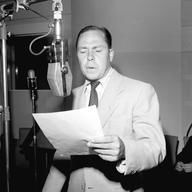
Johnny Mercer
PART 1
PART II
In 1969, Douglas Cooper met lyricist Johnny Mercer at the train from the City to New Rochelle, New York. On that visit with mutual friends, Mercer gave Cooper several hours, and later wrote to him (somewhat awkwardly) that, "It was the best interview I ever had taken."
The Interview
I asked Mercer when he got started. "I began singing and lyric writing in high school, but it was mostly scribblings from which I learned vocabulary and rhyming. I also booked musical entertainment on campus."
Mercer told me about his early songwriting and lyric writing in New York, where he wrote his first hit, Lazybones; his split of the royalty was $1250. He joined ASCAP and met the greats of Tin Pan Alley: Cole Porter, George Gershwin and Irving Berlin.
In California, he became fast friends with Bing Crosby and wrote words and music to I'm an Old Cowhand for him. Mercer told me he liked to party, and had great fun at Hollywood parties. That same year ('37), he turned out Goody Goody.
"The next year I joined forces with Harry Warren, and we wrote Jeepers Creepers for Louis Armstrong. You Must Have Been a Beautiful Baby was big that year too". Mercer became a fill-in emcee on the Camel Caravan and had five of the top ten hits on another popular show, Your Hit Parade. He met Harold Arlen and they wrote Blues in the Night in 1941, followed by his first Oscar with On the Athchison, Topeka and the Santa Fe.
Mercer told me that when he founded Capitol Records in 1942 there was a lot of un-signed talent around. He latched onto Nat King Cole. Mercer continued to mostly write lyrics after the melody, although he sometimes wrote side-by-side.
In 1961, he wrote Moon River and followed it with Days of Wine and Roses, capturing his third and fourth Academy Awards. In 1969 he helped found the Songwriters Hall of Fame.
_______________________________________________________________________________________________________________
The Douglas P. Cooper Distinguished Contemporaries Collection (1967-1974) contains rare interviews with influential writers, statesmen, artists, songwriters, journalists and others who have left their mark on our culture.
The Origins of The Cooper Collection

WNYC is funded by sponsors and member donations