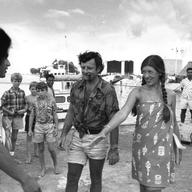
John Fairfax and Sylvia Cook
The Douglas P. Cooper Distinguished Contemporaries Collection | Dec 31, 2015
Doug Cooper and George O’Brien convene at the Royal Manhattan Hotel to debrief Fairfax and Cook on their nearly year-long course across the world's largest ocean, as told in their memoir, Oars Across The Pacific.
The Interview
The first thing I asked John Fairfax was whether his trek across the Atlantic in 1969 increased or decreased his interest in the Pacific venture, which was even further, 8,000 miles. Fairfax said that when he was first to travel that ocean alone, in Britannia I, the main thought he had was that he would never again make such a trip alone. He would take a teammate, a woman. He felt that women had tremendous moral strength and self-reliance.
George asked if the psychological tax wasn't as great as the physical hardship, and Fairfax responded that at times it was. He said that with a stalwart partner like Sylvia Cook, there was a tendency for one to be "up" when the other was "down".
Sylvia said her biggest fear came when John was bitten by a shark and bleeding. He climbed back aboard the thirty-five foot Brittania II completely pale, white. She cried, thinking he would die. Yes, people thought we were grandstanding, but the dangers were real!
George O'Brien asked if their trip entailed many times the risk of American sport? Sylvia said she thought that mountaineering was just as dangerous. She felt the common denominator for both was tremendous optimism.
We share a laugh over Sylvia's naïveté at the outset. She didn't know the difference between port and starboard. As they left San Francisco Bay, there was a 25 knot wind and tidal currents. John called, "hard a starboard," and Sylvia veered hard a port. Finally, they rowed out in the middle of the night, when there was no wind or current.
Their first major test was a gale that lasted for five weeks. Despite the fact that they had a self-bailing boat, they were damp and cold and had to cuddle up in a compartment they called a "rat hole." Sylvia had agreed to go before she even saw the boat.
Then they cracked the rudder and had to come ashore at Ensenada, Mexico in Baja California. Sylvia had only good things to say about how they were treated. John agreed, but pointed out that there was a theft of cameras and film. He went on to say that by the end of the voyage, the seas overtook 90% of their film.
George asked why they'd written so casually about their hardships. John said that they wanted to tell exactly what had happened, unexaggerated, and let readers use their imaginations.
George exemplified their "cool," by pointing out that Sylvia took a snapshot of John's just-acquired shark bite. John explained that it could have been traumatic, with his trying to gut a shark while spear fishing, but he used the camera as a way to divert Sylvia's fears, as his 6" bite bled profusely back aboard.
We wound up the discussion with comments on the hurricane they'd encountered, the logistical struggles and the reef they got caught on. Both said that it took will, energy and inventiveness, and there was no pay big enough for these satisfactions. The challenges of city life had no appeal, they concurred.

Douglas P. Cooper
WNYC is funded by sponsors and member donations