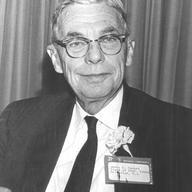
James Bryant Conant
Douglas Cooper met with Dr. James Bryant Conant, in his New York Apartment, to discuss his then-current memoir, My Several Lives: Memoir of a Social Inventor.
The Interview
Cooper asks Dr. Conant if his "several lives" didn't often overlap. He responded that it was true he often had concurrent responsibilities, and he gave the example of the war years, when he was traveling to Washington to assist with war decisions, then back to Harvard to tend his reform agenda without ever being deemed "acting" President of Harvard; he kept the full title, "President" for twenty years.
Those were tough years he told me. His favorite period was as a young, carefree chemist, after he'd served in World War I, developing poison gases.
I stopped him there and asked about his rise through the ranks researching the physical structures of natural products, like chlorophyll. He downplayed that work, but the fact is he received the highest award in the field, the Priestly Medal.
I asked about the major changes he'd made at Harvard. He had brought women into the Law and Medical Schools, dispensed with the Latin requirement and athletic scholarships and instituted an "up or out" policy for professors, under which they succeeded or were dropped.
I asked about his role in the atomic bomb. He had become Chair of the National Defense Research Committee in 1941, overseeing the Manhattan Project.
We went on to talk about his post war role as High Commissioner to Germany and the first Ambassador to West Germany. He oversaw the restoration of German sovereignty.
We then talked about his last career, as both a critic and a proponent on education. I asked him about a Time cover on his work captioned, Education Must Have Relevance. He said that the old curriculum requirements had to be dropped in favor of a practical education for high school students who weren't seeking professional careers. He felt that format should be practical, relevant and vocational. What is the relation of formal education to manual labor, he asked. We need to question, for young men and women who are not going to college, what kind of experience should they have?
Behind the Scenes
By the time I saw Dr. Conant, he was age 77. He'd received over fifty honorary degrees and the Medal of Freedom. Yet, as I'd observed so often, once an individual of such renown had retired and no longer held an official capacity, and had reached an advanced age, they could no longer command attention around a subject that interested them.
In Bryant's case, he asked over and over if he could talk about his plan for enhancing education in New Jersey. I said, certainly. But one of the important lessons I learned, especially spending so much time with septuagenarians and octogenarians, was that there was but a thin veil between adulation and ageism.
_______________________________________________________________________________________________________________
The Douglas P. Cooper Distinguished Contemporaries Collection (1967-1974) contains rare interviews with influential writers, statesmen, artists, songwriters, journalists and others who have left their mark on our culture.
The Origins of The Cooper Collection

WNYC is funded by sponsors and member donations