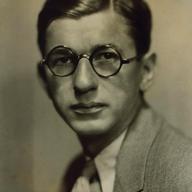
Irving Caesar
Douglas Cooper and George O'Brien discuss lyric writing with songwriter Irving Caesar in his office at the Brill Building in “Tin Pan Alley" (defined in Behind the Scenes, below.)
The Interview
O'Brien introduces Caesar as one of the country's most noted lyricists. Caesar names a few of his old popular songs: Tea for Two, Swanee, I Wanna Be Happy, Sometimes I'm Happy.
Cooper points out that the latter two were from shows. Caesar says, Yes, but some became hits because of a singer. For example, Swanee became a hit when Al Jolson sang it. I wrote that lyric in 1919, when I was 23 or 24. We never saw the Swanee River when George Gershwin and I wrote that. It runs through a part of Georgia and northern Florida.
Cooper reiterates that the singer made the song. Caesar asserts that singers always make the song, as long as it's a part of his repertoire. Look at Mami, April Showers, Sonny Boy. Those are pure Jolson!
Cooper says Yeah, but Jolson is gone and your songs for No, No Nanette were introduced in 1925 and the show goes on today. Caesar says the show is currently playing in London, Stockholm, Sidney, Denver and other cities.
O'Brien reiterates that Caesar introduced Tea for Two in that show. Caesar states that a great song is a spontaneous inspiration. He says he wrote Tea for Two in five minutes. Vincent Youmans played me the music five or six times around midnight. This was after I wrote with Gershwin.
O'Brien says that Gershwin was an American classic. Caesar says Gershwin has a niche of his own. We wrote a dozen songs together before I wrote with his brother, Ira. George was a great natural pianist.
Caesar demeans the songs of the day (1973). He says today's songs reflect the decadence in the world. "Tell me what a nation is singing and I'll tell you what a nation is thinking".
Behind the Scenes
Tin Pan Alley is the name given a collection of music writers and publishers in New York City. They dominated popular music in the late nineteenth and early twentieth centuries.
The genre started to grow on Broadway around 32nd Street and ultimately moved north to Broadway between 40th and 50th. The words tin pan came from the sound of songwriters pounding out new songs for music publishers. As film, radio and television grew, other centers of influence gained, and Tin Pan Alley lost, its influence.
_______________________________________________________________________________________________________________
The Douglas P. Cooper Distinguished Contemporaries Collection (1967-1974) contains rare interviews with influential writers, statesmen, artists, songwriters, journalists and others who have left their mark on our culture.
The Origins of The Cooper Collection

WNYC is funded by sponsors and member donations