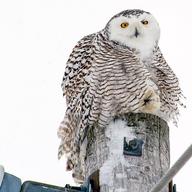
'Irruption' of Snowy Owls Brings Birds Far South This Winter
An influx of snowy owls is expected to land in parts of the Northeast, including New Jersey and New York, over the next several weeks.
Snowy owls, Bubo scandiacus, migrate this far south about every four years in what's called an "irruption," according to Scott Weidensaul, co-director of Project Snowstorm, an independently funded research organization. An irruption results not so much because food is scarce, but rather from an abundance of lemmings, their main prey, in the Arctic the prior summer. This then sparks a successful owl breeding season.
The population of lemmings has a boom-and-bust cycle of approximately four years.
The last irruption took place in winter 2013, and was the largest "invasion" in almost a century, Weidensaul says. It's too soon to estimate this year's magnitude.
"It's really just starting, so we really don't know at this point," says Weidensaul, who lives in Pennsylvania and is a nature writer. "We just know that a much higher than usual number of snowy owls are coming down into the East."
Since 2013, Project Snowstorm has installed trackers on 52 snowy owls to research how they adapt to life outside the Arctic. The first owl of the 2017-18 season, a juvenile female named "Hilton," was tagged in western New York along Lake Ontario. This week, NJ.com reported on a snowy owl sighting in Island Beach State Park, where Snowstorm caught and tagged it "Island Beach."
Snowy owls are individualistic, Weidensaul says. They can be drawn to urban environments, coast lines and wide open farmland.
"It's kind of like saying, 'Why does one person like the city and one person like the country?'" he explained.
Weidensaul says owls aren't used to living in cities and could be impacted by vehicles and airplanes especially. Snowy owls, which have five-foot wing spans, tend to settle in airports' perch-friendly areas. (In January 2016, a court in Manhattan ruled that Port Authority could kill most migratory birds in emergency situations.)
Weidensaul encourages people take advantage of irruption to catch a glimpse of the "Arctic wilderness" while keeping a respectable distance. After all, given their uninhabited homeland, snowy owls aren't accustomed to human companionship.

WNYC is funded by sponsors and member donations