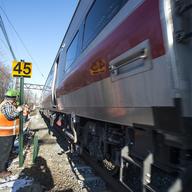
Federally-Mandated Safety System Still Years Away for MTA
Like many other railroads, the MTA will miss the federally-mandated end-of-2015 deadline to install positive train control.
And, like many other railroads, one big reason is financial: It will cost the MTA about a billion dollars to install the system on Metro-North and Long Island Rail Road; the agency only recently secured a federal loan to pay for it. The MTA's PTC system is not expected to be operational before 2018.
"One of the most challenging thing that PTC had for everybody in the industry is that it was an unfunded mandate with an unrealistic schedule for completion," said MTA chief Tom Prendergast last month, speaking at the agency's April board meeting. "There’s a dialog in Congress about extending that, so some relief on the timeframe, but really no money being brought to the table."
But acquiring the money is just one piece. PTC requires multiple radio frequencies — or spectrum — to function, because radio devices on trains communicate with transponders installed along the track. In a densely populated region like the New York City metropolitan area, spectrum is in high demand and short supply, and radio interference is a big stumbling block. The MTA is still working to acquire the spectrum it needs.
It also needs to install the transponders on tracks and antenna on cars, and ensure that its system is compatible with other railroads that share its track, like Amtrak and NJ Transit.
In the interim, the MTA says it has already implemented a number of safety protocols, many of which were mandated by the federal government in the wake of a series of incidents — including the 2013 deadly Metro-North crash in the Bronx.
Since then, the MTA has upgraded signals at five Metro-North curves deemed critical, as well as five moveable bridges. On these locations, compliance with speed reductions is controlled and enforced automatically. All Metro-North and LIRR trains also have alerter devices installed designed to insure that engineers remain responsive. The agency has also instituted a confidential close-call reporting system for employees to anonymously report possibly hazardous conditions, and the MTA is also piloting a program to screen engineers for sleep apnea.
So far, the Federal Railroad Administration is expecting railroads to comply with the 2015 deadline. An FRA spokesman told WNYC it has the discretion to apply penalties to railroads who fail to comply.

WNYC is funded by sponsors and member donations