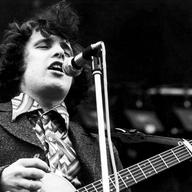
Don McLean
Douglas Cooper interviewed singer, songwriter Don McLean, by telephone, to examine the motives and motifs in his burgeoning career.
McLean acknowledged that it's hard to put a label on him, because he draws from so many influences: Sinatra and Basie, Bessie Smith, Elvis. He paid particular tribute to Buddy Holly in "American Pie," employing a universal theme (1972--end of a Golden era), couched in particular recollections that make it very personal.
He did the same, he says, with "Vincent," looking at persistence, and then identifying with just one man. He claims not to be nostalgic; says even "American Pie" is his own recollections, and they are historical. He also focused on cyclicality in the world and in his own life, so he's optimistic that there will be a "rebirth," as in the resurgence of interest in Buddy Holly.
He's happy that in his own life he worked homes and small clubs and the back of trucks, after walking out of Villanova in 1964. Now he feels secure in that he's got both musical ammunition, and the luxury of feeling secure.
He liked, as a kid, to hear "true sounds," no double tracking just because it's there. What he tries to produce in the studio is the sound of a live performance, just as he'd admired in Pete Seeger and The Weavers as a kid in New Rochelle, NY.
"Music and art has to be an extension of the artist!s life," he proclaims. No gimmicks, no fantasy--I seek out my real emotions, and write lyrics concurrent with melody, breaking rules and expectations with chords, bridges and codas in unusual spots." I don't want to repeat myself in melody or theme from one song to the next. The critics, seeking to sell print, either call you a sell-out for repeating, or a commercial success, and I'm not a commercial artist: I don't like the constant limelight.
As a period comes to an end, you can get the glitter we're seeing, pathetic extensions of what once was original. "Writers who've run out of ideas, so they break their instruments and rely on theatrics."
_______________________________________________________________________________________________________________
The Douglas P. Cooper Distinguished Contemporaries Collection (1967-1974) contains rare interviews with influential writers, statesmen, artists, songwriters, journalists and others who have left their mark on our culture.

WNYC is funded by sponsors and member donations