Bernie's Brooklyn. Nearby, and Far, Far Away
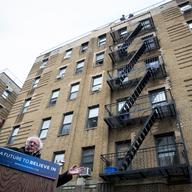
Last week, when Bernie Sanders held a rally on his old block — East 26th Street near Kings Highway — he found a street that, unlike so many in Brooklyn, hadn’t changed much. "I spent the first 18 years of my life in apartment 2C, right here!" Sanders thundered to a crowd that was small for him but symbolically large in the context of his life.
"Right on this street! Right on this street I spent thousands of hours playing punchball, do they still play punchball?" Sanders queried his listeners, many his junior by 40 years or more.
Punchball is a street game similar to baseball but with a rubber ball and no pitcher. It has pretty much disappeared, like the Brooklyn Sanders grew up in.
Two days before Sanders’ rally, I came to this block with Ron Schweiger, the Brooklyn Borough Historian. Schweiger, who is just a few years younger than Sanders, grew up nearby. "I remember going to Ebbets Field and perhaps Bernie did, too. He was a Brooklyn Dodgers Fan," Schweiger told me. "I remember riding on the trolley cars."
After 1953, when Sanders was in high school, a subway token cost fifteen cents. And Brooklynites traveling to Manhattan would see signs that said, “To the City.” For thirty five cents, you could go to one of the many area movie theaters, like the Avalon, and see a double feature, cartoons, and newsreel.
"It was predominantly Jewish neighborhood, but I know there were a couple of Italian families on my block at the time," Schweiger said. "It was mostly an all-white neighborhood."
When I stand on Sanders' old block, I see how small his world was. His elementary school — K-8 in those days — was a couple of blocks down Kings Highway. His street, just one-block long, ends at the campus of James Madison High School, where Sanders was a track star.
"I remember as teenagers we would walk on Kings Highway on a Friday night looking for girls and you see all the high school students with their jackets on, the Lincoln jackets, the Madison jackets," Schweiger recalled. At his rally, Sanders said he would sometimes hang out on Kings Highway, too.
In those days, a Brooklynite without much education — an employee at one of the local garment factories, maybe, or the transit authority — could live on a nice block like this one here. There are two-story unattached houses with driveways and small lawns.
But Bernie Sanders' dad was a struggling paint salesman. The Sanders' lived in a tan brick apartment building at the end of the block. Sanders told WCBS TV earlier this year it was his mother’s lifelong dream, unfulfilled, to have a home of her own. "Not having enough money was a cause of constant tension," Sanders said, reverting to the second person, a distancing effect. "When you are five or six years old and your parents are yelling, you look back at it now and it's traumatic."
For these immigrant parents, education was the way out. "Everything was on education," Madison Alumni president Marty Alpert told Vermont Public Radio in its documentary, Becoming Bernie. "And they stressed this, it was like a mindset. I couldn’t do it in Europe, you have to do it here. This is what you have to do. Not to be famous, but to make something of your life. To be successful in that way."
That was the legacy of children of holocaust survivors, to have a better life than their parents. Sanders doesn’t talk about being Jewish too much, but at a Flint debate last month, he spoke of what it meant to grow up as a Jew in the 1940s. "I learned that lesson when I was a tiny, tiny child, when my mother would take me shopping and we would see people with numbers on their arms because they had been in Hitler's concentration camps," Sanders said.
That history of persecution underpinned the politics of Jewish life in the area, Dartmouth historian Annelise Orleck told me. Orleck, like Sanders, lives in Vermont but grew up in Brooklyn. Orleck calls Jewish Brooklyn of those days "the pink parlor," because its residents were heavily unionized, pro-labor, and pro-socialist. Many were refugees from the holocaust and Russia’s pogroms.
"That was the generation of Jewish immigrants that proudly displayed posters of Eugene V. Debs on their walls," Orleck said "Bernie’s attachment to Debs is not accidental." Debs was a labor organizer and five-time socialist candidate for president. Sanders once made a documentary about Debs, who's namesake radio station, WEVD, emanated from radios in living rooms all over Jewish Brooklyn.
But Sanders left that world. He ended up the University of Chicago, one of the few prominent universities at the time that didn’t have a Jewish quota. At Chicago, Sanders became an activist. Almost immediately upon graduation, he bought land in Vermont and settled there.
This fact bothers Schweiger, the borough historian. It’s not as bad a betrayal as the Dodgers leaving, but still. "People are saying, he’s a Brooklynite," Schweiger said. "I say, yeah, but he’s not. You know, he’s got the Brooklyn accent which we love...but he left."
While Sanders has been building a political life in Vermont, his home borough has undergone profound transformations. "The Brooklyn that he left in the 1960's is a really different Brooklyn than the Brooklyn that we understand today," said Julie Golia, director of public history at the Brooklyn Historical Society. "It was the Brooklyn that was just beginning a long process of de-industrialization and a real transformation of its economy and who even lived here."
In the 1960’s, the city plunged into a recession. Many whites moved to the suburbs. In Manhattan, vast swaths of Brooklyn became known as "the ghetto."
"Neighborhoods that are today these pristine brownstone neighborhoods were broad-brushed as slums and were seen as neighborhoods that couldn’t be saved," Golia said.
In the last decade, of course, all that has changed. Brooklyn has come to symbolize youthful energy, multi-cultural hipsterism, creativity layered on top of all that the place has ever been. It’s become so desirable that working class families are being forced out, lending energy to a social movement that decries the accumulation of mega-wealth to the detriment of the 99 percent.
The very movement that has held the Sanders campaign aloft from the cornfields of Iowa back to the neighborhoods of Brooklyn.

WNYC is funded by sponsors and member donations