Benny Goodman
The Interview
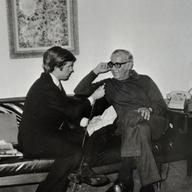
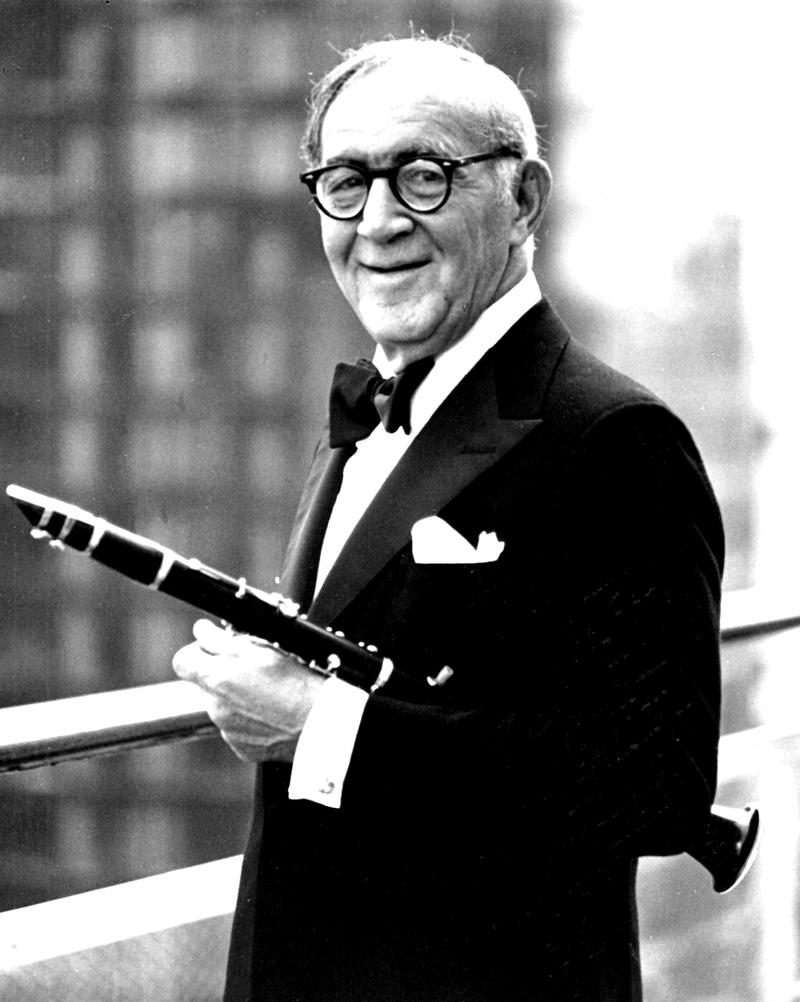
Douglas Cooper holds a conversation with Benny Goodman at his New York apartment, before his preparations for an evening flight to a European concert tour.
Cooper asks Goodman about his musical entree into society. Here's what critic Bruce Eder had to say on this subject, Goodman's 1938 appearance at Carnegie Hall: "[It was] the single most important jazz or popular music concert in history: jazz's "coming out" party to the world of 'respectable' music."
Cooper thanks Goodman for letting him stop by given his scheduled flight abroad. He notes that Goodman will be received by two ambassadors, and the musician was surprised that the word was out.
They discussed the cities he was planning to tour. Then he talked about the reception he's gotten in Europe over the years. Cooper brings up Khrushchev's criticism years earlier, and Goodman responds that, "he wasn't a fan."
Cooper asks his favorite venues to perform, and he recites a few, including San Francisco. Cooper wonders what radio did for the band, and Goodman tells him that radio was important, and mentions two shows of his own. Records, he insists, were the most salient. They talk about publicity, but Goodman defers to word-of-mouth advertising: his talent.
They talk about his reception, recently, at the nearby Rainbow Grill. Goodman says, you couldn't get a seat, would he believe that?
Behind the Scenes
Benny Goodman received me and my photographer friend at his apartment door and reached out a hand. I went to shake, and there was a very odd sensation of one of his fingers in the middle of my hand. As we uncoupled, I held up my right hand so I could stare at it. It didn't occur to me until much later that it was a jazz handshake, and I had just "tipped my hand" as not being amongst the cognoscenti. Goodman asked, "What station did you say you're with?"
As we settled into a couch in the den, my friend Joan loaded the Polaroid. I had just one chance to make a recording (so I carried at least three recorders) and to get a photograph (so, in those days, one of the cameras had to be a Polaroid, to be certain we had a shot).
An unfortunate risk with the Polaroid was that when the photograph was separated from the dye-laden negative, some of the emulsion could escape, and then, additionally, if one or more negatives turned upside down, the permanent discoloration, in this instance to Mr. Goodman's leather-top desk and yellow silk guest chair, constituted a mini-disaster.
Meantime, I was learning that my guest was a man of few words. And unlike gregarious interviewees, or those who felt duty-bound to be complete or even to make me look good, my only consolation with the clarinetist was my ability to edit. The saving grace was that we were not live on the air!
Upon thanking him for joining me, "the traveller" got up and walked to a remote bedroom. His administrator appeared in the doorway and cordially asked us to see our way out. Joan and I packed up and, obviously disoriented, swung open the door
and proceeded into an expansive, walk-in closet.
_______________________________________________________________________________________________________________
The Douglas P. Cooper Distinguished Contemporaries Collection (1967-1974) contains rare interviews with influential writers, statesmen, artists, songwriters, journalists and others who have left their mark on our culture.

WNYC is funded by sponsors and member donations