New Airport Ebola Screening: How It Works
Federal officials announced on Wednesday that the U.S. will now limit flights from Liberia, Guinea and Sierra Leone to the five airports where screening for Ebola symptoms began earlier this month: John F. Kennedy International, Newark Liberty International, O’Hare International in Chicago, Hartsfield-Jackson Atlanta International, and Washington Dulles International. In addition, ALL passengers from the three countries will be monitored for symptoms of the virus for 21 days. Here's a primer on what now happens to them from the beginning of their trip in West Africa:
1. How does the screening work? Does anything happen on the ground in the affected countries?
Before passengers board planes in Liberia, Guinea, or Sierra Leone, they are subjected to screening by CDC-trained local personnel. Tom Skinner, a spokesman for the CDC, said each passenger has his or her temperature taken and fills out a questionnaire that asks about in-country activities. "Where have you been, what have you been doing, have you had contact with anybody that's had Ebola, have you attended a funeral of somebody that's had Ebola," Skinner said.
2. What if a person from one of the three affected countries has bought a plane ticket to an airport in the U.S. that's not one of the five approved airports — say, San Francisco or Detroit?
Skinner says that person's ticket is invalid and they must rebook on a flight terminating in one of the five airports. "The bottom line is you won't get into the U.S. unless you go through one of those five airports."
3. What if the traveler goes through another city like Brussels or Paris before coming to the U.S.? Do they get screened there as well?
While some European cities have screening procedures in place for people flying in from the affected countries — London, for example — passengers who don't leave the airports generally don't get screened. But everybody from the three affected countries gets screened upon arrival in the U.S. "Your itinerary will still take you through one of the airports where the monitoring is going on," said Skinner.
4. What happens when someone from the three West African nations lands in JFK or Newark Liberty?
In all, the CDC says about 150 people a day arrive at the five designated U.S. airports, including JFK and Newark, from the three West African nations. After going through passport control, each one of them is pulled aside by Customers and Border Patrol employees and screened. "They take your temperature and administer another questionnaire," said Skinner, who says CBP staff will also be looking for signs of illness. If the travelers have a fever or other sign of illness — or if their questionnaire reveals possible exposure to Ebola — they will be evaluated by a CDC quarantine station health officer.
5. And if they're sick enough, will they be quarantined?
They would first be transported to a specially designated hospital for further testing. In New York, that would be either Bellevue, Mt. Sinai, Northshore-LIJ, New York-Presbyterian or Montefiore. In New Jersey, it would most likely be University Hospital in Newark, which is very close to the airport, but it could theoretically also be Hackensack University Medical Center or Robert Wood Johnson Hospital in New Brunswick. Both states have labs that can confirm Ebola virus is present. If they test positive, they would most likely remain isolated in those hospitals.
6. And people who receive a clean bill of health are cleared to enter the country?
Yes, but there's a catch: the CDC just announced that beginning Monday, Oct. 27, it will begin requiring all travelers from affected countries to engage in "active post-arrival monitoring." According to the CDC, people heading to six states (New York, Pennsylvania, Maryland, Virginia, New Jersey, and Georgia) must self-report their health and maintain daily contact with local health officials for 21 days after arriving in the U.S.
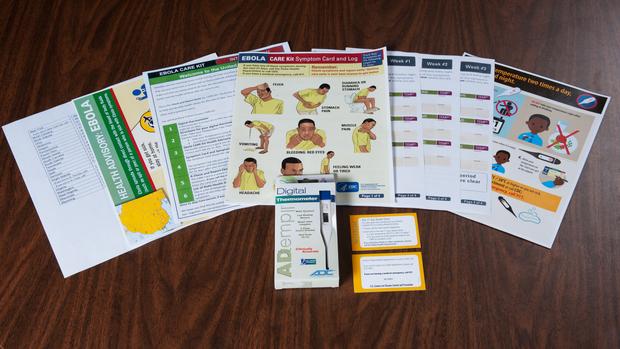
According to the CDC: "State and local authorities will require travelers to report the following information daily: their temperature and the presence or absence of other Ebola symptoms such as headache, joint and muscle aches, weakness, diarrhea, vomiting, stomach pain, lack of appetite, or abnormal bleeding; and their intent to travel in-state or out-of-state. In the event a traveler does not report in, state or local public health officials will take immediate steps to locate the individual to ensure that active monitoring continues on a daily basis."
7. Is this self-reporting mandatory? What happens if someone misses a phone call?
Yes, it's mandatory. "We can track them down and quarantine them if we have to," says Skinner. "That's going to be done by the state and local health departments or CDC."
8. What if a person from Liberia flies to another city — in Africa, Europe or any other place outside the U.S. — stays there for a week, and then buys a plane ticket to the United States? Are they automatically screened or flagged?
Not currently. "We're working on a system to fine-tune that," said Skinner. But those individuals, he said, "are very few and far between."

WNYC is funded by sponsors and member donations