Audio Download: Uptown with Peggy Guggenheim at Art of This Century
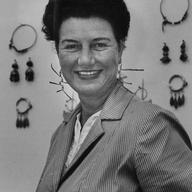
There are galleries – and there are galleries. Peggy Guggenheim’s Art of This Century wasn’t your average display space. It had curving gumwood walls, turquoise floors, amoeboid furniture and bizarre mechanical contraptions. It was the product of one of New York’s more notorious socialites (Peggy was renowned for her free-love ways) and a rotating cast of architects, surrealists, poets, artists, oddball curators and thinkers.
Though initially intended as a platform to show the works of her European artist friends, Peggy's gallery became the place to see works by a generation of young American artists who were tearing painting apart. She would become a key patron to the Abstract Expressionists (in particular, Jackson Pollock), at a time when few people were supporting the movement — or art in general. (It was the middle of World War II, after all.) For this report, we pay a visit to the space that, over the course of five short years in the '40s, helped transform art history. And we look at the unusual, single-minded woman who made it all happen.
Interviewed in this piece (in order of appearance) are:
- Zang Toi, a fashion designer who today occupies the gallery's old space at 30 W. 57th Street
- Ann Temkin, the Marie-Josée and Henry Kravis Chief Curator of Painting and Sculpture at the Museum of Modern Art
- Steven Naifeh, co-author of "Jackson Pollock: An American Saga"
- Jed Perl, author of "New Art City: Manhattan at Mid-Century"
- Susan Davidson, Senior Curator, Collections and Exhibitionst, at the Guggenheim Museum and co-author of "Peggy Guggenheim and Frederick Kiesler: The Story of Art of This Century"
Vintage audio of Peggy Guggenheim is from the WNYC archive. (You can listen to the full interview here.)
The music featured includes:
- "Music for Jackson Pollock (for 2 cellos)," written by Morton Feldman (1950-51), performed by Philipp Vandre & Turfan Ensemble
- "Sonatas and Interludes for Prepared Piano," written by John Cage (1946-48), performed by Herbert Henck
- "Nuages," written by Django Reinhardt (1940), performed by Django Reinhardt & The Quintet of the Hot Club de France
- "Concerto for Cootie," written by Duke Ellington (1940), performed by The Duke Ellington Orchestra
- "Leap Frog," written by Charlie Parker, performed by Dizzy Gillespie - Charlie Parker Quintet (1950)

WNYC is funded by sponsors and member donations