SLIDESHOW: Baby Falcons Nest High Above New York City
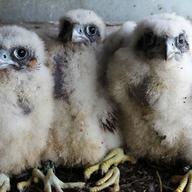
360-degree panoramic views, no board approval, occasional visits from the landlord: dozens of peregrine falcon chicks are living the high life in New York City.
Six chicks were born this spring on two New York City bridges: the Marine Parkway-Gil Hodges Memorial Bridge in Queens and the Throgs Neck, which connects the Bronx and Queens.
According to New York's MTA, which operates the bridges, the structures "provide an excellent vantage point for hunting prey, including pigeons and small birds."
Chris Nadareski, a wildlife biologist with NYC's Department of Environmental Protection, climbs the city's bridges each year to band and record the falcons. So far, he's banded 33 nestlings in different locations across New York City. "And there will be a couple more before the season ends," he said.

You want to do WHAT?! (photo courtesy NYC DEP)
In New York State, the peregrine falcon is still listed as an endangered species. But Nadareski says the local population is doing quite well.
"We generally consider New York City to be one of the highest concentrations of nesting peregrine falcons anywhere," he said. "The varied topography of bridges, buildings and towers, with a lot of available food, like pigeons and blue jays, really has helped them survive and concentrate their breeding activity throughout the five boroughs of New York City."
The number of falcon nests increases slightly each year. Right now, New York City has 20 active nesting pairs.
"Of the 20 (pairs), I definitely know that 15 of those 20 are successful" this year, Nadareski said -- meaning the pairing has produced eggs.
The Throgs Neck and the Marine Parkway bridges are just two sites that play host to falcons. Nadareski says the Verrazano and Throgs Neck bridges have had nesting falcons since 1983.
"Those were the first two nests that were established back to New York State after a very long period," he said. The pesticide DDT had devastated the population. "The falcons were considered extinct in the wild in the eastern United States as of the early 1960s," he said. After DDT was banned, scientists began breeding the birds in captivity and releasing them in the wild.
And 'wild,' for many of the birds, means the George Washington Bridge and the Brooklyn Bridge. Two other reliable falcon locations: Riverside Church in Manhattan's Morningside Heights neighborhood and the Met Life building in Midtown.
One building in lower Manhattan operates a live falcon cam when a breeding pair is in residence.
Nadareski's job is to monitor the city's nesting population. He usually checks in on each nest when the chicks are three weeks old. He examines the young, treats them for external parasites if needed, and then places two bands on each bird. (Yes, he's been dive-bombed by anxious parents, which is why he usually wears a construction helmet, safety goggles, and thick gloves. "The falcon is one of the more aggressive species in terms of protecting the young, especially in and around the nest site," he said.)
One band is an aluminum tag with a numerical ID; the other is black over green, indicating the bird originated in the Northeastern United States.
While many New York City falcons remain in the city, some have been spotted by biologists as far away as Wisconsin and Virginia.
Nadareski says the birds reach adult size by six weeks. They usually start breeding by the time they are one to two years old.

WNYC is funded by sponsors and member donations