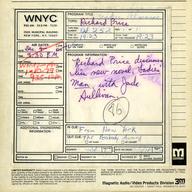
The Scrappy Wunderkind of the Bronx Projects: Author Richard Price on Reader's Almanac, 1978
In this 1978 episode of Reader's Almanac, host Jack Sullivan interviews Richard Price, 28, on the publication of his third novel, Ladies’ Man.
Richard Price is today known as a master of urban crime fiction, with his recent novels Clockers, Freedomland and Lush Life all garnering admiring reviews. This interview takes place at the other end of his career, when Price was the scrappy wunderkind of the Bronx projects.
Jack Sullivan, of the New York University School of Continuing Education, briefly mentions the highlights of Price's career to date, beginning with his reputation-making first novel, The Wanderers, the streetwise story of a teenage Bronx greaser gang.
In writing The Wanderers, Price was inspired by the near-mythical tales of street rumbles in his blue-collar neighborhood. But the story is not autobiographical: Price had escaped the Bronx and studied at Cornell and Stanford before beginning work on the novel as a student in Columbia University's writing program.
The Wanderers had been snapped up by film producers following its publication in 1974 (the movie would be released in 1979). Price's second book, Bloodbrothers, published in 1976, had an even quicker leap to the big screen: the film version opened in theaters two months before this radio interview.
In his introduction, Jack Sullivan places Ladies' Man on the same shelf as its predecessors, noting the reviews have been "astoundingly good."
Ladies' Man tells the story of Kenny Becker, a 30-year-old door-to-door salesman from the Upper West Side. In a week's time, Kenny loses his girlfriend and his job, and descends, unmoored, into the nighttime world of singles bars and sex clubs.
Sullivan and Price pass over the details of the book's origin, perhaps in deference to the genteel audience of public radio. In a 1996 interview with The Paris Review, Price explained how the book came about:
"Ladies’ Man came out of an assignment from Penthouse. They wanted a series of three articles about public places in which you can go and either participate in or observe actual sex: massage parlors, back-room gay bars, Plato’s Retreat–type places, even singles bars. At the time I had never been to any of these places, not even a singles bar. So I went to a singles retreat in the Catskills—just the most desultory, horrific, depressing place.…
Then an old friend of mine who is gay took me to the back rooms of bars like The Anvil, The Toilet, The Ramp, The Strap, The Stirrup, The Eagle’s Nest, and God knows what. I started writing about this stuff and I couldn't stop. It was so freaky, such a sense of anarchy, anything goes. It’s like you go crazy....
So I realized I wanted to write a story about a guy who goes to a place like The Eagle’s Nest, then the Catskills place, singles bars, massage parlors. Like Lost Weekend, but about sex, not alcohol.
However, Sullivan does remark on the novel's salty language, a recurring pattern in Price's work. The writer explains his style matter-of-factly: "That's me. I speak like the neighborhood bookie. That doesn't mean I don't read books."
Sullivan and Price enlarge on the novel's themes, giving today's listeners a glimpse into life in the 1970s. Price comments on the disconnection and loneliness he found in his research on the Manhattan singles scene -- the dark underside of the self-centered self-actualization movements of the era. As Price says of his book, "Warm, as in heartwarming, it's certainly not."
Sullivan notes that Ladies' Man was written in three weeks, and Price explains, "I was thinking about it for a year. Writing is the last stage." The novelist bats away talk of writer's block: "The only time I write is when I've absolutely got something to write, and then I write fast."
Price's words are fateful. As he would later explain to the Paris Review, soon after publishing this book he turned to screenwriting: "I started to write screenplays because as a novelist I felt the well was dry. It had been for a while."
The novelist's search for alternative outlets would eventually lead back to books, but not before a productive association with Martin Scorsese. The director invited Price to work on an adaptation of another author's novel about an aging pool hustler, and the result, "The Color of Money", won Price an Oscar nomination for his first produced screenplay. Later, Price would mine his research for Ladies' Man to write Sea of Love, a crime drama in which Al Pacino starred as a detective in search of a serial killer who stalks Manhattan singles. Price spent hours shadowing homicide detectives in additional research for the film. Those experiences, in turn, would bear fruit in the gritty crime stories of Clockers and Freedomland.

WNYC is funded by sponsors and member donations