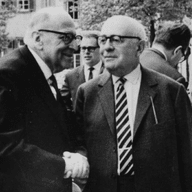
Frankfurt School Theorist on WNYC in 1940
Theodor Adorno was a key figure in the German refugee-led Institute for Social Research when it resettled at Columbia University before the U.S. entry into World War II. At Columbia he was also associated with the Office of Radio Research and headed up the Music Division of what became known as the Princeton Radio Project (1937-1941), studying the effects of mass media on society.
On February 22, 1940, at the station's invitation, Adorno provided commentary for a concert of new German music he organized that included works by Arnold Schoenberg, Hanns Eisler, and Alexander Zemlinsky and Ernst Krenek. In April a second program produced by Henrietta Yurchenco with Flora Schreiber and Paul Kresh was to be introduced this way:
We know our listeners have had their fill of music appreciation broadcasts. This isn't another one. Here at the station, at least, we think there is too much talk on the air these days about musical mountain peaks and starving yet immortal masters, with too little assistance in understanding the music itself. We don't want to go to the other extreme and present a series of dry lectures on a subject already in danger of becoming hackneyed…Dr. Adorno believes the mere enjoyment of music is not enough. To him it is more than entertainment; it goes beyond it. The fullest experience comes only from a true understanding of the structure and not from blurred, half-hearted listening, or quasi-analysis. This of course, demands a certain amount of effort from the listener.[1]
In March Adorno wrote station director Morris Novik a substantial proposal for a series of a dozen lectures on "How to Listen to Music Over WNYC." According to historian Robert Hullot-Kentor the lectures "were designed as a foreplay to thoughts on compositions that eventually would support the understanding of new music." The scholar also notes that Adorno's papers contain a note from WNYC that a Sunday afternoon program like this could reach 100,000 listeners, including serious concertgoers and music students. [2]
The lecture series was to begin on April 28, 1940 but never launched and Adorno's papers contain only outlines of programs. Although he had written home with the expectation that he would have a regular slot.
After a lot of toing and froing, we have not yet begun the regular educational broadcasts on WNYC after all, nor will I begin them before the autumn, as it would be too inconvenient in the next months. But I am giving regular introductory lectures for the modern concerts broadcast on that station, the next two of which are on 28 May and 11 June. [3]
The May 28th program focused on Anton Webern's op. 12 songs, while the June 11th concert featured a performance of Alban Berg’s Four Clarinet Pieces, op. 5, along with Berg’s Piano Sonata, songs by Gustav Mahler and two movements from the Sonata for Oboe and Piano by Stefan Wolpe. The Berg and Wolpe works were performed live by Trude Rittman, piano, and Josef Marx, oboe. In an oral history interview, Rittman explained what happened:
I was supposed to play the [Alban] Berg Sonata, Op. 1, and then to end the program Joe Marx and I played Stefan's [Wolpe] Oboe Sonata. Then a terrible thing happened. I played the Berg Sonata, and nobody knew that I would repeat the exposition part, which I did. And so when Joe and I started the Oboe Sonata and played and played and played, we were not done when the time was finished. So part of it was hacked off, and poor Stefan had a fit. We played to the end, but didn't know they had turned off. Adorno was called out while we were playing, and returned looking very pale and disturbed, and afterwards he told us Mayor LaGuardia had called to say he didn't want any more of that music on his station. He was very outspoken about it…[4]
Adorno reportedly had another unfortunate encounter via WNYC. This one involved the great Hungarian composer Bela Bartok. According to the late ethnomusicologist Henrietta Yurchenco, she met with Bartok at his hotel shortly after his arrival in the United States to arrange a WNYC broadcast in his honor. Adorno joined her as he was scheduled to interview Bartok for the program. She wrote:
Bartok, a slender man with chiseled features and a gentle demeanor greeted us courteously. Adorno, a Schoenberg disciple, immediately antagonized him: "Mr. Bartok," he said, "I have just read through your Fourth String Quartet. You have written an atonal work, have you not?" (atonality was the cornerstone of Schoenberg's theories of composition). Bartok looked him square in the face his icy blue yes seemed to burn as he coldly said in perfect English: "Mr. Adorno, you may believe anything you like." It was certainly one of the great put-downs in musical history.[5]
Writing to his parents in May 1940, Adorno reported no issues other than time while speaking to the great composer.
The Bartok interview turned out quite well, except that the available time was too short, and that Bartok is so incapable of any theoretical utterance that no great words of wisdom were spoken. [6]
It's unclear if or when this interview aired in 1940, but a transcript from the Adorno archives has the following exchange on the subject of atonality.
ADORNO: Now, to the other extreme. Atonality. If I'm not mistaken, your attitude toward this problem has somewhat changed. Would you mind telling us something about it?
BARTOK: There was a time when I felt my works tending toward atonality. This was the period when I wrote the ballet music, The Amazing Mandarin, and the two violin sonatas. But I have tended away from atonality since my first piano concerto. If there are radical elements in my later music, these cannot be explained on a basis of tonality or atonality, buth rather on the structural requirements of the music itself. I should say the tonal feeling in my music has increased. Incidentally, music based on folk music cannot be very atonal, because folk music itself is never atonal.[7]
Unfortunately, there is no extant recording of the interview. Bartok, however, was heard a few years later over WNYC in a July 2, 1944 at a Brooklyn Museum concert with David LaVita conducting the interview. You can listen to that broadcast here: BARTOK.
________________________________________
[1] Current of Music: Elements of a Radio Theory, by Theodor W. Adorno, edited by Robert Hullot-Kentor, Suhrkamp Verlag, Frankfurt, 2006. pg. 346. Note: Adorno was a friend and colleague of the philosopher and critical theorist Walter Benjamin.
[2] Ibid., pg. 59.
[3] Gödde, Christoph, Henri Lonitz eds. with translation by Wieland Hoban, Theodore Adorno: Letters to His Parents 1939-1951, Polity Press, Malden, MA, 2006, pg. 51.
[4] Trude Rittman quoted in the oral history for German-born composer Stefan Wolpe: Recollections of Stefan Wolpe . Trude Rittman was a choral and dance music arranger who helped shape such landmark Broadway productions as Carousel, The Sound of Music and Camelot.
[5] Yurchenco, Henrietta, Around the World in 80 Years: A Memoir, MRI Press, Point Richmond, CA, 2002, pgs. 33-34.
[6] Ibid, Gödde, Christoph, pg. 51.
[7] Ewenz,Gabriele, Christoph Gödde, Henri Lonitz, and Michael Schwarz, eds., Adorno Eine Bildmonograpie: Herausgegebe vom Theodore W. Adorno Archiv, Suhrkamp Verlag, Frankfurt, 2003, pg. 173.
Special thanks to Frank Burkatzky for his German-to-English translations.

WNYC is funded by sponsors and member donations