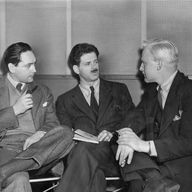
The Poet Laureate of Radio: Norman Corwin on WNYC and WQXR
There is little doubt that Norman Corwin is the most celebrated writer, director, and producer of radio drama ever. At a time when radio was the dominant medium, his works helped to ramp-up the national morale and patriotic fervor following the savage attack at Pearl Harbor and to celebrate the victories over Germany and Japan in 1945. Afterward, his many works for United Nations radio underscored the need for human rights and international cooperation. He continued to write noted works for the stage, television, and other venues, and to teach, until his death in 2011 at the age of 101.
Corwin became known as 'the poet laureate of radio.' It was a title that had at its root his first radio job with WBZA, a small Massachusetts station owned by the Springfield Republican. There he launched the poetry program Rhymes and Cadences. By June 1937 Corwin moved to New York and took the show with him to WQXR where it aired as Poetic License through April 1938. Hearing the program, William B. Lewis, the vice president of programming at CBS, invited the young talent to CBS. Not quite 28, in December 1938 Corwin relaunched his poetry broadcasts on the network as Words Without Music.
Above is a brief interview with Corwin done by WNYC's Sarah Montague and below, a rare copy of WQXR's Poetic License from January 5, 1938. In this segment, Corwin finds dynamic ways of introducing and discussing poetry and women poets.
Thirty-five years later Corwin would write to WQXR co-founder Elliott Sanger:
"I had no idea [WQXR's] beginnings were so humble ---$5 for a spot announcement, and a gross monthly income (in the year you took me on) of less than $200 for two summer months. Of course, I was paid nothing for Poetic License, but it seemed to me then that the price was right; and in terms of the good it did me, I might have paid you for the privilege." *
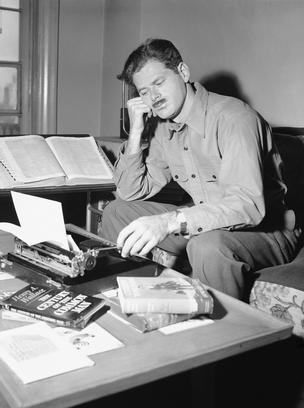
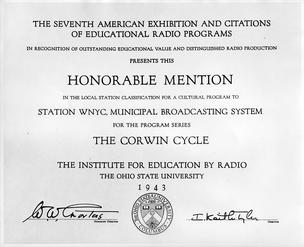
By 1942, Corwin was a well-established star at CBS. But he took some time-out to visit for a revival of some of his most popular works at WNYC known as The Corwin Cycle. Corwin collaborator Joel O'Brien directed most of the WNYC series along with assistance from station drama director Mitchell Grayson. These dramas included Fly Through the Air With the Greatest of Ease, The Odyssey of Runyan Jones, Oracle of Philadelphia, To Tim at 20, My Client Curley, Descent of the Gods, Good Heaven, Samson, Daybreak and Mary the Fairy. The Brooklyn Eagle's radio columnist Jo Ranson described the series as "a fine idea...because the able writer has something to say, and always says it with vigor and wisdom." The revival garnered the award for Outstanding Drama Series in 1942 from the Institute for Education by Radio at Ohio State University.
*Langguth, A.J., Norman, Ed., Norman Corwin's Letters, Barricade Books, Inc., New York, 1994, pg. 314.

WNYC is funded by sponsors and member donations