Stephen Reader appears in the following:
Timeline: What's Happening in Wisconsin?
Monday, February 21, 2011
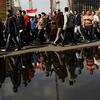
A lot can happen in a week, especially in a state that's trying to balance its budget by asking for concessions from public employees. In the wake of Wisconsin Governor Scott Walker's budget proposal, and the ensuing outrage from public sector unions still embroiling the capitol, here's a day-by-day breakdown of what's happening the state.
Protecting Journalists
Friday, February 18, 2011
—Maryam Ishani, a reporter who was assaulted in Cairo during anti-government protests, on the Brian Lehrer Show.
Facing Big Budget Gap, CT Governor Calls for Higher Taxes
Wednesday, February 16, 2011
Connecticut Governor Dan Malloy released his budget proposal for fiscal years 2012-2013 Wednesday morning, and while it shares a lot in common with New York Governor Andrew Cuomo's, it departs on one significant, contentious aspect: taxes. Malloy said he wants to raise them; Cuomo promises he won't.
The Speaker's Speech
Wednesday, February 16, 2011
—New York City Council Speaker Christine Quinn talks about some of the ideas in her State of the City address The Brian Lehrer Show
The 2011 Food Crisis
Wednesday, February 16, 2011
—Raj Patel, visiting scholar at UC Berkeley's Center for African Studies, on The Brian Lehrer Show
Obama's Budget, the GOP Budget and Missing Entitlements
Tuesday, February 15, 2011
House Republicans hate President Obama's $3.7 trillion budget. Rep. Paul Ryan has been loud and clear about an alternative he'd like to see implemented. His "Roadmap for America's Future Act" is a proposal that's been around since last year; it's even been in circulation long enough for the Congressional Budget Office to evaluate it and conclude that Ryan's plan would produce surpluses by 2080, whereas the current trajectory suggests deficits at 42 percent of GDP by that time.
So why aren't you hearing widespread GOP support for a proposal that would curb spending and cancel deficits? Simple: Because it privatizes Social Security.
Egypt in the Eyes of the USA
Monday, February 14, 2011
—Ambassador Thomas Pickering,of the National Committee on American Foreign Policy, on The Brian Lehrer Show
Pres. Obama: 'The People of Egypt Have Spoken.'
Friday, February 11, 2011
Hours after the resignation of Egyptian President Hosni Mubarak, President Barack Obama remarked on the situation from the Grand Foyer of the White House.
"The people of Egypt have spoken," Obama said. "Their voices have been heard. And Egypt will never be the same."
At CPAC, a Conservative House Divided?
Thursday, February 10, 2011
The annual Conservative Political Action Conference is always a big shindig, but this year there will be some new faces at the planning table: GOProud, a gay group that implicitly supports gay marriage in addition to the usual laundry list of conservative ideals. GOProud's attendance was enough to set off a boycott of CPAC by prominent conservative politicans and groups, including individuals who had previously attended the conference and even delivered keynote speeches there.
Strange Bedfellows Block Patriot Act
Wednesday, February 09, 2011
—Julian Sanchez, research fellow at the Cato Institute, on The Brian Lehrer Show
Rejecting The Muslim Brotherhood
Wednesday, February 09, 2011
— Ayaan Hirsi Ali, former member the Muslim Brotherhood in Kenya and the author of Nomad: From Islam to America: A Personal Journey Through the Clash of Civilizations, on The Brian Lehrer Show.
Who Benefits from the HuffPost and AOL Merger?
Monday, February 07, 2011
— Betsy Morgan, President of Glenn Beck's The Blaze and former CEO of The Huffington Post on the Brian Lehrer Show.
Iowa Caucuses: America's Political Dinner Bell
Monday, February 07, 2011
American democracy, in a nutshell: Every four years, a bunch of Iowans gather in public schools, libraries, and homes across their great state to decide who will get to be the most powerful person on Earth.
Okay, not quite, but it’s something like that. Since 1972, Iowa has had first dibs on picking the names that will appear on presidential ballots across the nation come November.
In Show of Solidarity With Egyptians, Hundreds Converge on Times Square
Friday, February 04, 2011
As a nascent revolution rages in Cairo, demonstrations in support of Egyptian protestors continue to take place throughout New York City. Beginning last Saturday with a rally in front of the United Nations headquarters, a week of public organizing was capped off by a large, loud gathering on Friday in Times Square.
Cuomo's Budget: The Day After
Wednesday, February 02, 2011
— Errol Louis, host of NY1's Inside City Hall, on The Brian Lehrer Show
Word Choice: Declaring a Revolution
Tuesday, February 01, 2011
In media coverage of recent events in Egypt, one word is used more cautiously than any other: revolution. That's with good reason—after all, we're not sure if what's happening in Egypt is really a revolution. At least, not yet.
Egypt Protests One Week In
Monday, January 31, 2011
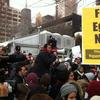
— Mona Eltahawy, columnist and public speaker on Arab and Muslim issues, on The Brian Lehrer Show
At Anti-Mubarak Rally, Anger and Optimism from Egyptians
Saturday, January 29, 2011

Hundreds of protesters gathered outside the United Nations headquarters in New York City Saturday, calling for the resignation of Egyptian President Hosni Mubarak. They were optimistic about Egypt's future, though many complained that it was time for the United States government to start supporting the Egyptian people and not their dictator.
Protests in Yemen
Friday, January 28, 2011
All of them have one common denominator, which is injustice, social injustice. All of those regimes had privileged certain groups in society and amassed wealth through illegal means like corruption...The people needed to be the rulers, not the other way around. If Tunisia did it, why shouldn't we do it?
— Walid Al-Saqaf, founder and administrator of Yemen Portal, speaking about protest in Yemen and the rest of the Arab world on The Brian Lehrer Show
Closing Tax Loopholes: Obama's Best Shot?
Thursday, January 27, 2011
By all measures, President Obama began his 2012 campaign on Tuesday night. He used big numbers—not just ones with dollar signs attached, but ones that exist only in imaginations: 2035. 2020. 2015. The thinking was grand, the planning long-term, the rhetoric Sputnik-ed.
And yet, one of the president’s proposals in his State of the Union address was all about the fine print: closing tax loopholes. Absent from the speech was a broad-stroke promise to raise or lower taxes. The closest Obama came to doing so was a thinly-veiled threat to eventually let the Bush tax cuts expire for the wealthiest Americans, this after agreeing to extend them only last month.
Regardless of what happens to the top tax bracket, focusing on tax loopholes is a shrewd move politically, particularly with the president’s 2012 reelection campaign now in view. It realigns the tax debate on the minutiae of the federal code, getting away from the same old tax-versus-spend back and forth.