Julian Zelizer appears in the following:
Past Presidents and Today's Conflicts
Monday, February 20, 2023
Presidential history and where it connects to today's news.

January 6th and Presidential Accountability
Wednesday, December 28, 2022
A look to lessons from Watergate for what needs to happen with the Jan. 6th committee report.

Looking Back on One-Term Presidents
Wednesday, August 10, 2022
Historian Julian Zelizer joins to discuss the history of one-term presidents, as former President Trump angles to leave that list, and rumors grow that President Biden may join it.
Julian Zelizer Offers His Historical Perspective on the Biden Administration
Thursday, January 21, 2021
Julian Zelizer on the Biden administration’s challenges in comparison to other presidents that inherited major crises.

Historical Election Perspective
Friday, November 06, 2020
Princeton University professor Julian Zelizer joins us to discuss past moments of political uncertainty.

The History of 'Court Packing'
Monday, November 02, 2020
Princeton University professor Julian Zelizer looks at why Franklin D. Roosevelt wanted to add up to 6 seats to the Supreme Court in 1937, and what could happen in 2021.

The History Behind The Rise Of The Modern Republican Party
Tuesday, July 07, 2020
Julian Zelizer on Newt Gingrich's role in the rise of the modern Republican Party.

Historical Context on Coronavirus and the Campaign
Tuesday, April 28, 2020
Prof. of History, Julian Zelizer, offers a historical perspective on the current crisis.
Who's Your Favorite President?
Monday, February 17, 2020
Julian Zelizer, professor of history and public affairs at Princeton University, joins us to talk about the best, worst and favorite presidents as part of a Presidents Day call in.

And The Impeachment Manager Role Goes To...
Wednesday, January 15, 2020
The Impeachment process in the House is officially over. House Speaker Nancy Pelosi has chosen impeachment managers, and the House has voted to officially pass the baton to the Senate.

Impeachment Managers Named
Wednesday, January 15, 2020
Live coverage of Speaker Pelosi's press conference naming the impeachment managers, plus analysis with Julian Zelizer
Trump: 'I can do whatever I want.' Pelosi: “No.”
Thursday, December 05, 2019
After the Judiciary Committee's first hearing, Speaker Pelosi formally asked for Articles of Impeachment. On this episode: the past, present and near-future developments in the probe.
Impeachment News: Judiciary Committee & The Speaker's Announcement
Thursday, December 05, 2019
A deep dive into where we are now with impeachment, including Speaker Pelosi's announcement.
How to Write an Article of Impeachment
Tuesday, November 12, 2019
The House is expected to vote on Articles of Impeachment soon after Thanksgiving. Today, a trip back in time with the ghosts of impeachments past, to see what could be ahead for Trump.
Impeachment News
Tuesday, November 12, 2019
Call us at 844-745-TALK for YOUR Articles of Impeachment....

The Fault in Our Party Lines
Tuesday, January 22, 2019
A history of polarization in the United States... beginning with Nixon.

The History Behind President Trump's First Year
Wednesday, January 17, 2018
Julian Zelizer puts Trump's first year into historical context and makes predictions for 2018.

The 100 Day Dash: The Best Presidential Benchmark?
Tuesday, April 25, 2017
This weekend, Donald Trump will cross the 100-day mark of his presidency. Does it make sense to judge a president in the first 100 days?

30 Issues | A History of Criminal Justice and Policing
Wednesday, July 13, 2016
Princeton's Julian Zelizer reviews the audio archive of American criminal justice and race relations, including the tumult of 1968.
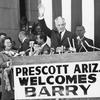
Goldwater and Humphrey: The Also-Rans of the Sixties
Tuesday, July 12, 2016
This week, “Also-Rans” looks at two almost-Presidents from the 1960s: Barry Goldwater and Hubert Humphrey.

