Andy Lanset appears in the following:
On the Eve of New Year's Eve 1924
Friday, December 30, 2011
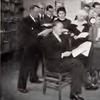
On December 30, 1924, The New York Times radio listings* for WNYC included a remote broadcast from the Newspaper Club of New York. It was a children's Christmas party for the sons and daughters of newspaper men. The entertainment line-up included Marilyn Miller, the Duncan Sisters, The Singer Midgets, George Haas and his singing canaries, Betty Bronson, Toto, Bob Miller, Gedney and Magee, Winifred Toomey, Rachel Mastrota, Richard B. Gilbert, Sam Wooding's Orchestra and Teddy, the baby elephant. Who were they? Let's find out.
WNYC Promotes Health and Wellness with Olympian Joe Ruddy
Friday, December 23, 2011
Keeping Fit was a regular series of health and exercise talks by Joe Ruddy on WNYC in 1926.
Cartoonist and Sports Writer Thornton Fisher, WNYC Sports Commentator 1924-1925
Friday, December 16, 2011
Thornton Fisher (1888-1975) began his broadcasting career in 1923 at AT&T's WEAF in New York as one of radio's earliest sports commentators. He switched to WNYC the following year, not long after the municipal station began broadcasting. The Evening Leader of Corning, New York praised Fisher's Tuesday and Thursday evening program, Sports Analysis, and said, "he is one of the keenest sports writers and cartoonists in the world of journalism. His love for all sports, coupled with his sparkling wit and understanding of every phase of every game, have created an immortal place for him as chronicler of the progress of sports."[1]
The Five Locust Sisters Perform on WNYC
Friday, December 09, 2011
On December 9, 1926, the Locust Sisters sang popular tunes in our studio. The Locust Sisters were a singing quartet with a fifth sister, Mathilda, on the piano. Known as the "miracle makers of harmony," they were featured as missionaries in the 1927 Vincent Youmans Broadway musical Hit the Deck. Reviewing the performance in The New York Times, Brook Atkinson wrote, "the thin harmonies of the four Locust Sisters, admirably introduced, are artless and delightful." They also appeared in a five-minute movie short in 1928, the first of their two appearances for MGM Metro Movietone Revue. The sisters also briefly recorded for Columbia Records. Watch and listen to them in their 1930 MGM short at: LOCUST SISTERS.
First Jewish Daily Forward Radio Program is on WNYC
Friday, November 04, 2011
Contrary to prevailing belief, the Jewish Daily Forward's first radio program was not on WEVD (a leader in Jewish and Yiddish radio programming in the 1930s and 40s), but on WNYC! The Yiddish newspaper marked the May 21, 1926 broadcast nine days later by printing the photos on the left with the following caption:
"The First Forward Radio Concert --Isa Kremer, the world famous balladiste, who was the featured soloist of the Forward radio hour May 21, from WNYC. (Left) The famous Stringwood Ensemble, which rendered a program of classical music."*
Frankfurt School Theorist on WNYC in 1940
Friday, October 28, 2011
Theodor Adorno was a key figure in the German refugee-led Institute for Social Research when it resettled at Columbia University before the U.S. entry into World War II. At Columbia he was also associated with the Office of Radio Research and headed up the Music Division of what became known as the Princeton Radio Project (1937-1941), studying the effects of mass media on society. Beginning in late April, 1940 he presented a new series of music programs on WNYC. The announcer introduced them this way:
WNYC QSL CARDS
Friday, September 30, 2011
QSL postcards were used to confirm reports that a station had been heard. QSL is a "Q" code from amateur and radiotelegraph jargon that means "I confirm contact with you."
WNYC 9/11/2001
Friday, September 09, 2011
A transcript from our September, 11, 2001 airchecks.
WNYC's New AM Transmitter, 1937
Friday, September 02, 2011
Following the landfall of Hurricane Irene this past weekend, flood waters overtook the WNYC AM transmitter site in Kearny, NJ, causing the station to stop over-the-air broadcasting. WNYC has owned several other transmitters in its history -- indeed, the AM tower used to be in Greenpoint, Brooklyn, in the location that will soon become WNYC Transmitter Park. This AM transmitter was dedicated in a ceremony on October 31, 1937.
Berlin 1961
Friday, September 02, 2011
In this 1965 Overseas Press Club Luncheon, Hallie Burnett, novelist and publisher, describes her experience in Berlin in August, 1961. On assignment for Reader’s Digest, Burnett was charged with reporting on the conditions of the East German refugees, who were “coming over at that time at about 2,000 a night.” Amidst a quiet week, she describes the night of August 13 when the foundations for the Berlin wall were laid. She describes standing among Berliners at the Brandenburg Gate, who were so shocked they had not yet found their voices to protest.
Leadbelly and Lomax Together at the American Music Festival
Friday, August 19, 2011
It's always exciting when we turn up an important long lost recording. In this case, the unlabeled flip side of one of Mayor La Guardia's talks had half-a-show that's not been heard for 67 years. Hailing from February 14th, 1944, we hear two friends get together to share some music with each other and WNYC's listeners. And what better venue than the station's annual American Music Festival, eleven days of studio performances and concerts around the city dedicated to home-grown music and talent? Talent indeed. Huddie Ledbetter, better known as Leadbelly, a renowned folksinger and bluesman, performed with pioneering folklorist Alan Lomax.
Kurt Vonnegut: Reporter on the Afterlife
Friday, August 05, 2011
The author Kurt Vonnegut (1922-2007) worked with WNYC producer Marty Goldensohn on a 1998 series known as Reports on the Afterlife. A year earlier, Vonnegut explained these reports would come as a result of "controlled near-death experiences."
News + Drama = Early Radio Newsreel
Monday, July 25, 2011
Dramatization of the news started long before television!
WNYC: 87 Years and the Romance of Radio
Friday, July 08, 2011
When WNYC began broadcasting 87 years ago, radio was still very much a toddler exploring the new terrain and occasionally falling down and getting bruised. There was also a certain mystique and mystery.
Do You Have What It Takes to Be a WNYC Announcer in 1938 or 1948?
Friday, July 01, 2011
Surprise Yourself. Take the Test!
Woody Guthrie and WNYC
Friday, June 24, 2011
Woody Guthrie left California and arrived in New York City early in 1940. By summer he was making his first appearance on WNYC, on Henrietta Yurchenco and Paul Kresh's second Adventures in Music program on July 13. The show's theme was folk music of the mountains and the plains, featuring Jim Garland, Sarah Ann Ogan and Guthrie, who was introduced as "a modern troubadour who sings as he pleases and makes up his own tunes as he goes." Guthrie performed "Hobo Blues," "Dusty Old Dust," and "Tom Joad."
Edward Tatnall Canby: Reviewer, Critic, Audiophile, Conductor, Teacher & Host
Friday, June 17, 2011
WNYC music critic, reviewer, audiophile and host Edward Tatnall Canby (1912-1998) began his nearly 25-year stint at WNYC in 1947. His show, The New Recordings, was described that first year as "a program of wide-ranging comment on music in general and the new records in particular." It was based on his weekly column in The Saturday Review. The name of the program was changed and is probably best recalled as Recordings, E.T.C.
Intrepid City College Staffers Record Dust Bowl Refugees for WNYC Documentary
Friday, June 10, 2011
Robert Sonkin and Charles Todd were working at the City College Department of Public Speaking when they decided to spend their summer vacations in 1940 and '41 at the Farm Security Administration (FSA) camps of central California. With the help of Alan Lomax, their project was underwritten by the Archive of American Folk Song at the Library of Congress. Carrying a "portable" 50-pound Presto disc cutter, they recorded cowboy songs, traditional ballads, square dance calls, camp council meetings, storytelling sessions and the personal experiences of the Dust Bowl refugees who lived in the camps. Drawing from more than 200 field recordings, the folklorists produced the above documentary for WNYC in 1942, one of three in a broadcast series called Songs of the Okies.
David Randolph: The Father of Weekly Thematic Music Programming
Friday, June 03, 2011
On July 2, 1946, David Randolph began a series of weekly broadcasts on WNYC called Music for the Connoisseur, later known as The David Randolph Concert.*
On his fourth broadcast, he surveyed the subject of humor in music. With that, David pioneered the thematic radio broadcast devoted to a single musical subject with commentary. Above, you can listen to the full broadcast of "Composers' Senses of Humor," David's 375th show that aired in June, 1954.
The programs were later syndicated nationally on the 72-station network of the National Association of Educational Broadcasters (NAEB). The broadcasts garnered four Ohio State University Awards as "the best programs of music and commentary in the nation," and aired for 33 years. They also resulted in invitations from 23 publishers to write a book, and This Is Music: A Guide to the Pleasures of Listening was published by McGraw-Hill in 1964. It was described by the New York Times as "one of the best of the year."