Andrea Bernstein appears in the following:

BREAKING: Citibank Is Sponsor of NYC Bike Share, "Citibike." [UPDATED w/Pics and Details]
Monday, May 07, 2012
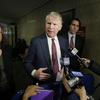
(Photo by Andrea Bernstein)
New York City has found two sponsors to pay for its bike share program, the only large bike share network in the country to operate entirely without government subsidies. When fully implemented in the spring of 2013, New York will have 10,000 bikes and 600 stations, the largest bike share system in North America and one of the largest in the world.
Citibank will be the primary sponsor of the "citibike" bike share program, with a $41 million, 5-year contract. Mastercard will also kick in $6.5 million, and will operate the payment system for the bikes.
"We're getting an entirely new 24/7 transportation network ," Mayor Michael Bloomberg said, "We are getting an entirely new transportation network without spending any taxpayer money," Bloomberg repeated. "Who thought that that could be done?"
Bloomberg himself presided over a bike share announcement for the first time today at a City Hall plaza news conference adorned by sample blue citibikes and a sample docking station.
But today's celebratory announcement was tempered by an acknowledgment that several neighborhoods in the city won't see bike share until 2013.
"It's going to be a phased deployment," Transportation Commissioner Janette Sadik-Khan said at the announcement. "I mean we can't just airdrop 10,000 bikes in. So it will be between August and the Spring of 2013 that we will have the full system."
The city's DOT website says "In 2012, the operating area will include Manhattan south of 59th Street, along with most of Brooklyn north of Bergen Street, and Long Island City in Queens. In the spring of 2013, the system will expand to include parts of the Upper West and East Sides, Cobble Hill, Park Slope, Prospect Heights and Crown Heights."
Sadik-Khan wouldn't say when the decision was made to to delay deployment in most of Brooklyn.
New York City's bike share program will be called citibike (with a new website)
They are the same model as those in other cities with programs also run by the Alta bicycle share company: baskets in the front, built-in lights in front and back with a thick single bar for the frame. Transportation Commissioner Janette Sadik-Khan said the docking stations will be solar powered and wireless, and the program will launch "end of July."
It will cost $95 a year to join the bike share program, $25 for a weekly membership or $9.95 for a 24 membership. Annual members will get to use the bikes for up to 45 minutes at no charge, which daily members will get to use them for up to 30 minutes for free.
After the that the price scale will escalate sharply upwards, with the bikes becoming increasingly expensive the longer they're used. (For example, if you keep the bike 24 hours, it will cost $150) Pricing, meant to encourage short-term, one-way hops that keep the bikes in circulation, is consistent with other cities.
The bank sponsorship makes NYC's bike share stock look a lot like London's where a two tone blue coat marks the Barclay's Bike program. NYC's program will be the biggest in the U.S.
(Photo by Andrea Bernstein)
Sample docking station for NYC's Citibike bike share program. (Photo by Andrea Bernstein)
Sample NYC pay station with newly announced sponsorship branding. (Photo by Andrea Bernstein)
Citibank to Sponsor City's Bike-Share Program
Monday, May 07, 2012
Citibank is the title sponsor of the city's bike share program, which is scheduled to roll out in Manhattan and Brooklyn this summer, Mayor Michael Bloomberg announced Monday
MAP: Where To Find Bike Share in Lower Manhattan
Friday, May 04, 2012
As we've been reporting, New York City DOT is quietly presenting almost final maps of bike share stations. (We've made an interactive map, showing how many bikes will be at each station, below.)
The City DOT isn't making it easy -- to see their almost final maps of bike share stations, you have to physically attend a community board meeting. Jim O'Grady did that -- took a bunch of cell phone photos of slides presented by the DOT -- and we've converted them into a map.
(We're missing a segment, one slide -- so sorry, the area just east of City Hall down to the river. We'll update as soon as we can.)
Some notable highlights:
* You can get pretty close to the World Trade Center -- about a block away -- but not in the security zone.
*There's one near Stuyvesant High School.
*There's one at the Wall Street Ferry dock, and a whole bunch by the Staten Island Ferry.
*There's one next to the Stock Exchange -- but it hasn't yet been approved by the Department of Homeland Security, which controls the area.
We'll be attending as many of these future meetings as we can -- if you go, send us photos! -- and continuing to map them, until the city DOT puts out its own maps. These maps have yet to get final community board and city sign-off, though we've heard a generally positive reaction from community boards.
The New York Times has this map of midtown bike stations.
Here are the upcoming community board meeting:
- Manhattan Community Board 1: May 3
- Manhattan Community Board 2: Transportation Committee, May 8, Full Board, May 24 (DOT presentation not yet scheduled)
- Manhattan Community Board 4: May 2 (vote on resolution on tentative map)
- Manhattan Community Board 5: May 31
- Manhattan Community Board 6: May 17
- Manhattan Community Board 7: not yet scheduled
- Brooklyn Community Board 2: information not yet available
- Brooklyn Community Board 3: Full Board, May 7, Transportation Committee May 8
- Brooklyn Community Board 6: May 17 (tentative)
The program is slated to start in July -- with an annual pass costing $95, a weekly pass $25, and a day pass for $10. That gets you 45 minutes per ride, with an escalating scale upwards after that.
LaHood: DOT Should Oversee Transit Safety
Friday, May 04, 2012
Washington's Metro (photo: http://www.flickr.com/photos/nj_dodge/68549080/)
U.S. Transportation Secretary Ray LaHood is stepping up his efforts to get Congress to pass his legislation allowing the DOT to oversee local transit agency's safety performance. "Particularly in communities all over America that have stepped up transit, LaHood tells WAMU.
"We believe there ought to be some agency," says LaHood. "We think it ought to be the Department of Transportation and so did the Senate."
The U.S. DOT has been trying to get this legislation passed for several years.
TN Moving Stories: Lower Manhattan Bike Share Stations Revealed, Pittsburgh Faces 35% Transit Cuts, MN Biking Safer, CA High Speed Rail Segment Approved and Foo
Friday, May 04, 2012
Top Stories on TN:
New York reveals locations for lower Manhattan bike share docks, we've got the details (link)
NY Governor Cuomo releases the names of who will be making decisions on big infrastructure projects (other than him) (link) but doesn't give any hint how he'll fund the $5.2 billion Tappan Zee Bridge project (link)
Ireland's Transport Minister says that country over-invested in infrastructure and can't afford anything now (link)
Houston gets a bike share, and Gail gets all the details on how it will work (link)
And Kate takes a spin on Leipzig's tram and does cartwheels (link) Metaphorically.
Hard to know what's hipper... your lastest app, your fixie, your artisanal food, or your food truck (photo: Librarygroover via flickr)
Marketplace looks at why better fuel-efficiency could lead to higher gas prices (Marketplace)
A California board greenlights the first segment of that state's high-speed rail, construction could start this year (Fresno Bee)
...while candidates for Congress spar on its merits (Bakersfield Californian)
Business execs & Democrats speak out against biggest transit cuts in Pittsburgh's history (Pittsburgh Post-Gazette)
But in North Carolina, where voters approved a transit tax, plans are in the works for a light rail from Raleigh to Durham (WRAL.com)
In Minnesota, more people are riding bikes, but fatalities are down (Chicago Tribune)
Used to be, when you hit a pedestrian, you were charged with a crime (Atlantic Cities)
And NPR's Planet Money team rides along as food trucks seek that "mystical spot) (NPR)
Members of NY Infrastructure Bank Board Announced
Thursday, May 03, 2012
Here's the list of who will be on the New York Works board
No big heads of transit agencies or transportation authorities on the list, but you'll note the Governor did name Bob Yaro, of the Regional Plan Association, a longtime transit advocate. There's also an environmentalist, Peter Goldmark, and Felix Rohatyn, the man who "saved" New York after former President Gerald Ford infamously told the bankrupt city to "drop dead."
Otherwise it's mostly elected officials and union reps.
Governor Appointments:
Denis Hughes, Former President, NYS AFL-CIO – co-chair
Felix Rohatyn, Former Chairman, Municipal Assistance Corporation – co-chair
Mayor Byron Brown, Mayor of Buffalo
Michael Fishman, President, SEIU Local 32BJ
Peter Goldmark, Program Director for Climate and Air, Environmental Defense Fund
Gary LaBarbera, President, NYC Building & Construction Trades Council
Carol Kellermann, President, Citizens Budget Commission
Mayor Stephanie Miner, Mayor of Syracuse
Robert Yaro, President, Regional Plan Association
Senate Majority Appointments:
John Cameron, Chairman, Long Island Regional Planning Council
Robert Mujica, Chief of Staff to the Senate Majority and Secretary to the Senate Finance Committee
Assembly Majority Appointments:
Ron Canestrari, Assembly Majority Leader
Herman D. Farrell, Chairman of the Assembly Ways and Means Committee
Biographies of the members can be found here:http://www.governor.ny.gov/assets/NYWorksTaskForceBiographiesfinal.pdf
Staff to the Task Force will include a team of state officials led by Margaret Tobin, a finance and economic development specialist, who will serve as Executive Director.
TN Moving Stories: Houston Gets Bike Share, In London's Mayoral Race, It's All About the Bikes, GM CEO Defends SUVs and Tsunami Motorcycle Washes Up on Canadian
Thursday, May 03, 2012
Poor Die More in Car Crashes (Link)
LaHood Convenes Meeting on To Save Dulles Silver Line (Link)as Pressure Grows to Drop Project Labor Agreement (Link)
As Fuel Prices Dip, So Does Fuel Economy in New Cars (Link)
NY Officials to Add Barriers, Speed Monitoring to Stretch of Parkway Where 7 Died (Link)
NY, 44 Cities Blow Through Smog Standards (Link)
Montana Now One of Eight States That Can Instantly Verify Liability Insurance (Link)
New York's Comptroller Says He'll Block New "Taxi of Tomorrow" Contract Because the New Cabs Aren't Accessible (Link)
West Wing Fanatics, They Reunited the Cast...and Produced This: (Link)
Kate's Photo Essay on All The Things Germany has that You Don't: Fast Trains with Bike Cars, Plenty of Space for Parking Your Bike, Cool Trams (Link)
Houston's Bike Share (photo; Imelda via flickr)
CEO of GM, Dan Akerson, Defends SUVS, Bailout, in Chat with The Takeaway's Celeste Headlee (The Takeaway)
Vancouver's Bus Rapid Transit Greenlighted (The Columbian)
Houston Bike Share Pilot Launches (ahead of NY, SF & Chicago!) (Houston Chronicle)
London's Mayoral Race: It's all About the Bikes...And the Trains (in Shakespearean terms, no less) (NPR)
Benefactor will Fund Transit For Needy Boy Who Got An Agent Fired For Giving Free Rides (SF Chronicle)
SpaceX Rocket Launch Delayed (WMFE)
Chicago's New Red Line Depends on Transpo Bill (Chicago Tribune)
Business Big: Those Who Want Transit on Tappan Zee Either Ignorant or "Pure Obstructionists" (LoHud.com)
You Can't Get There From Here -- the NY Times Looks at How Hard it is to Get Between Smaller Cities (NY Times) and Other Ways Business Travel is Hell (NY Times)
And....Motorcycle Washed Away in Japanese Tsuanami Washes Up on Candian Island 4000 Miles Away (Fuji TV via Boston Globe)
No Resolution on Dulles Metro Impasse, But LaHood Optimistic
Wednesday, May 02, 2012
Here's his statement:
We have gathered here the Loudon county chair, the Fairfax chair, the WMATA chair and the Vice Chair of the Metro. We just had a very good meeting. And what we've decided to do is continue to stand behind this project; it's a very important project. There are a few things that need to be worked out. We'll probably have a couple more meetings, and then gather together again and find where we stand on things. The one sticking point, I think that probably is the biggest sticking point, is a provision called PLA, Project Labor Agreement. And the Virginia legislature, when they voted for their budget said that that was something that they prohibited on this project. So we're going to work with stakeholders, our friends from the airport and the Commonwealth and we'll work this out. There is actually an agreement that’s been signed by all of the parties. So the one sticking point I think can be worked out, and it will be worked out pretty quickly, and we'll proceed ahead.
The West Wing Walking Video: Not Really That Funny
Wednesday, May 02, 2012
I got all excited when I learned from Streetsblog that the cast of the West Wing was getting together to promote walking. I LOVED the West Wing, kind of like I love the Good Wife now. One degree of separation, smart cast, great writing, plot twists. Anything to see them together again. Ah well.
It's still nice to see my fave Allison Janney, and Martin Sheen as President, but really, wouldn't have this been more effective it had lived up to its promise to be "funny or die"?
Instead, they tell us, walking is free, good for you, and decreases your chances of contracting nasty-sounding diseases.
Scripts welcome for a better West Wing.
Pressure Grows To Drop Union Pay Premium for Dulles Metro
Wednesday, May 02, 2012
Transportation Secretary Ray LaHood is convening a meeting of the stakeholders in the Dulles Silver Line project as a dispute among the parties threatens to derail the project.
As we've been reporting, Virginia is balking at a premium for union contracts on the project, and is threatening to pull funding.
Officials say Lahood, concerned that a crucial economic development project may be thwarted, has invited representatives from the Governor's office, MWAA, WMATA and Loudon and Fairfax counties to participate in the meeting.
Meantime, the Washington Airports Task Force issued the following statement today:
"We call upon all Dulles Rail funding stakeholders—MWAA leaders, federal, state and local government leaders, and WMATA’s management—to focus on resolving the issues concerning the second phase, in order to find the common ground that will enable Phase 2 of the Dulles Metrorail Project to move smartly forward to Dulles Airport and Loudoun County. In so calling, we applaud the further effort of U.S. Secretary Ray LaHood to save this project.
"The MWAA has managed Phase 1 essentially on cost and on time. It is now time to focus on the real issues, which are:
1) Funding Phase 2 without placing an unreasonable burden on Toll Road users.
2) Dropping the PLA preference, and instead requiring the contractor to provide a well-qualified and reliable workforce to build Phase 2 in a similar manner to Phase 1. The successful contractor should be left with the ability to use every tool in their toolbox to complete Phase 2 safely, within budget, on time and in conformance with Virginia’s right to work laws."America has built its greatness upon a pragmatic approach to business, science and politics. Pragmatism means working together to achieve what is best for the common good, and surrendering extreme desires in the interest of that common good.
"Extension of rail to Dulles/Loudoun County is a “Game Changer” for the whole region. The Dulles Metrorail Project will link the Dulles Corridor to the rest of the region. This project will benefit:
Ø Virginia, through increased revenue from the support of economic and employment growth in Northern Virginia.
Ø The District of Columbia, through economic and employment growth, and improved access to its international gateway for tourism.
Ø Maryland, by linking the entire Metrorail system to a corridor that now constitutes 25% of the entire Metro Region’s economy, bringing Maryland employers closer to Virginia residents and vice versa."It is unconscionable to think that, as a region, we would not move swiftly forward with the second phase of the Dulles Metrorail Project. If we did allow the project to fail, how could we, as one of the nation’s wealthiest areas, expect to solve the bigger transportation issues challenging our region, including swift multi-modal access between activity centers, relief for our congested highways, and creation of an effective, fair, sustainable source of regional infrastructure funding? "
More later.
Chicago Residents to Get a Look at 2020 Bike Network
Tuesday, May 01, 2012
Building a bike lane in Chicago, 2007 (photo by TouringCyclist via Flickr)
More in the flood of bike news on this first day of bike month.
Chicagoans will get a look at the Streets for Cycling Plan 2020 in a series of upcoming meetings.
Chicago DOT says the goal of the plan "is to identify roadways throughout the City for innovative bicycle facilities so that all Chicagoans, from children riding to school to senior citizens riding to the grocery store, can feel safe and comfortable bicycling on our streets."
"In addition to viewing the draft 2020 network, those attending the public meetings will see possible street treatments and proposed bike facilities, and hear about the remaining challenges and next steps for the Streets for Cycling Plan 2020."
The four public meetings and two online webinars are scheduled for the following dates and locations:
- Tuesday, May 22nd, Copernicus Center, 5216 W. Lawrence Ave., 4 – 8 p.m., presentation with Q&A at 4:30 & 6:30p.m.
- Thursday, May 31st, Gary Comer Youth Center - Exhibition Hall, 3rd floor, 7200 S. Ingleside Ave., 4 – 8 p.m., presentation with Q&A at 4:30 & 6:30p.m.
- Wednesday, June 6th, Douglas Park Cultural and Community Center - Ballroom, 1401 S. Sacramento Dr., 4 – 8 p.m., presentation with Q&A at 4:30 & 6:30p.m.
- Saturday, June 9th, 77 S. Dearborn – Building Lobby, 10 a.m. – 4 p.m. Open House
- Monday, June 11th, Webinar #1, 12 – 1 p.m., Reserve your Webinar seat now at: http://goo.gl/lEV2k
- Wednesday, June 13th, Webinar #2, 6 – 7 p.m., Reserve your Webinar seat now at: http://goo.gl/CQSS9
Feds: Where We've Added Bikeways, Biking Up 50%
Tuesday, May 01, 2012
Ray LaHood in bike helmet, with Rep. Earl Blumenauer (D-OR) (Photo: USDOT)
A federal program to encouraging biking and walking in four communities -- Columbia, MO; Marin County, CA; Minneapolis, MN; and Sheboygan County, WI, is meeting with success, according to a new bike month post by Transportation Secretary Ray LaHood on his Fastlane blog.
LaHood describes the program as "a four-year effort required by Congress to construct a network of sidewalks, bicycle lanes, and pedestrian and bicycle trails connecting directly with schools, residences, businesses, recreation areas, transit centers, and other community activity centers."
According to LaHood:
- Over four years, people in these four communities alone walked or bicycled an estimated 32 million miles they would have otherwise driven;
- The communities saw an average increase of 49 percent in the number of bicyclists and a 22 percent increase in the number of pedestrians;
- The percentage of trips taken by bike instead of car increased 36 percent, and those taken on foot increased 14 percent;
- While each pilot community experienced increases in bicycling and walking, fatal bicycle and pedestrian crashes held steady or decreased in all of the communities; and
- The pilot communities saved an estimated 7,701 tons of CO2 in 2010.
Oh by the way, LaHood dons a helmet and urges you to do the same.
Obama Hits Congress on Transpo Bill
Monday, April 30, 2012
President Obama speaking at an auto plant earlier this year. (photo: BarackObama.com)
President Barack Obama is getting pointed on the transportation bill.
Speaking at the AFL-CIO's Building and Construction Trades Department Conference today, Obama whacked the Republican-led House of Representatives for "refusing to pass a bipartisan bill that could guarantee work for millions of construction workers. Already passed the Senate. Ready to go, ready to put folks back to work. Used to be the most -- the easiest bill to pass in Washington used to be getting roads and bridges built, because it’s not like only Democrats are allowed to use these things. Everybody is permitted. (Laughter.) Everybody needs them. (Applause.)
"So this makes no sense. Congress needs to do the right thing. Pass this bill right away. It shouldn’t be that hard. It shouldn’t be that hard. Not everything should be subject to thinking about the next election instead of thinking about the next generation."
While Obama spent a good deal of time this fall criticizing Congress for failing to pass a jobs bill, these are some of his most pointed remarks to date on the transportation bill, and they drew boos (for the Republicans) from the union crowd.
"As a share of the economy, Europe invests more than twice what we do in infrastructure; China about four times as much," the President said. "Are we going to sit back and let other countries build the newest airports and the fastest railroads and the most modern schools?"
The President left the stage to thunderous applause, so we may be hearing more of this.
Here's the full transcript:
THE PRESIDENT: Hey! Hello, everybody! (Applause.) Thank you. Thank you.
AUDIENCE: Four more years! Four more years!
THE PRESIDENT: Thank you. Thank you very much. Everybody, please have a seat. (Applause.) Thank you, guys. Everybody, take a seat. Well, thank you, Sean, for that outstanding introduction.
AUDIENCE MEMBER: Four more years! Four more years!
THE PRESIDENT: (Laughter.) I'll take it. Thank you. Thank you.
Well, it is good to be back among friends. The last time I was here we -- was Saturday night. (Laughter.) And they tell me I did okay. But I want to not only thank Sean for his extraordinary leadership; I want to acknowledge all the other presidents who are on stage for what they do each and every day on behalf of not just their members, but on behalf of all working people. I'm proud of that. (Applause.)
I want to thank my good friend, Tim Kaine, who is here and is a friend of labor -- (applause) -- the next United States senator from the great Commonwealth of Virginia.
And obviously, we come here at a time where -- I just want to repeat my condolences to everybody in the building and construction trades on the passing of Mark Ayers. Mark was a tremendous leader. He was a good friend. His commitment to the labor movement and to working people will leave a mark for years to come. And my thoughts and prayers are with his family. But I know that Sean is going to do an outstanding job, and we wish him all the best in his future endeavors. So congratulations. (Applause.)
So it's good to be back in front of all of you. It's always an honor to be with folks who get up every day and work real jobs -- (laughter) -- and every day fight for America's workers. You represent the latest in a long, proud line of men and women who built this country from the bottom up. That's who you are. (Applause.) It was workers like you who led us westward. It was workers like you who pushed us skyward. It was your predecessors who put down the hard hats and helped us defeat fascism. And when that was done, you kept on building --highways that we drive on, and the houses we live in, and the schools where our children learn. And you established the foundation of what it means to be a proud American.
And along the way, unions like yours made sure that everybody had a fair shake, everybody had a fair shot. You helped build the greatest middle class that we've ever seen. You believed that prosperity shouldn’t be reserved just for a privileged few; it should extend all the way from the boardroom all the way down to the factory floor. That's what you believe. (Applause.)
Time and again, you stood up for the idea that hard work should pay off; responsibility should be rewarded. When folks do the right thing, they should be able to make it here in America. And because you did, America became home of the greatest middle class the world has ever known. You helped make that possible -- not just through your organizing but how you lived; looking after your families, looking out for your communities. You’re what America is about.
And so sometimes when I listen to the political debates, it seems as if people have forgotten American progress has always been driven by American workers. And that’s especially important to remember today.
The last decade has been tough on everybody. But the men and women of the building and construction trades have suffered more than most. Since the housing bubble burst, millions of your brothers and sisters have had to look for work. Even more have had to struggle to keep the work coming in. And that makes absolutely no sense at a time when there is so much work to be done.
I don’t have to tell you we’ve got bridges and roads all over this country in desperate need of repair. Our highways are clogged with traffic. Our railroads are no longer the fastest in the world. Our skies are congested, our airports are the busiest on the planet. All of this costs families and businesses billions of dollars a year. That drags down our entire economy.
And the worst part of it is that we could be doing something about it. I think about what my grandparents’ generation built: the Hoover Dam, the Golden Gate Bridge, the Interstate Highway System. That's what we do. We build. There was a time where we would never accept the notion that some other country has better roads than us, and some other country has better airports than us. I don't know about you, but I’m chauvinistic. I want America to have the best stuff. I want us to be doing the building, not somebody else. (Applause.) We should be having -- (applause) -- people should be visiting us from all over the world. They should be visiting us from all over the world and marveling at what at what we’ve done.
That kind of unbridled, can-do spirit -- that’s what made America an economic superpower. And now, it’s up to us to continue that tradition, to give our businesses access to the best roads and airports and high-speed rail and Internet networks. It’s up to us to make sure our kids are learning in state-of-the-art schools. It’s our turn to do big things. It is our turn to do big things.
But here’s the thing -- as a share of the economy, Europe invests more than twice what we do in infrastructure; China about four times as much. Are we going to sit back and let other countries build the newest airports and the fastest railroads and the most modern schools, at a time when we’ve got private construction companies all over the world -- or all over the country -- and millions of workers who are ready and willing to do that work right here in the United States of America?
American workers built this country, and now we need American workers to rebuild this country. That’s what we need. (Applause.) It is time we take some of the money that we spend on wars, use half of it to pay down our debt, and then use the rest of it to do some nation-building right here at home. (Applause.) There is work to be done. There are workers ready to do it, and you guys can help lead the way.
AUDIENCE MEMBER: We can do it!
THE PRESIDENT: We can do it. We’ve done it before. And the truth is, the only way we can do it on a scale that’s needed is with some bold action from Congress. They’re the ones with the purse strings. That’s why, over the last year, I’ve sent Congress a whole series of jobs bills to put people to work, to put your members back to work. (Applause.) Again and again, I’ve said now is the time do this; interest rates are low, construction workers are out of work. Contractors are begging for work, and the work needs to be done. Let’s do it. And time after time, the Republicans have gotten together and they’ve said no.
AUDIENCE: Booo --
THE PRESIDENT: I sent them a jobs bill that would have put hundreds of thousands of construction workers back to work repairing our roads, our bridges, schools, transit systems, along with saving the jobs of cops and teachers and firefighters, creating a new tax cut for businesses. They said no.
AUDIENCE: Booo --
THE PRESIDENT: I went to the Speaker’s hometown, stood under a bridge that was crumbling. Everybody acknowledges it needs to be rebuilt.
AUDIENCE MEMBER: Let him drive on it! (Laughter.)
THE PRESIDENT: Maybe he doesn’t drive anymore. (Laughter.) Maybe he doesn’t notice how messed up it was. (Laughter.) They still said no.
There are bridges between Kentucky and Ohio where some of the key Republican leadership come from, where folks are having to do detours an extra hour, hour and a half drive every day on their commute because these bridges don’t work. They still said no. So then I said, well, maybe they couldn’t handle the whole bill in one big piece. Let’s break it up. Maybe it’s just too much for them.
So I sent them just the part of the bill that would have created these construction jobs. They said no.
AUDIENCE: Booo --
THE PRESIDENT: We’re seeing it again right now. As we speak, the House Republicans are refusing to pass a bipartisan bill that could guarantee work for millions of construction workers. Already passed the Senate. Ready to go, ready to put folks back to work. Used to be the most -- the easiest bill to pass in Washington used to be getting roads and bridges built, because it’s not like only Democrats are allowed to use these things. Everybody is permitted. (Laughter.) Everybody needs them. (Applause.)
So this makes no sense. Congress needs to do the right thing. Pass this bill right away. It shouldn’t be that hard. It shouldn’t be that hard. Not everything should be subject to thinking about the next election instead of thinking about the next generation. (Applause.) Not everything should be subject to politics instead of thinking about all those families out there and all your membership that need work -- that don’t just support their own families, but support entire communities.
So we’re still waiting for Congress. But we can’t afford to just wait for Congress. You can’t afford to wait. So where Congress won’t act, I will. That’s why I’ve taken steps on my own. (Applause.) That's why I’ve taken steps on my own and speeded up loans and speeded up competitive grants for projects across the country that will support thousands of jobs. That’s why we’re cutting through the red tape and launching a lot of existing projects faster and more efficiently.
Because the truth is, government can be smarter. A whole bunch of projects at the state level sometimes are ready to go, but they get tangled up in all kinds of bureaucracy and red tape. So what we’ve said is if there’s red tape that's stopping a project and stopping folks from getting to work right now, let’s put that aside.
Because the point is, infrastructure shouldn’t be a partisan issue. Investments in better roads and safer bridges -- these have never been made by just one party or another because they benefit all of us. They lead to a strong, durable economy. Ronald Reagan once said that rebuilding our infrastructure is “common sense” -- “an investment in tomorrow that we need to make today.” Ronald Reagan said that, that great socialist -- Ronald Reagan. (Laughter.) Couldn’t get through a Republican primary these days.
The folks up on Capitol Hill right now, they seem to have exactly the opposite view. They voted to cut spending on transportation infrastructure by almost 30 percent. That means instead of putting more construction workers back on the job, they want to lay more off. Instead of breaking ground on new projects, they want to let existing projects grind to a halt. Instead of making the investments we need to get ahead, they’re willing to let us all fall further behind.
Now, when you ask them, well, why are you doing this -- other than the fact that I’m proposing it? (Laughter.) They’ll say it’s because we need to pay down our deficit. And you know what, the deficit is a real problem. All of us recognize in our own lives and our own families, we try to live within our means. So we got to deal with the debt and we got to deal with the deficit.
And their argument might actually fly if they didn’t just vote to spend $4.6 trillion on lower tax rates -– that’s with a T, trillion -– on top of the $1 trillion they’d spend on tax cuts for people making more than $250,000 a year. So they're willing to spend over $5 trillion to give tax breaks to folks like me who don't need them and weren’t even asking for them at a time when this country needs to be rebuilt. That gives you a sense of their priorities.
Think about that. Republicans in Congress would rather put fewer of you to work rebuilding America than ask millionaires and billionaires to live without massive new tax cuts on top of the ones they’ve already gotten.
Now, what do you think would make the economy stronger? Giving another tax break to every millionaire and billionaire in the country? Or rebuilding our roads and our bridges and our broadband networks that will help our businesses sell goods all around the world? It’s pretty clear. This choice is not a hard one. (Applause.)
Of course, we need to bring down our deficits in the long term. But if we’re smart about it, we also will be making and can afford to make the investments that will help our country and the American people in the short term. Not only will it put people back to work, but if the economy is growing -- look, every time one of your members is on a job, that means they’ve got more money in their pockets. That means that they’re going to the restaurant, and that restaurant owner suddenly is doing a little bit better. They’re going to Home Depot to buy some stuff, and suddenly Home Depot is doing a little bit better.
This is a no-brainer. And, by the way, when everybody is doing better and the economy is growing, lo and behold, that actually helps to bring down the deficit, helps us pay off our debt. Previous generations understood this. Apparently, right now, Republicans disagree.
And what makes it worse -- it would be bad enough if they just had these set of bad ideas, but they’ve also set their sights on dismantling unions like yours. I mean, if you ask them, what’s their big economic plan in addition to tax cuts for rich folks, it’s dismantling your unions. After all you’ve done to build and protect the middle class, they make the argument you’re responsible for the problems facing the middle class. Somehow, that makes sense to them.
That’s not what I believe. I believe our economy is stronger when workers are getting paid good wages and good benefits. That’s what I believe. (Applause.) That’s what I believe. I believe the economy is stronger when collective bargaining rights are protected. I believe all of us are better off when we’ve got broad-based prosperity that grows outwards from a strong middle class. I believe when folks try and take collective bargaining rights away by passing so-called “right to work” laws that might also be called “right to work for less,” laws -- (applause) -- that’s not about economics, that’s about politics. That’s about politics.
That’s why we’ve reversed harmful decisions designed to undermine those rights. That’s why we passed the Fair Pay Act to help stop pay discrimination. That’s why we’ve supported Davis-Bacon. That’s why we reversed the ban on Project Labor Agreements, because we believe in those things as part of a strategy to rebuild America. (Applause.)
And as long as I’m your President, I’m going to keep it up. (Applause.) I am going to keep it up -- because the right to organize and negotiate fair pay for hard work, that’s the right of every American, from the CEO in the corner office all the way to the worker who built that office.
And every day, you’re hearing from the other side whether it’s the idea that tax cuts for the wealthy are more important than investing for our future, or the notion we should pursue anti-worker policies in the hopes that somehow unions are going to crumble. It’s all part of that same old philosophy -- tired, worn-out philosophy that says if you’ve already made it, we’ll protect you; if you haven’t made it yet, well, tough luck, you’re on your own.
That misreads America. That's not what America is about. The American story has never been about what we can do on our own. It’s about what we do together. In the construction industry, nobody gets very far by themselves. I'm the first to admit -- I’ve got to be careful here because I just barely can hammer a -- (laughter) -- nail into the wall, and my wife is not impressed with my skills when it comes to fixing up the house. (Laughter.) Right now, fortunately, I'm in a rental, so -- (laughter) -- I don't end up having to do a lot of work. (Laughter and applause.)
But here is what I know about the trades: If you’ve got folks who aren't pulling together, doing their own thing, things don’t work. But if you've got enough people with the same goal, pulling in the same direction, looking at the same game plan, you can build something that will stand long after you're gone. That's how a Hoover Dam or a Golden Gate Bridge or a Empire State Building gets built -- folks working together. We can do more together than we can do on our own.
That's why unions were built -- understood workers on their own wouldn't have the same ability to look after themselves and their families as they could together. And what’s true for you is true for America. We can’t settle for a country where just a few people do really well and everybody else struggles to get by. We've got to build an economy where everybody has got a fair shot, and everybody does their fair share, and everybody plays by the same set of rules. We can’t just cut our way to prosperity. We need to fight for an economy that helps everybody -– one built on things like American education, and American energy, and American manufacturing, and a kind of world-class infrastructure that makes it all possible.
Now, these have been some tough years we've been in. I know a lot of your membership can get discouraged, and they can feel like nobody is looking out for them, and they can get frustrated and they -- sure, it's easy to give up on Washington. I know that. But we've been through tougher times before. Your unions have been through tougher times before. And we’ve always been able to overcome it, because we don't quit.
I know we can get there, because here in America we don't give up. We’ve been through tougher times before, and we’ve made it through because we didn't quit, and we didn't throw in the towel. We rolled up our sleeves. We fired up our engines, and we remembered a fundamental truth about our country: Here in America, we rise or fall together as one nation, as one people.
It doesn't matter where you come from, what you look like, what your last name is. It doesn't matter whether your folks came from Poland, or came from Italy or came from Mexico. One people -- strong, united, firing all cylinders. That's the America I know. That's the America I believe in. That's the America we can rebuild together. (Applause.)
So if you’re willing to join us in this project of rebuilding America, I want you to know -- when I was running for this office, I told people I’m not perfect. I’m not a perfect man. Michelle can tell you that. (Laughter.) I’m not a perfect President. But I made a promise I’d always tell you where I stood. I’d always tell you what I thought, what I believed in, and most importantly I would wake up every single day working as hard as I know how to make your lives a little bit better.
And for all that we’ve gone through over the last three and a half, four years, I have kept that promise. I have kept that promise. (Applause.) And I’m still thinking about you. I’m still thinking about you, and I still believe in you. And if you join me, we’ll remind the world just why it is that America is the greatest nation on Earth. (Applause.)
Thank you. God bless you. God bless the United States of America. (Applause.)
Feds: Airfares in 2011 Highest on Record
Monday, April 30, 2012
Airfares in 2011 were the highest on record at an average of $364, up 8.3 percent from 2010.
That's according to the Bureau of Transportation Statistics, which released its fourth quarter data today. In the fourth quarter, average domestic airfares rose to $368, up 10 percent from a similar period in 2010. Cincinnati had the highest average fare, while Atlantic City, NJ had the lowest.
In inflation-adjusted dollars, the BTS says, this is not the most expensive year ever. 2000 was, with inflation-adjusted fares in 1995 dollars of $300, compared to 2011's $247.
Here's the full BTS press release, with lots of links:
BTS Releases 4th-Quarter 2011 Air Fare Data;
4th-Quarter Domestic Air Fares Rose 10% from 4th Quarter 2010 Top 100 Airports: Highest Fares at Cincinnati, Lowest Fares at Atlantic City
Domestic Air FaresAverage domestic air fares rose to $368 in the fourth quarter of 2011, up 10 percent from the average fare of $335 in the fourth quarter of 2010 (Table 1), the U.S. Department of Transportation’s Bureau of Transportation Statistics (BTS) reported today. Cincinnati had the highest average fare, $502, while Atlantic City, NJ, had the lowest, $189 (Table 3).
Fourth-quarter fares increased 2.1 percent from the third quarter (Table 2). Quarter-to-quarter changes may be affected by seasonal factors.
BTS, a part of the Research and Innovative Technology Administration, reports average fares based on domestic itinerary fares. Itinerary fares consist of round-trip fares unless the customer does not purchase a return trip. In that case, the one-way fare is included. Fares are based on the total ticket value which consists of the price charged by the airlines plus any additional taxes and fees levied by an outside entity at the time of purchase. Fares include only the price paid at the time of the ticket purchase and do not include other fees, such as baggage fees, paid at the airport or onboard the aircraft. Averages do not include frequent-flyer or “zero fares” or a few abnormally high reported fares.
When not adjusted for inflation, the $368 fourth-quarter 2011 average fares were up 6.6 percent from the previous fourth-quarter high of $345 in 2008. Unadjusted fourth-quarter fares dropped to $320 in 2009 during the recession. Fourth-quarter 2011 fares were up 15.2 percent from 2009, not adjusted for inflation. They were also up 23.9 percent from the post 9/11 low of $297 in 2004 (Table 6).
Fourth-quarter 2011 fares, not adjusted for inflation, were the second highest of any quarter, exceeded only by the high of $370 in the second quarter of 2011. Adjusted for inflation, fourth-quarter 2011 fares in 1995 dollars were $251, down 16.3 percent from the fourth quarter of 2000, which, at $300, was the inflation-adjusted high for any fourth quarter since 1995 (Table 1). BTS air fare records begin in 1995. See BTS Air Fare web page for historic data.
Average fares for the full year in 2011 were the highest on record at $364, up 8.3 percent from 2010. The 2011 fares were up 5.2 percent from 2008, which at $346 was previously the highest year on record since 1995, not adjusted for inflation. Adjusting for inflation in 1995 dollars, fares in 2011 averaged $247, up 4.9 percent from 2010 but down 17.6 percent from the inflation-adjusted high of $300 in 2000. See Annual Fares .
Passenger airlines collected 71.4 percent of their total revenue from passenger fares during the third quarter of 2011, the most recent quarter available (Table 1A).
Air fares in the fourth quarter of 2011 increased 8.3 percent from the fourth quarter of 2000, not adjusted for inflation, compared to an overall increase in consumer prices of 29.7 percent during that period. In the 16 years from 1995, the first year of BTS air fare records, air fares rose 28 percent compared to a 47 percent inflation rate (Table 6). The average inflation-adjusted fourth-quarter 2011 fare in 1995 dollars was $251 compared to $288 in 1995 and $300 in 2000 (Table 1).
See Tables 3-5 for data about the top 100 airports based on 2010 originating passengers.
Table 3: Five highest and five lowest average fares in the fourth quarter: Cincinnati, a market with a high representation of business travelers, had the highest average fare, $502, while Atlantic City, a leisure-dominated market, had the lowest, $189. For the Top 100 Airports, see Table 8 on the BTS website.
Table 4: Five largest increases and five largest decreases from the fourth quarter of 2010 to the fourth quarter of 2011: Fort Myers, FL, had the largest increase, 26.4 percent, and Charleston, SC, had the largest decrease, 8.3 percent. For the Top 100 Airports, see Table 9 on the BTS website.
Table 5: Five largest increases and five largest decreases from the fourth quarter of 2000 to the fourth quarter of 2011: Burbank/Glendale/Pasadena, CA, had the largest increase, 59.1 percent, and White Plains, NY, had the largest decrease, 34.9 percent. For the Top 100 Airports, see Table 10 on the BTS website.
For additional data, see Top 100 Airports , Rankings or All Airports . Since average fares are based on the Origin and Destination Survey 10 percent ticket sample, averages for airports with smaller samples may be less reliable. Fares for Alaska, Hawaii and Puerto Rico airports are not included in rankings but are available on the web page. First-quarter 2012 average fare data will be released on July 26.
Table 1: 4th Quarter Average Fares 1995-2011 Compared to Inflation Rate
Fares based on domestic itinerary fares. Itinerary fares consist of round-trip fares unless the customer does not purchase a return trip. In that case, the one-way fare is included. Fares are based on the total ticket value which consists of the price charged by the airlines plus any additional taxes and fees levied by an outside entity at the time of purchase. Fares include only the price paid at the time of the ticket purchase and do not include other fees, such as baggage fees, paid at the airport or onboard the aircraft. Averages do not include frequent-flyer or “zero fares” or a few abnormally high reported fares.
| Average Domestic 4Q Fares ($) | Percent change from previous year | Percent change from 1995 | ||||
| Average Fares (4Q to 4Q) | Inflation (Dec from previous Dec)* | Cumulative Average Fares (4Q 1995 to 4Q of each year) | Cumulative inflation rate (Dec of each year from Dec 1995)* | Average Fare in 1995 dollars | ||
| 1995 | 288 | 288 | ||||
| 1996 | 278 | -3.3 | 3.3 | -3.3 | 3.3 | 269 |
| 1997 | 294 | 5.5 | 1.7 | 2.0 | 5.1 | 279 |
| 1998 | 316 | 7.7 | 1.6 | 9.9 | 6.8 | 296 |
| 1999 | 318 | 0.6 | 2.7 | 10.5 | 9.6 | 290 |
| 2000 | 340 | 7.0 | 3.4 | 18.2 | 13.4 | 300 |
| 2001 | 300 | -11.8 | 1.6 | 4.2 | 15.1 | 260 |
| 2002 | 309 | 3.0 | 2.4 | 7.3 | 17.9 | 262 |
| 2003 | 316 | 2.2 | 1.9 | 9.7 | 20.1 | 263 |
| 2004 | 297 | -5.9 | 3.3 | 3.3 | 24.0 | 240 |
| 2005 | 315 | 5.9 | 3.4 | 9.4 | 28.2 | 246 |
| 2006 | 318 | 1.1 | 2.5 | 10.6 | 31.5 | 242 |
| 2007 | 330 | 3.6 | 4.1 | 14.6 | 36.8 | 241 |
| 2008 | 345 | 4.7 | 0.1 | 20.0 | 37.0 | 252 |
| 2009 | 320 | -7.4 | 2.7 | 11.1 | 40.7 | 227 |
| 2010 | 335 | 4.7 | 1.5 | 16.3 | 42.8 | 234 |
| 2011 | 368 | 10.0 | 3.0 | 28.0 | 47.0 | 251 |
Here's the New NYC Livery Cab Color -- Apple Green
Sunday, April 29, 2012
And the winner is..."Apple Green." Some weeks ago we broke the news that the new taxis would be green, and had you imagine what color you'd like for the new livery cabs that can be hailed on the streets in the outer boros.
The idea being, they have to be distinct from yellow cabs, and black cars, so you know right away they are licensed to pick up street hails.
You picked electric lime. (Though, in fairness, we didn't offer apple green. Silly us!)
And here's the city's pick:
The city's new outer-boro street hails, inspired by the color of Granny Smith apples (photo: Brigid Bergin/WNYC)
Close-up of the new livery cab color (photo; WNYC/Brigid Bergin)
Arlington Backing out of Transit Funding Deal
Thursday, April 26, 2012
(Washington, DC -- Michael Pope, WAMU) Leaders in Arlington County and the City of Alexandria in the Washington, DC suburbs are moving in different directions along a high-capacity transit corridor on U.S. Route 1, and it's causing some tension among lawmakers in Alexandria.Two years ago, Arlington asked Alexandria to join an environmental analysis for the Crystal City-Potomac Yard transit corridor. Arlington would pay $2.4 million, and Alexandria would add $1 million. Together, the neighboring jurisdictions would save money by combining efforts. Now, Arlington County is backing out of the deal, leaving Alexandria holding the bag.
"I think in fairness, Arlington should have had the courtesy of saying, 'Let's have a sit-down talk about where we are, what our dilemmas are, what our challengers are,'" says Alexandria Mayor Bill Euille. "That hasn't happened.”
Euille is now calling for a joint meeting between members of the Arlington County Board and Alexandria City Council to discuss the future of the transit corridor. At issue is $40-120 million worth of federal funds, which city officials say would be jeopardized without the study.
"If we are going to continue on this alternative, I think Arlington definitely needs to be on board because they've kind of gotten us to this point, and they can’t just walk away," says Alexandria Council member Frank Fannon.
Alexandria Council member Alicia Hughes agrees.
"I think that it is a show of bad faith on the part of the Arlington County Board to have come to the city of Alexandria and ask us enter something with them, and now that we've done it and it's time to take the next step, lo and behold it's like if you looked under a rock you could not find them," Hughes says.
Arlington County Board Chair Mary Hynes did not return phone calls, although she issued a written statement along with Mayor Euille saying the two jurisdictions have different strategies. A spokeswoman for the Arlington County government declined to answer questions.
Sam Schwartz: Don't Call it Congestion Pricing
Thursday, April 26, 2012
Sam Schwartz, in a 2011 dramatization of what East River Bridge tolls would have amounted to if they'd been in effect since the bridges were open. (photo Jim O'Grady)
Former New York City Traffic Commissioner Sam Schwartz doesn't want you to call his fair plan "congestion pricing." Speaking on the Brian Lehrer show today (end of the segment) -- the last of four segments discussing his fair plan to reorganize tolls and fund transit -- Schwartz said he was disappointed to hear Cuomo's response to his plan, but thinks it's a matter of framing.
Here's the exchange:
Brian Lehrer: "We've had a great caller response all month Sam, you've gotten good press, from media outlets ranging from the New York Times to National Review on line. But in the real world you would need Albany's support. I'm sure you're aware that Governor Cuomo was asked about your plan in a press conference just Tuesday of this week. He was asked if he had seen "Sam Schwartz's revised congestion pricing plan."
And he said this:
Cuomo: I have not seen it. We've talked about congestion pricing for many years, we've tried to pass it in the past, it hasn't passed, i don't know that anything has happened to change that dynamic. I just don't know that you have the political support to pass it."
BL: Were you disappointed to hear that, Sam -- that he hadn't even heard about it?
Schwartz: The Governor I'm sure has read about it. It certainly got a lot of coverage but when you frame it as congestion pricing alone and not as correcting the pricing scheme that you have in New York --
BL: That was the problem. I was annoyed. Because it was framed as having seen Sam Schwartz's congestion pricing plan, rather than Sam Schwartz's innovative overall, the imaginative plan for the next 50 years of New York City and vicinity maybe he would have responded a little differently if it wasn't just asked as congestion pricing plan.
Schwartz: Exactly Brian, and that's how I felt. That's why you'll rarely see me using the words congestion pricing.
Walkscore Ranks Top Ten U.S. Cities for Transit
Thursday, April 26, 2012
Walkscore map of all the places you can get to in 30 minutes from Grand Central Terminal
Walkscore, the group that tells you how easy it is to get places from your home on foot, now tells you which cities in the U.S. have the best transit. The score calculates how well each block is served by transit, and then puts that into an algorithm which aggregates the whole city.
Here are the scores:
Ranking:
(1) New York (Transit Score: 81)
(2) San Francisco (Transit Score: 80)
(3) Boston (Transit Score: 74)
(4) Washington, DC (Transit Score: 69)
(5) Philadelphia (Transit Score: 68)
(6) Chicago (Transit Score: 65)
(7) Seattle (Transit Score: 59)
(8) Miami (Transit Score: 57)
(9) Baltimore (Transit Score: 57)
(10) Portland (Transit Score: 50)