Alex Goldman appears in the following:
Professors Are More Likely to Mentor You If You're a White Man
Tuesday, May 06, 2014
According to a recent study, professors are much more likely to be willing to meet with students who are white and male than they are with minority and female students.
The Wharton School recently tried an experiment where it sent the exact same email to 6,500 professors at 259 schools across the United States, posing as a student requesting a meeting. The only difference was that some of them were from a student named "Brad Roberts," while others had names like "Meredith Roberts, Lamar Washington, LaToya Brown, Juanita Martinez, Deepak Patel, Sonali Desai, Chang Wong," and "Mei Chen."

The NSA's Best PR Move in Months
Monday, May 05, 2014
The NSA could really use some good PR right now. It has had a rough year, deservedly so. With information about the agency's hoovering of personal information continuing to leak as well as the FISA court's alleged rubber stamping of government requests for surveillance, the revelations by contractor Edward Snowden have cast the NSA in a very negative light. It hasn't helped that the agency's response to the leaks by both the agency and The President was slow, and for the most part unsatisfying. Surprisingly, the first thing I've seen the NSA do correctly in months has arrived in the form of total gibberish.

You Can Buy Amazon Stuff on Twitter Now. How is this a good thing?
Monday, May 05, 2014
Marketers are still only lukewarm on the platform, but Amazon thinks its found the key by turning your tweets into one part advertisement, one part buy-it-now button.

#24 - The Million Dollar Homepage
Thursday, May 01, 2014

The Anti-SOPA Dream Team is Considering A Reunion Against the FCC's Proposed Net Neutrality Rules
Thursday, May 01, 2014
Just over two years ago, the Internet (that's big 'I' Internet) launched a coordinated campaign against Congressman Lamar Smith's Stop Online Piracy Act. The bill, it was feared, would kill the open, free Internet as we know it and stifle innovative new technologies and businesses by forcing ISPs to block domains that hosted potentially copyright infringing material. On January 18th, 2012, Wikipedia, Google, Mozilla, Craigslist, and thousands more, blacked out their homepages in protest of SOPA, a move that eventually spurred lawmakers to abandon the change. According to the Wall St. Journal, these heavyweights are considering a reunion tour.

How Can You Parody Buzzfeed?
Wednesday, April 30, 2014
Yesterday, the Onion told the New York Business Journal that it would be producing a parody of sites like Buzzfeed and Upworthy called "Clickhole." Sure, those sites are ripe for a takedown, but how do you parody sites that are already basically self-parody? Here are 20 ways that will astound you.

Art Gallery Does the Impossible, Makes Gifs Boring
Tuesday, April 29, 2014
According to Wired, London's Saatchi gallery has created a gif competition that awards prizes in what it now calls "motion photography." Wired sees this as legitimizing gifs as an artform, but in the process of legitimizing, it completely misunderstands the point of gifs.

Band Makes the World's Most Difficult To Access Album, But It's Still Pretty Cool
Tuesday, April 29, 2014
Getting attention for your music in the internet age requires a lot of flair, a bit of ingenuity, and maybe some performance art.

Turning Fruit Into Musical Instruments
Friday, April 25, 2014
There is a strong tradition in contemporary composition of making music from non-musical objects. Musique Concrète, playing the jug, Eugene Chadbourne playing an electric rake. But for some reason, there is a critical mass of "making music by playing weird shit" Kickstarters at the moment. Some much cooler than others.

#23 - A Bitcoin Story for People Who Don't Care About Bitcoin
Thursday, April 24, 2014

Her Husband's Stupid Record Collection, And Her Divisive Blog
Tuesday, April 22, 2014

Spotify Asks Vulfpeck To Remove "Sleepify"
Tuesday, April 22, 2014
A few weeks ago, we did a TLDR episode about the band Vulfpeck, which had come up with a novel way to fund their tour. They uploaded an album of silence to Spotify called "Sleepify," and asked their fans to stream it while they slept. The royalties from the plays of those songs would allow the band to tour for free.
An hour ago, the band announced on its Facebook page that Spotify has requested that they remove "Sleepify" from Spotify.

Good Work Getting Kicked In the Head There, Pal
Tuesday, April 22, 2014
This is how the internet handles celebrity, unless of course you're a cat.
You Can Be Critical Of Art On the Internet Without Being A Misogynist Jerk
Sunday, April 20, 2014
Edit: I embarrassingly misspelled Eugenia Williamson "Eugenia Williams" initially. I have now fixed. I regret the error.
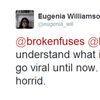
Last week, PJ and I wrote an article in response to a failed interview between Boston Magazine writer Eugenia Williamson and former child star-turned Velvet Underground parodist Macaulay Culkin. I read the article as fairly mean spirited, viciously personal, and not particularly illuminating of its subject. But in writing the article about it, I strove to keep my critique measured and specific. The larger internet picked up on the story, and didn't make a similar effort.
TLDR #22 - What Happens When You Tell The Whole Internet Your Password
Friday, April 18, 2014
Earlier this week, a commenter named Y. Woodman Brown posted his online passwords in the Washington Post comments section to show just how little his online security mattered to him. It was quickly picked up by the press as an example of online security hubris. Naturally, we had to find him. Alex talks to Y. Woodman Brown and the person who hijacked his Twitter account after the passwords were posted.
#22 - What Happens When You Tell The Whole Internet Your Password
Friday, April 18, 2014

TLDR Update - Peeking Into The Brain of The Army's Recruitment Robot
Friday, April 18, 2014
In March, I did a story for TLDR about Sgt. Star, the Army website's virtual recruiter that answers questions from potential future soldiers. You can hear that story below.
In that story, we spoke to Dave Maass of the Electronic Frontier Foundation who had sent a FOIA request to the Army for more information on Sgt Star, but had not received any response. But now he has, and he wrote an impressive update on the EFF blog. Among other things, the EFF received every single answer that Sgt Star can give. I spoke to Maass about the things he learned about Sgt Star, like how he was born, his relationship to the CIA and the FBI, and even his astrological sign. Listen to the update below.

The Army's Robot Recruiter
Friday, April 18, 2014
Sergeant Star is a chatbot designed to influence potential recruits to enlist. Alex Goldman of our podcast TLDR wasn't sure how he felt about that, so he talked to the Army and a reporter who's covered recruitment abuses to consider the pros and cons of deploying a Siri to guide our decision to go to war.
This story originally appeared in a longer form on the TLDR Podcast. If you would like to hear a longer version of this story and Alex's update with Dave Maass of the Electronic Frontier Foundation, follow this link.
Music: Kraftwerk - Pocket Calculator. Special thanks to @M0X1 (Mo Xie) for the suggestion on Twitter!

Field Recordings From a Virtual World
Thursday, April 17, 2014
Triple A video game titles (meaning the ones that cost hundreds of millions of dollars and have huge launches) are always trying to push for greater and greater verisimilitude. This is one of the reasons that there is a new round of consoles every 7 years or so, and why sound design in games is ever evolving to better evoke a sense of place. These audio environments are now interesting enough that at least one person has decided to record these habitats for posterity.

Let’s Stop Sending Nasty Emails to Macaulay Culkin
Thursday, April 17, 2014
When internet writing goes terribly wrong.

